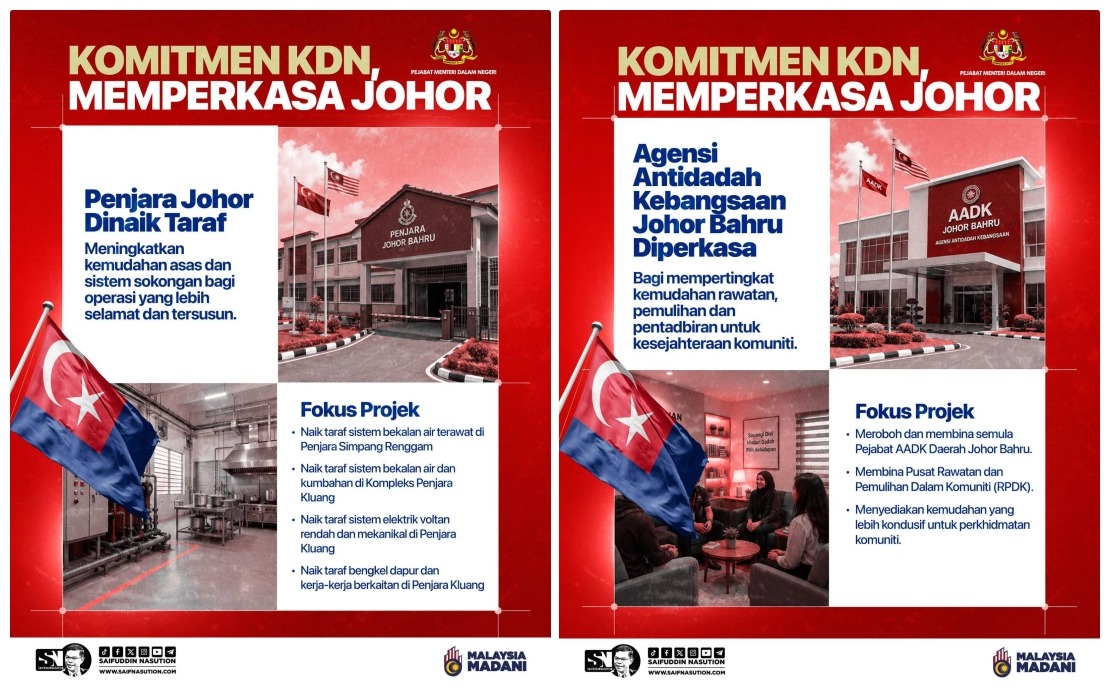
As Johor heads toward state elections this week, Home Minister Datuk Seri Saifuddin Nasution Ismail has outlined an ambitious infrastructure programme designed to fortify security operations and administrative capacity across the state. The Home Ministry's portfolio of projects reflects recognition of Johor's strategic importance within Malaysia's security architecture, given its position as a gateway state bordering Singapore and its role as a hub for multiple federal agencies overseeing law enforcement, border management and public administration.
The initiative encompasses work by six separate agencies operating under the Home Ministry's umbrella, each addressing specific operational and infrastructure gaps identified within their respective jurisdictions. This coordinated approach suggests a recognition within federal leadership that Johor's security and service delivery ecosystem requires comprehensive modernisation rather than piecemeal improvements. The scale of the planned interventions indicates substantial resource commitment from the federal government toward enhancing the state's institutional capacity, with implications for both operational effectiveness and public confidence in state institutions.
The Royal Malaysia Police component includes construction of new district headquarters in Segamat, land acquisition for a planned Pengerang facility, and maintenance work on police accommodation and building systems at various locations. These investments directly address longstanding infrastructure constraints that have affected police operational efficiency in districts where modern facilities have been lacking. Segamat, located in the western reaches of Johor, has historically faced resource constraints relative to urban centres, making the new headquarters a potentially transformative development for policing in that region.
Immigration and border services also feature prominently in the ministry's plans, with significant renovation work scheduled for both the Sultan Iskandar Building and Sultan Abu Bakar Complex. These facilities form critical nodes in Malaysia's immigration processing system, handling substantial volumes of cross-border traffic given Johor's proximity to Singapore. Improved facilities and modernised systems at these complexes have direct implications for processing times, traveller experience, and the state's competitiveness as a transit hub within the region. The emphasis on efficiency and integrity in these upgrades suggests awareness of public perception surrounding border services.
The National Registration Department's expansion into Batu Pahat represents an attempt to decentralise administrative services that have been concentrated in larger urban centres. Providing locally accessible registration facilities reduces travel burdens on rural and semi-rural populations seeking identification documents and related services. This type of infrastructure investment can significantly improve government service accessibility for dispersed communities, potentially reducing administrative friction in their interactions with federal systems.
Correctional infrastructure upgrades at Kluang and Simpang Renggam prisons address maintenance and systems modernisation requirements within facilities that form part of Malaysia's detention network. Investment in prison infrastructure, while less visible to the general public than police facilities, carries importance for operational security, prisoner welfare, and staff safety. These upgrades suggest that federal oversight extends to conditions within correctional institutions across all states.
The National Anti-Drugs Agency's facility redevelopment encompasses both administrative offices and treatment centres, recognising that drug control operations require both enforcement capacity and rehabilitation infrastructure. The dual emphasis on offices and treatment facilities suggests a balanced approach to substance abuse challenges in Johor, which like other Malaysian states faces ongoing issues with illicit drug availability and consumption. Modern treatment facilities can improve outcomes for individuals undergoing rehabilitation programmes.
Maritime enforcement capability receives attention through improvements to Abu Bakar Maritime Base, where jetty upgrades and building renovations aim to enhance operational readiness for the Malaysian Maritime Enforcement Agency. This is particularly significant given Johor's extensive coastline and the importance of maritime security in the surrounding waters. Enhanced facilities at this base support surveillance and enforcement operations across maritime zones critical to national security and regional stability.
The timing of these announcements, coinciding with the state electoral cycle, reflects a broader pattern where federal infrastructure commitments are frequently communicated during election periods. However, the substance of the ministry's plans appears grounded in genuine infrastructure requirements rather than purely symbolic gestures. The involvement of multiple agencies, specificity of named locations, and reference to particular facility types suggest these projects reflect longer-term operational planning rather than hasty electoral announcements.
For Malaysian and Southeast Asian observers, the Home Ministry's Johor initiative demonstrates the federal government's sustained strategic focus on the southern region as a security priority. Johor's geographic position as Malaysia's land bridge to Singapore and its role in managing regional maritime traffic justify continued investment in institutional capacity. The projects also reflect broader trends in Malaysian governance toward modernising older government infrastructure and consolidating service delivery within purpose-built facilities.
The success of these initiatives will ultimately depend on implementation capacity, budget allocation, and project management quality. Malaysian experience with government infrastructure projects shows variable outcomes, with some programmes delivering transformative improvements while others experience delays and cost overruns. The breadth of this Johor programme, spanning six separate agencies and multiple facility types, presents both opportunity for comprehensive improvement and risk of coordination challenges.
Looking forward, Johor's institutional capacity improvements should enhance the state's ability to manage security challenges and deliver services to its population of approximately 4.1 million residents. The investments signal confidence in Johor's continued importance within Malaysia's federal structure, even as the state navigates its own political transitions and development priorities. How effectively these infrastructure improvements translate into tangible security gains and service enhancements will be assessed by both federal oversight bodies and Johor's electorate in coming years.

