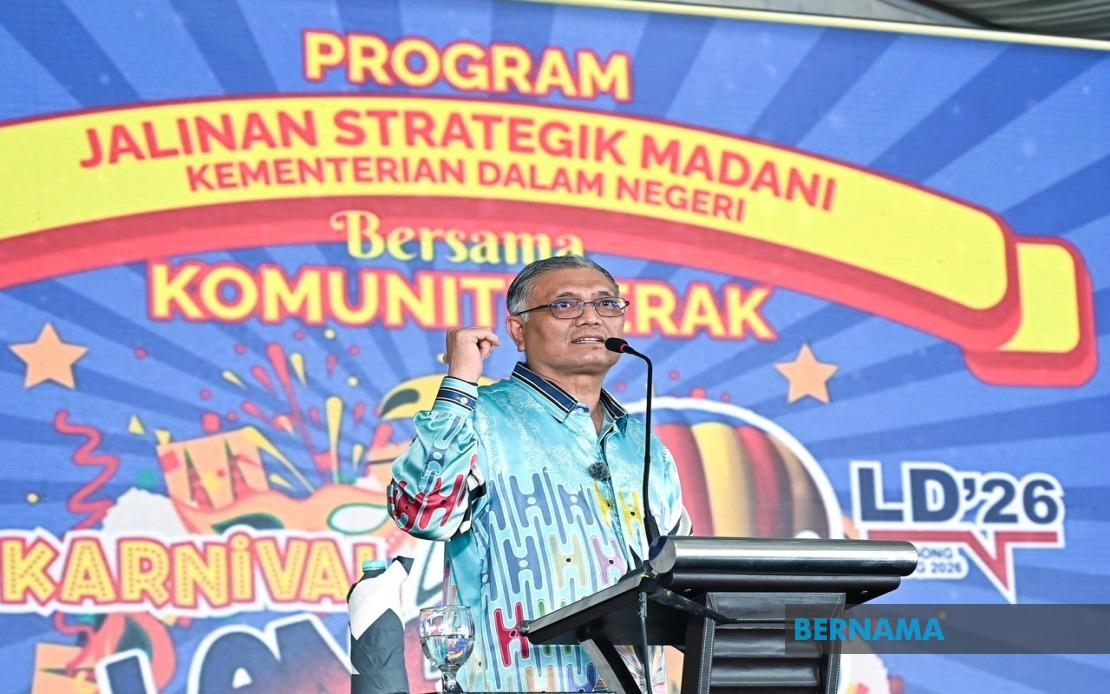
Malaysia's Home Ministry showcased its commitment to grassroots engagement this week, deploying its MADANI Strategic Partnership Programme to the historic Lenggong district in Perak. The two-day initiative, centred at Dataran Lenggong, represented a deliberate effort to bring ministerial services and security operations within closer reach of ordinary Malaysians, moving beyond conventional bureaucratic channels to establish direct contact with communities.
Deputy Home Minister Datuk Seri Dr Shamsul Anuar Nasarah, who also represents Lenggong as its Member of Parliament, articulated the programme's broader philosophy when officiating the event. The initiative transcends mere administrative convenience, he explained, functioning instead as a structured channel for reciprocal communication between law enforcement and security bodies with the people they serve. This two-way mechanism becomes increasingly important as Malaysian communities grapple with persistent challenges around street crime, substance abuse, and local security concerns—issues that often require community intelligence and cooperation to address effectively.
The activation of service counters operated by various KDN agencies proved among the programme's most practical elements. The Royal Malaysia Police (PDRM), Immigration Department of Malaysia (JIM), and National Anti-Drugs Agency (AADK) all maintained operational stations throughout the event, offering Lenggong residents a rare opportunity to update personal records, obtain official advice, or lodge formal complaints without travelling to distant state capitals or district offices. For many rural Malaysians, such accessibility represents a meaningful reduction in the time and expense historically required to interact with federal agencies.
The programme's design incorporated deliberate elements aimed at broadening appeal beyond bureaucratic transactions. Organisers scheduled religious talks, children's art competitions, and youth performance opportunities, recognising that community engagement succeeds only when it accommodates diverse interests and age groups. This inclusive approach reflects a wider shift within Malaysian governance toward acknowledging that effective public service depends on building genuine rapport rather than simply dispensing assistance from above.
A particularly noteworthy component involved the coordination of a Fun Ride and Fun Run event, which drew approximately 1,190 participants. Organised jointly by the People's Volunteer Corps (RELA) and AADK, this athletic component served multiple purposes simultaneously. Participants traversed villages surrounding Lenggong, absorbing the region's natural environment while simultaneously reinforcing wellness messaging and institutional presence within communities that might otherwise experience government mainly during enforcement operations.
The geographical setting itself carried significance. Lenggong Valley, designated as a UNESCO World Heritage Site, holds archaeological and cultural importance for Malaysia. By anchoring the MADANI programme within this heritage landscape, the Home Ministry implicitly connected national security initiatives to broader narratives about Malaysia's patrimony and regional standing. For Lenggong residents, the programme thus reinforced local pride while demonstrating that even remote, culturally significant communities receive ministerial attention and investment in public infrastructure and services.
The exhibition of assets and capabilities operated by PDRM, JIM, and AADK provided transparency regarding the organisations' operational scope and technical capacity. Such visibility serves multiple audiences: citizens gain tangible understanding of the capabilities protecting them, while security personnel benefit from direct feedback about public perceptions and concerns. This transparency, while limited in scope, represents progress toward demystifying security operations and building confidence between institutions and communities.
From a policy perspective, the MADANI programme illustrates a recognition within Malaysian federal bureaucracy that rural areas require deliberate, sustained engagement. Perak, like several Malaysian states, experiences both geographic dispersion and economic disparities that can inadvertently create distance between citizens and government. By bringing multiple agencies to a single, accessible location, the programme acknowledges these structural barriers and attempts, however modestly, to overcome them.
The involvement of RELA—a civilian volunteer body—also merits attention. This incorporation signals an attempt to position community engagement not as something imposed by government but as something jointly owned by state and society. When RELA members work alongside federal agencies, the message conveyed suggests that security and good governance remain collective responsibilities rather than exclusively government functions.
For Malaysian and Southeast Asian observers, the MADANI programme reflects a broader regional conversation about whether government institutions can remain relevant and trusted amid rapid social change and rising citizen expectations. Malaysia's approach here—bringing services to communities, enabling direct dialogue, incorporating cultural and wellness elements—offers one model. Its success, or otherwise, will likely influence how other Malaysian agencies and perhaps neighbouring governments conceptualise public engagement in coming years.
The initiative also indirectly addresses a longstanding Malaysian challenge: ensuring that communities beyond Kuala Lumpur and major urban centres feel included in national conversations about security, governance, and citizen rights. By selecting Lenggong and partnering with the Perak Community 2026, the Home Ministry signalled that such peripheral areas warrant ministerial-level attention and resource allocation. Whether this represents a sustained commitment or a periodic gesture will become clearer as similar programmes either expand or conclude.

