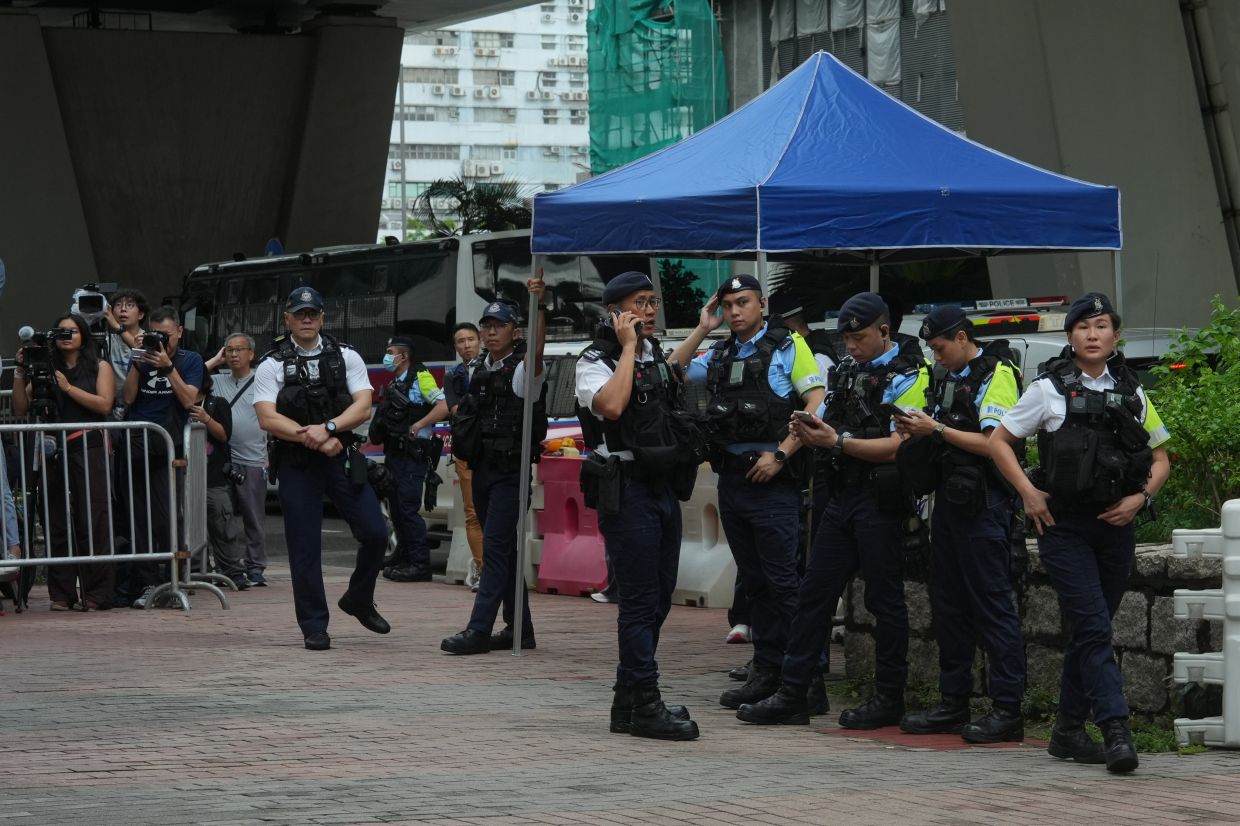
Hong Kong's police force has detained a woman on allegations of wearing a T-shirt carrying seditious messaging outside West Kowloon Court, marking another flashpoint in the city's intensifying security enforcement. The arrest, announced by authorities on Monday evening, saw the suspect held on suspicion of public disorder, obstruction of police, and acting with seditious intention. Officials offered minimal explanation, stating only that the operation was intended to maintain public safety and order, though specifics remain undisclosed—a posture reflective of how security concerns now operate in the territory.
The detention occurred just hours before the court delivered guilty verdicts against two prominent figures: Lee Cheuk‑yan, former chairman of the now-dissolved Hong Kong Alliance in Support of Patriotic Democratic Movements of China, and Chow Hang‑tung, the alliance's former vice-chairwoman. Both had faced charges of inciting subversion under Hong Kong's national security law, allegations rooted in their organization's calls for an end to "one‑party dictatorship" in mainland China. The timing of the arrest underscores the heightened security posture surrounding politically sensitive proceedings in the city.
In the early hours of Friday morning, over fifty individuals had gathered outside the courthouse to either observe or follow proceedings related to the high-profile case. According to witnesses and media accounts, a plain-clothes officer identified the woman in question, singled her out from the crowd, and escorted her into a police vehicle. The woman was reportedly wearing a black T-shirt printed with Japanese characters, though authorities have not publicly disclosed which specific design or message prompted their intervention. The incident was documented by journalists present at the scene, though police reportedly directed media personnel to vacate the area as she was being removed.
The arrest reflects a broader pattern in Hong Kong where authorities are enforcing sedition laws with expanding scope and interpretation. The seizure of a garment as potential evidence of seditious conduct demonstrates how far enforcement has extended beyond speech into symbolic expression and sartorial choices. For regional observers, this marks a significant escalation in how political dissent is being deterred—not through prosecution of organized movements alone, but through preemptive action against individuals for ambiguous visual statements.
Later that same day, the High Court delivered its verdict in a 216-page ruling that fundamentally reshapes what constitutes subversion in Hong Kong's legal landscape. Three judges determined that any attempt to overthrow or undermine the Communist Party of China's leadership satisfies the definition of subversion. More significantly, the court held that Hong Kong's constitutional framework does not accommodate Western-style democratic systems, establishing a legal precedent that places democratic advocacy itself in potential jeopardy under national security statutes.
Lee Cheuk‑yan, a former lawmaker, and Chow Hang‑tung, a practicing barrister, have each spent nearly five years in custody awaiting this verdict. Their extended detention prior to conviction underscores the severity with which authorities treat national security offences. The conviction carries implications for how the legal system will treat activism and civil society advocacy going forward, potentially chilling the activities of organizations and individuals engaged in peaceful political expression.
A fourth defendant in the broader case, Albert Ho Chun‑yan, who served as vice-chairman of the alliance, remains in detention after pleading guilty in January. He has been held for more than four years and awaits sentencing, suggesting that penalties could be substantial. The staggered guilty pleas and convictions indicate that the prosecution has proceeded methodically, building a comprehensive case that extends across multiple leadership figures within the disbanded organization.
The Hong Kong Alliance itself represented one of Asia's most established and visible platforms for remembrance of the 1989 Tiananmen Square incident. For three decades, the organization had coordinated annual vigils and public commemorations, serving as a focal point for international human rights advocacy within Hong Kong. The alliance's dissolution and the subsequent prosecution of its leadership represent a decisive turning point in how politically sensitive historical memory is managed in the territory under the national security law framework.
For Malaysia and other Southeast Asian jurisdictions, this sequence of events carries particular resonance. The aggressive enforcement posture—from the arrest over ambiguous clothing to the expansive judicial interpretation of subversion—demonstrates how national security legislation can be deployed to suppress peaceful political activity. The case raises questions about the trajectory of civil liberties in Hong Kong and sets a cautionary precedent for how security laws elsewhere in the region might be interpreted and applied. The willingness of courts to affirm that democratic advocacy constitutes subversion reflects a fundamentally different legal paradigm from those in neighbouring democracies, marking a divergence in how political rights are protected across Asia's most developed economies.
The practical implications extend beyond Hong Kong's borders. International observers, human rights organizations, and civil society groups across the region are monitoring how broadly these definitions will be applied. For activists, journalists, and ordinary citizens elsewhere in Asia, the Hong Kong cases serve as a visible demonstration of how national security frameworks can be mobilized. The arrest of an individual for clothing bearing potentially seditious messaging suggests that enforcement will not remain limited to organized political figures or formal advocacy organizations, but may increasingly target ordinary expressions of dissent.

