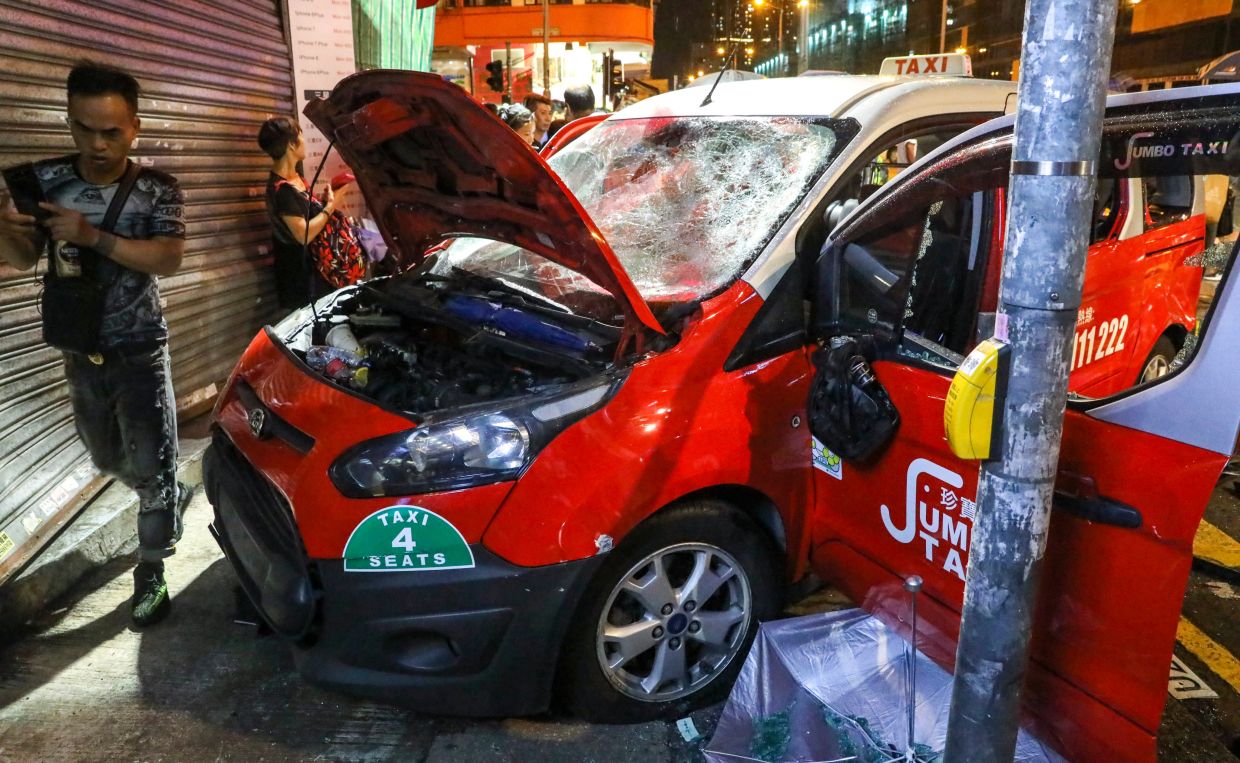
A Hong Kong kindergarten clerk who suffered severe injuries when a taxi mounted a pavement and struck her during a demonstration nearly five years ago is seeking HK$8.4 million in damages, opening a window into the lingering physical and psychological consequences of the 2019 protest period for ordinary Hong Kong residents caught in volatile circumstances. Park Hoi-lam's legal team presented arguments this week before the courts, contending that taxi driver Henry Cheng Kwok-chuen's vehicle struck her and another woman without warning on Yen Chow Street in Sham Shui Po on October 6, 2019, an incident that fundamentally altered the trajectory of her life.
The plaintiff's counsel, Susanna Leong, built her case on the premise that the collision itself constitutes irrefutable evidence of the driver's negligence and failure to exercise reasonable care. She emphasised that Cheng made no attempt to sound his horn or apply brakes before impact, a critical detail that speaks to whether he had any opportunity to avoid or mitigate the accident. This assertion became central to the distinction between a tragic but unavoidable outcome and one stemming from culpable carelessness. The defence, however, constructed a fundamentally different narrative, one in which accountability becomes murkier and the question of victimhood becomes contested.
Cheng's legal representatives took an unusually expansive approach to their defence, arguing that their client himself was a victim of the violent disorder that characterised Hong Kong's turbulent months in 2019. They characterised him as having been viciously assaulted with metal rods and hard objects during what should have been an ordinary working day, framing his predicament as one of someone caught between a crowded street and an angry mob. The defence contended that holding another victim of the violence financially responsible for her injuries, however severe, does not constitute genuine justice and instead represents an attempt to redistribute harm among the wounded. This argument attempts to recontextualise the accident as an inevitable consequence of broader chaos rather than a discrete act of individual negligence.
Park's account of that October afternoon reveals how swiftly circumstances spiralled from ordinary urban inconvenience to catastrophe. She and her friends were travelling toward Tsim Sha Tsui by bus when road blockages forced them to disembark in Sham Shui Po. Learning that railway services had been suspended as well, the group resolved to walk to Mong Kok. Park, moving faster than her companions, became separated from them and was alone when she heard commotion near the taxi. In her testimony, she described a moment of attempted flight—turning to run away—before the vehicle struck her at what she characterised as very high speed, the impact catching her completely off guard.
The physical toll has been substantial and unrelenting. Park underwent seven surgical procedures within three months of the collision, injuries severe enough that she remained hospitalised until mid-January 2020. Yet discharge from hospital marked not recovery but transition to a prolonged rehabilitation phase, one that continues into the present despite years of outpatient therapy. Her condition has stabilised but not normalised; she experiences persistent knee pain that restricts her ability to walk for extended periods, a constraint that fundamentally shapes her daily existence and employment possibilities.
Her current employment as a kindergarten clerk in Tuen Mun, while representing a return to productive work, illustrates the compromises her injuries have imposed. The position does not demand the physical robustness that her previous work did, yet even this reduced role creates challenges. She cannot lift heavy objects with the ease demanded of someone working with young children, nor can she physically comfort distressed toddlers by carrying them, a defining aspect of early childhood care work. The gap between her pre-injury capacity and her present capabilities remains visible and burdensome.
Longer-term medical uncertainty compounds the immediate limitations. Consultants have advised that her condition will not improve further despite two additional surgeries performed after her initial discharge, a prognostication that carries particular weight given the possibility of future knee replacement surgery. A cosmetic surgeon recommended reconstructive procedures for scarring on her legs, surgical interventions that remain financially inaccessible to her. This combination of chronic pain, functional restrictions, and deferred cosmetic remedies creates what Park implicitly argues is a profound disruption to what constitutes a meaningful life rather than mere biological existence.
The defence team attempted to undermine Park's account of ongoing disability by introducing covert surveillance footage obtained through private investigation. This material, capturing Park shopping and dining after work, was presented as evidence that she functions normally in daily activities. Park's response to this tactic proved telling: she acknowledged the footage depicted ordinary behaviour but questioned whether such moments of normalcy authentically represent a meaningful existence. This exchange crystallises a fundamental dispute about how disability and injury should be measured and valued—whether compliance with basic social rituals constitutes recovery, or whether genuine restoration requires freedom from pain and the resumption of all previous capacities.
Park's decision to retain legal representation when providing her initial police statement in March 2020 became another point of contention. Defence counsel Ashok Sakhrani posed this as potentially indicative of consciousness of guilt or worry about legal consequences, the implication being that an innocent bystander would not require such protection. Park's straightforward response—that she was protecting her own interests—reflects the reality that in highly politicised environments, even genuine victims may feel vulnerable to legal exposure simply by virtue of proximity to contested events. Her explicit denial of participation in the protest underscores how the 2019 demonstrations created scenarios in which ordinary residents became entangled in events not of their choosing.
The case raises broader questions about accountability, victimhood, and the distribution of responsibility during episodes of civil unrest that carry profound political dimensions. Whether one accepts the plaintiff's characterisation of a negligent driver or the defence's portrait of a man caught between a frightened passenger compartment and an angry street mob, the fundamental reality remains that Park's life trajectory was irreversibly altered by the collision. The trial, expected to extend across six days before Mr Justice Simon Leung Chun-man, will ultimately determine not merely how much compensation Park receives but how Hong Kong's legal system adjudicates claims arising from injuries sustained during the turbulent 2019 period.
For Malaysian observers, this case illuminates the complex aftermath of mass civil unrest—how injuries and disruptions extend far beyond immediate political consequences into the intimate details of individual lives, employment, and health. It demonstrates that the legal battles surrounding 2019 Hong Kong will likely occupy courts for years, with victims pursuing compensation through channels that often require revisiting and relitigating events they wish to move beyond. Whether through negligence claims or compensation schemes, the institutional processing of these injuries remains incomplete, and the question of who bears ultimate responsibility continues to generate contention.

