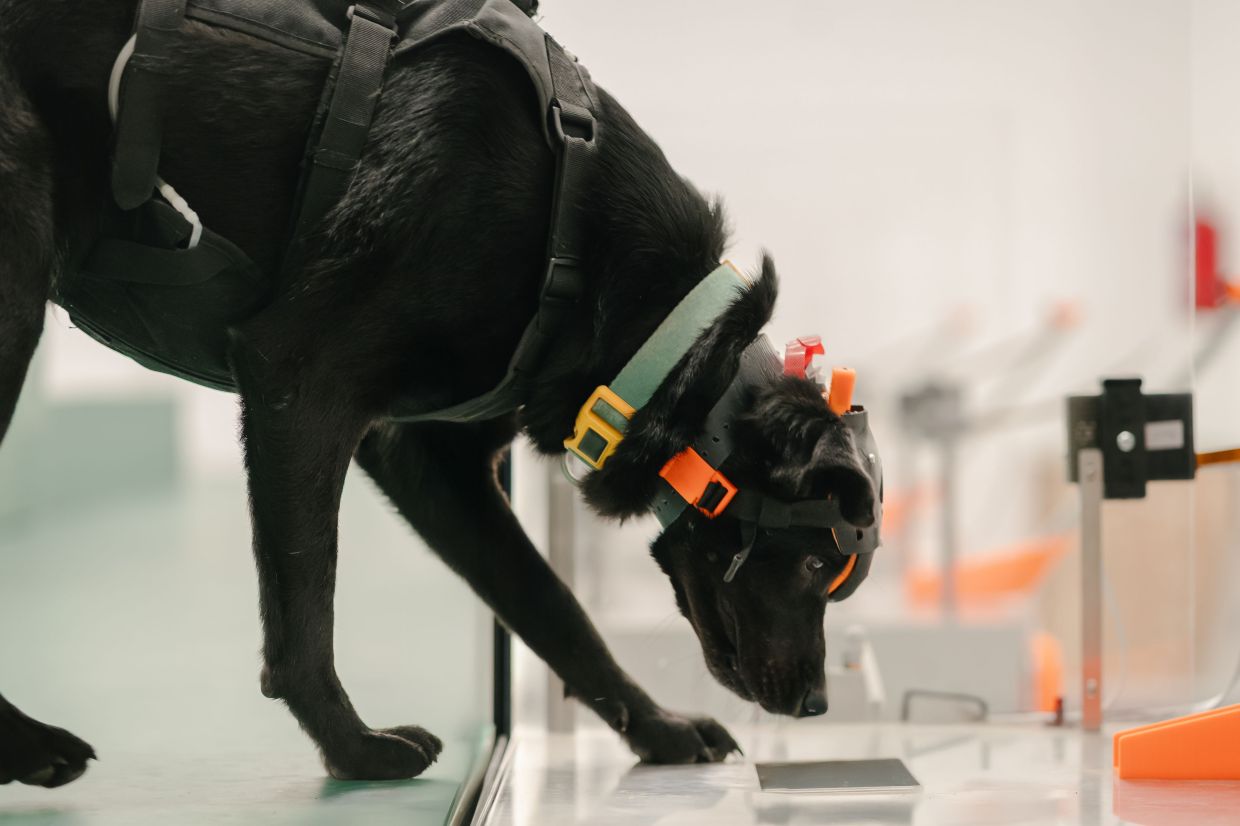
Across a two-acre facility outside Bengaluru, a team of beagles, labradors and Dutch shepherds report for duty each day with a singular purpose: detecting the molecular signatures of cancer in human breath. These aren't therapy animals or service dogs performing traditional roles. Billy, Jessie, Banu and their canine colleagues represent the frontline of an innovative health screening approach being developed by Dognosis, a young startup that has redirected the evolutionary gift of canine olfaction toward solving one of India's most pressing public health challenges. The dogs are equipped with sensors that track their movements, respiration and body language, while artificial intelligence algorithms process these behavioral signals to identify whether breath samples contain biomarkers indicative of malignancy.
The Dognosis model represents a fundamental reimagining of diagnostic medicine. Rather than relying on expensive imaging equipment, invasive biopsies or complex blood tests requiring laboratory infrastructure, the company has harnessed capabilities that dogs have possessed for millennia. Patients breathe into specially designed masks at home or at collection centers, with samples then transported to the Bengaluru facility where trained dogs are exposed to the breath samples in controlled conditions. The interaction between dog and sample—captured through multiple sensors monitoring everything from how long the animal pauses at a particular sample to subtle changes in respiratory patterns—feeds into machine learning systems that determine whether cancer markers are present. This approach transforms cancer screening from a clinical procedure into something approximating a trained search operation, scaled through technological oversight.
The company's backers demonstrate confidence in the model's potential. Accel India and San Francisco-based Caffeinated Capital led a pre-seed funding round that brought US$1.5mil (RM6.12mil) into the venture in 2024, with an additional undisclosed investment following recently. According to co-founder Akash Kulgod, these resources provide sufficient runway for two years of planned expansion. The capital infusion signals that despite the unconventional nature of the approach, sophisticated investors see genuine potential in applying canine biology to a massive unmet need in healthcare access. This confidence extends to the technical validation the company has already achieved.
In a Phase 2 clinical trial published in the Journal of Clinical Oncology, Dognosis reported approximately 90 percent sensitivity for early-stage cancers across seven broad groupings encompassing more than 20 cancer types, with breast cancer among those successfully identified. More intriguingly, when dogs trained on 10 specific cancer types encountered an 11th variety they had never previously encountered, they successfully identified it—suggesting that the animals possess a generalizable capacity to recognize malignant cellular activity rather than merely memorizing specific scent profiles. These results, while preliminary, indicate that the approach transcends simple pattern matching and may tap into deeper biological recognition capabilities that the dogs' olfactory system provides.
Yet the Indian context makes this innovation particularly consequential. According to the International Agency for Research on Cancer, India carries the world's third-highest burden of new cancer cases, with 1.5 million diagnoses and over 900,000 deaths recorded in 2024 alone. Approximately one in every 10 Indians faces a genuine risk of developing cancer before reaching age 75. Breast cancer leads the incidence statistics, followed by cancers of the lip, oral cavity, lung and cervix. Despite this staggering disease burden, screening coverage remains negligible. Data from 2019-2021 surveys revealed that merely 1.9 percent of Indian women had ever undergone cervical cancer screening, while less than one percent had been screened for breast or oral malignancies. Male screening rates proved even more dismal, with only 1.2 percent reporting oral cancer examinations. This massive gap between disease prevalence and screening capacity creates precisely the kind of market that Dognosis is positioned to address.
The economic barriers to conventional screening in India are substantial and multifaceted. Advanced imaging equipment such as mammograms or CT scanners requires significant capital investment, trained radiologists for interpretation and the physical infrastructure of established medical facilities. For India's vast rural populations and economically disadvantaged urban communities, these prerequisites remain inaccessible luxuries. Dognosis plans to launch its at-home multi-cancer prescreening test in India next year at a cost measured in thousands of rupees rather than tens of thousands, fundamentally altering the economics of early detection. This price point positions the service within reach of middle-income households and makes population-level screening genuinely feasible for the first time in the Indian context.
The operational ambitions demonstrate the startup's confidence in scaling this model. Dognosis intends to eventually process one million tests annually, more than double its current canine workforce to 30 animals and compress turnaround times from current levels to approximately one week. The company simultaneously pursues geographic expansion, with Kulgod indicating that a United States facility could open by late 2027 or early 2028. These projections require solving not merely the technical challenge of maintaining consistent dog performance but the logistical puzzle of processing, storing and transporting vast quantities of breath samples while preserving sample integrity. The venture is currently in Phase 3 trials, having commenced in April with participation from 10 hospitals across India, with plans to recruit approximately 10,000 participants over the next 12 months. This trial specifically targets asymptomatic individuals at elevated cancer risk and survivors vulnerable to disease recurrence, ensuring that positive findings can be validated through conventional follow-up including imaging and biopsy.
Yet substantial hurdles remain before Dognosis transitions from validated research to clinical reality. Demonstrating consistent accuracy across larger and more demographically diverse populations represents one critical requirement—controlled trials cannot perfectly replicate the variability and complexity of real-world screening. Building the organizational and logistical infrastructure to handle industrial-scale sample processing presents another. Perhaps most significantly, the company must overcome deep-seated skepticism within the medical establishment and among patients accustomed to conventional diagnostics. Dogs as diagnostic instruments challenge fundamental assumptions about medical authority and technological sophistication. Pankaj Chaturvedi, deputy director of the Centre for Cancer Epidemiology at Mumbai's Tata Memorial Centre, emphasized that emerging technologies should strengthen rather than displace existing screening programs—a measured perspective reflecting the medical establishment's appropriate caution about unproven methodologies.
Dognosis navigates an interesting regulatory landscape in India that may actually facilitate rapid commercialization. The company argues that since its offering functions as a prescreening tool rather than a definitive diagnostic device, it falls outside India's formal medical device regulatory framework. Kulgod contends that only diagnostic devices face regulatory requirements, creating potential space for the company to launch and gather real-world data more quickly than would be possible in more heavily regulated markets. This regulatory ambiguity cuts both ways, however—it enables faster market entry but also raises questions about quality assurance, data protection and what happens when false positives or false negatives occur in an unregulated environment.
The broader significance of Dognosis extends beyond a single company's commercial prospects. For Southeast Asia and the developing world more broadly, the startup represents a conceptual shift in how emerging technology addresses healthcare access problems. Rather than assuming that solutions must replicate the high-tech, capital-intensive models developed in wealthy nations, Dognosis has adapted existing biological capabilities to the constraints and possibilities of the Indian context. The approach leverages abundant cheap labor in the form of trainable animals, combines it with increasingly sophisticated and affordable sensor technology and artificial intelligence, and thereby creates screening capacity that expensive infrastructure-dependent alternatives cannot match. This model may find application beyond cancer detection, with similar approaches potentially addressing tuberculosis screening, diabetes monitoring or countless other conditions where early identification dramatically improves outcomes but remains inaccessible to the populations most burdened by disease.

