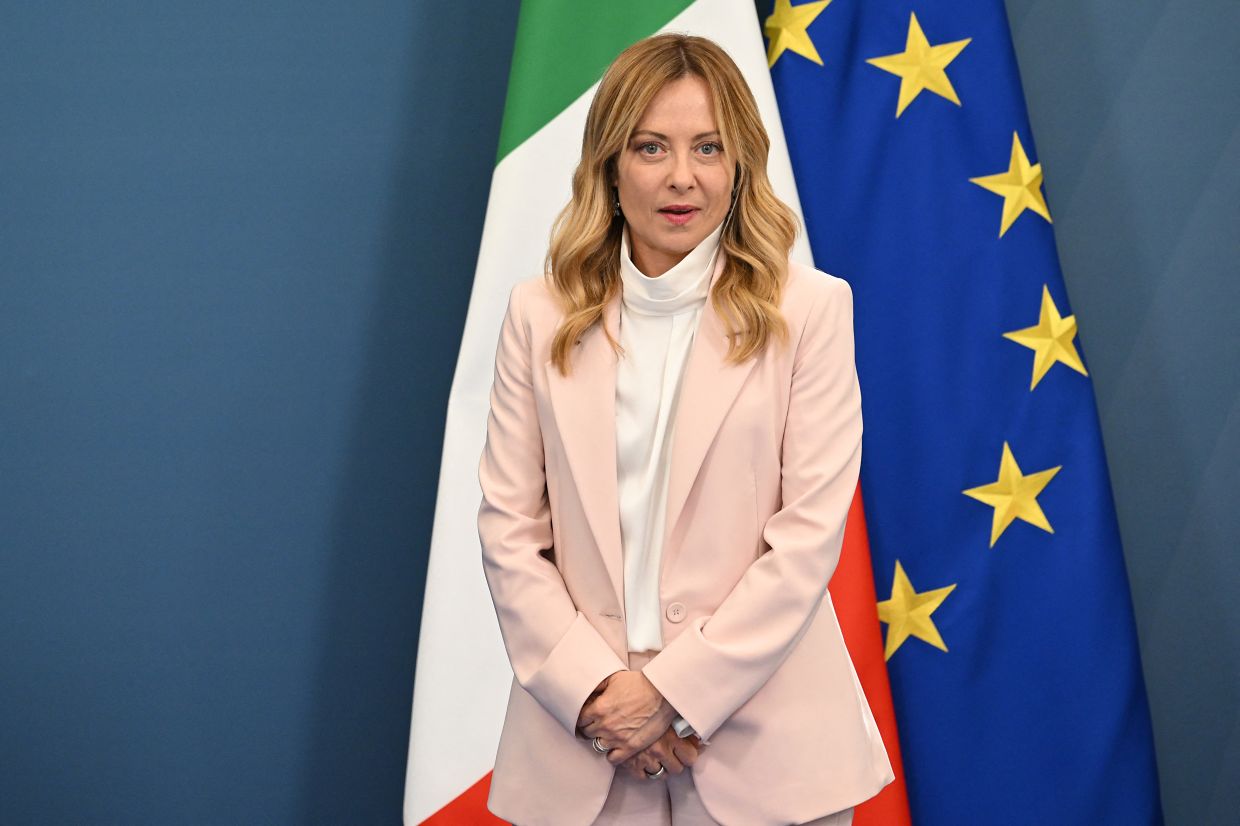
When Giorgia Meloni assumed the Italian premiership in October 2022, her visual presentation announced her political identity as starkly as her words: dark tailored suits, heavy black boots, and an aesthetic borrowed from the fringes of the country's right-wing movement. Twenty months into her tenure, as she manoeuvres toward becoming Italy's longest-serving postwar leader, that sartorial statement has transformed entirely. She now frequently appears in pastel-coloured suits with wide-legged trousers that conceal her heels, a deliberate wardrobe evolution that fashion analysts interpret as the visual grammar of political transformation.
The relationship between Meloni's clothing choices and her political trajectory reveals a sophisticated understanding of how non-verbal communication shapes public perception in contemporary governance. Fashion theorists and political observers note that her wardrobe serves as a carefully calibrated signal of authority without aggression—a critical distinction for a woman navigating the expectations surrounding female leadership in a traditionally conservative European context. Antonio Mancinelli, instructor at Rome's Costume And Fashion Academy, observes that Meloni comprehends the profound role clothing plays in political messaging, particularly when that message requires audiences to reconsider their preconceptions about who she is and what she represents.
Meloni's fashion recalibration occurs against the backdrop of her own political metamorphosis. When she entered office as the leader of a party with post-fascist historical roots, European observers anticipated aggressive posturing on continental affairs and radical domestic positioning. Instead, she has largely confounded those expectations. While maintaining conservative immigration policies domestically, she has adopted pragmatic positions toward the European Union and emerged as one of Ukraine's most vocal supporters during its conflict with Russia. She has even demonstrated willingness to publicly contradict United States President Donald Trump on matters of principle, an stance that has earned respect from fellow European leaders. This substantive shift toward the establishment centre requires corresponding visual representation, which is where her fashion choices become politically instrumental.
The significance of Meloni's sartorial choices carries particular weight given Italy's cultural position as a global fashion arbiter. Stella Jean, the Italian-Haitian fashion designer, emphasizes that when a woman leading the world's fashion capital communicates through clothing, the stakes transcend personal style and touch upon economic and cultural identity itself. For Meloni specifically, the ability to present herself as both authoritative and non-threatening through tailored elegance becomes essential to maintaining legitimacy across Italy's diverse political constituencies. Her softer aesthetic conveys the message that she can wield executive power without the coercive connotations that plagued her earlier public image.
The technical shift from her earlier all-black presentation to her current palette of muted and pastel tones carries deliberate psychological messaging. Fashion educator Michela Bonafoni, who instructs at Unicollege in Florence, explains that lighter colours communicate loyalty, tenderness, and approachability—qualities that balance the perception of governmental authority. Meloni's elimination of bold patterns, her consistent choice of trousers that obscure her footwear, and her preference for neutral colour schemes collectively construct a visual narrative of gravitas tempered with accessibility. This represents a calculated departure from the stark aesthetic choices of her youth, when she appeared entirely in black while organizing right-wing youth activism.
The contrast between Meloni's current presentation and her earlier incarnation proves particularly instructive. In 1996, when she was nineteen years old, French television documented her organizing activities within a right-wing youth movement, her appearance dominated by black clothing that signalled both youthful rebellion and ideological positioning. During that same period, she made controversial comments defending Benito Mussolini, remarks that have remained attached to her political biography despite her subsequent efforts to distance herself from Italy's fascist past. Her appearance then—militant, uncompromising, aesthetically aligned with historical extremism—conveyed an unmodulated political identity. The woman who now occupies the premier's office cannot afford to maintain that visual vocabulary.
Meloni's transformation accelerated during her tenure as youth minister under Prime Minister Silvio Berlusconi in 2008, when she began adopting more formal business attire, particularly dark suits paired with white shirts. This gradual modulation continued through subsequent positions, culminating in her 2022 election campaign, where she began broadening her public appeal beyond hard-right constituencies. During that campaign, she delivered a widely discussed speech in which she described herself as "a woman, a mother, a Christian"—language that transcended ideological positioning and appealed to conservative centrists who might otherwise have dismissed her based on her historical associations. The speech generated a viral remix that unexpectedly expanded her political coalition, demonstrating how her messaging was consciously designed to reach audiences beyond her original supporters.
Political analyst Riccardo Alcaro, affiliated with Italy's Institute For International Affairs, provides crucial context for understanding why Meloni's visual presentation has shifted so dramatically. When leading a small right-wing party, he observes, she required only that her appearance resonate with a narrow ideological constituency. Now, as head of a major European Union nation, she must project herself as a credible leader capable of articulating defensible positions on complex international matters. The global stage demands visual as well as rhetorical respectability. Her softer aesthetic—conveying seriousness and approachability simultaneously—provides the visual scaffolding for her political legitimacy at the European and international levels.
Yet as Meloni approaches the final year of her mandate, she faces mounting challenges from right-wing rivals who contest her centrist drift. These internal political pressures underscore that her fashion choices, however strategically calibrated, cannot entirely obscure the ideological tensions inherent in her political evolution. No pastel suit, however elegantly tailored, can entirely erase historical associations or resolve the contradictions between her party's origins and her current governance. Nevertheless, her wardrobe decisions represent a sophisticated recognition that political authority requires visual as well as rhetorical persuasion. The black boots and dark suits of 2022 announced her arrival as an outsider; the pastel suits of 2024 announce her consolidation as something far more conventional—a pragmatic European leader who has learned that power is best exercised through the language of inclusion rather than confrontation.
Meloni's approach to fashion and politics ultimately illustrates a broader dynamic in contemporary governance: the recognition that political identity is constructed through multiple registers simultaneously. While her office declines to comment on specific wardrobe advisors or decision-making processes, the consistency and deliberation behind her sartorial evolution suggests conscious strategic thinking. For Malaysian and Southeast Asian observers, her trajectory offers instructive lessons about how women navigating male-dominated political spaces can deploy visual communication as a tool for political repositioning and legitimacy-building across different audiences and constituencies.

