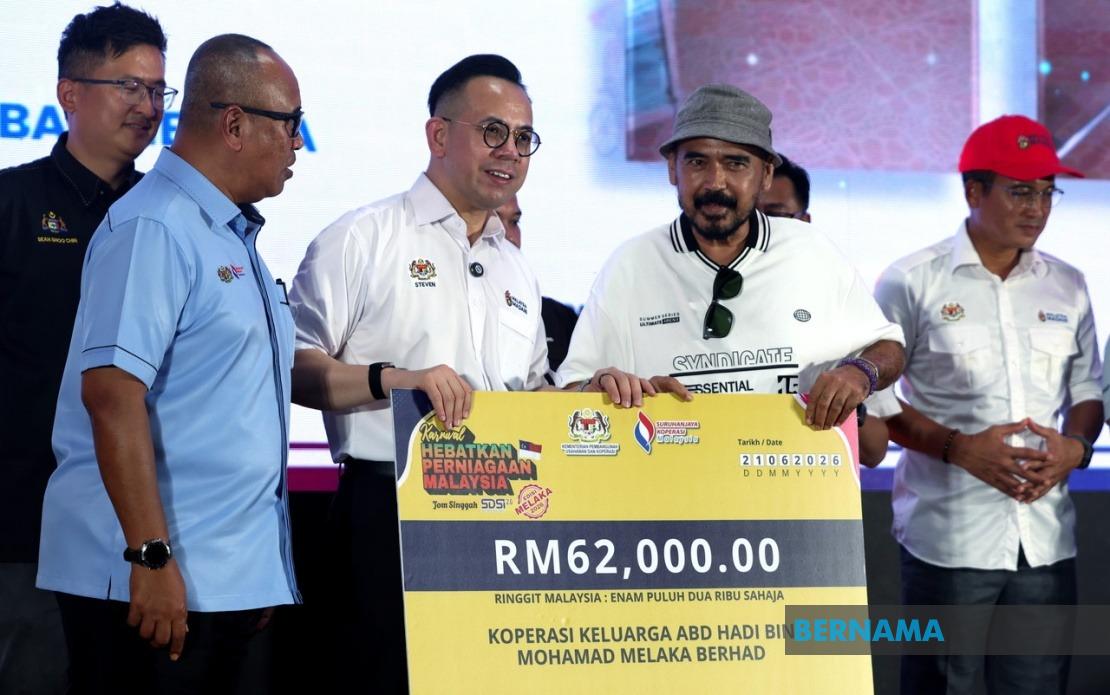
Malaysia's Empowering Malaysian Businesses Carnival (HPM 2026) concluded a highly successful three-day run in Melaka with combined business matching and financing potential valued at RM8.45 million, signalling strong momentum for the government's initiative to strengthen entrepreneurship across the country. The event, organised by the Ministry of Entrepreneur Development and Cooperatives (KUSKOP), reinforced its position as a flagship platform for connecting small business operators with growth opportunities and capital sources during an increasingly competitive economic environment.
Held from June 19 to 21, the carnival drew an impressive footfall of 70,000 visitors and generated immediate economic impact through direct product sales totalling RM532,802.77, demonstrating tangible consumer interest in homegrown enterprises. This visitor engagement reflects growing awareness among Malaysians regarding locally-produced goods and services, particularly as consumers increasingly prioritise supporting domestic businesses. The scale of attendance underscores the appetite within the entrepreneurial community for platforms that facilitate networking, knowledge-sharing, and commercial opportunities without geographical or logistical barriers.
The business matching sessions emerged as a cornerstone achievement, with 72 dedicated sessions connecting 25 prospective entrepreneurs and established business owners. These interactions generated RM6.4 million in identifiable business collaboration value, representing meaningful partnerships and supply chain integration opportunities that extend beyond the carnival itself. Such matching initiatives prove particularly valuable in Southeast Asia's fragmented entrepreneurial landscape, where smaller enterprises often struggle to identify complementary business partners or distribution channels without institutional support.
Equally significant was the financial connectivity component, which benefitted 55 micro, small and medium enterprises (MSMEs) through structured financing interaction sessions. The RM2.05 million in identified financing potential reflects lender interest in supporting small business growth and indicates improved capital accessibility—a persistent challenge for Malaysian MSMEs seeking to scale operations. This financing facilitation aligns with broader regional development priorities, as Southeast Asian governments recognise that capital constraints frequently prevent promising enterprises from realising expansion potential.
The HPM Carnival operates as a practical expression of the ABCD strategic mission, an acronym representing Accelerating Productivity, Bureaucracy Reduction, Capital Accessibility and Developing Market Access. This framework, championed by KUSKOP Minister Steven Sim Chee Keong, addresses fundamental structural challenges facing local enterprises. Rather than offering isolated support, the carnival provides integrated exposure to productivity enhancement techniques, simplified administrative access, financial institutions willing to evaluate small business lending applications, and expanded market visibility—a comprehensive approach that recognises enterprise development requires multi-faceted intervention.
The Hebatkan Perniagaan Malaysia agenda underlying these carnivals represents policy recognition that Malaysia's economic competitiveness increasingly depends on distributed entrepreneurial activity rather than concentration among large corporations. Particularly in the post-pandemic context, where supply chain disruptions highlighted the importance of business diversity and resilience, supporting thriving small enterprise ecosystems delivers strategic national benefits beyond immediate participant growth. The initiative demonstrates how government resources can be deployed to reduce transaction costs and information asymmetries that disproportionately disadvantage smaller operators.
For Malaysian entrepreneurs navigating increasingly sophisticated regional competition from established Indonesian, Thai, and Vietnamese business ecosystems, such platforms provide critical connective tissue. The integration of capacity-building, networking, and financing access within a single event reduces the friction typically involved in accessing multiple support services through disparate government agencies. Participants gain efficiency through consolidated engagement while organisers benefit from concentrated decision-making authority among potential collaborators and financiers.
Looking forward, the HPM 2026 series demonstrates institutional commitment to sustained engagement rather than one-off initiatives. The Melaka carnival's success has already prompted scheduling the third event for Penang from July 17 to 19 at the Penang Waterfront Convention Centre (PWCC), extending the geographic reach across peninsular Malaysia. This sequential regional rollout suggests ambitions to eventually establish HPM as an annual circuit that rotates through major economic zones, building stakeholder expectations and allowing lessons from earlier iterations to improve subsequent events.
The Penang venue selection carries particular significance, given that state's established role as a semiconductor and electronics manufacturing hub alongside its emergent position in digital economy and creative industries. Bringing the carnival to Penang enables tailored sector engagement reflecting that region's unique entrepreneurial profile, moving beyond generic business matching toward industry-specific partnerships. Regional differentiation improves relevance and participation quality compared to one-size-fits-all national initiatives.
For Malaysian readers and business stakeholders, the HPM Carnival's demonstrated success offers immediate takeaway: formal platforms increasingly exist for connecting with collaborators, financiers, and market opportunities without requiring years of industry relationship-building. The RM8.45 million in identified value represents not abstract statistics but tangible commercial transactions and partnerships now moving forward. Smaller enterprises should factor these regular carnivals into annual business development planning, treating them as reliable opportunities to showcase products, evaluate financing options, and identify synergistic partnerships.
Broader implications extend to government effectiveness in economic development. The carnival's strong attendance and measured outcomes suggest targeted deployment of public resources toward direct stakeholder engagement delivers superior results compared to dispersed programmes or purely regulatory approaches. As Malaysia competes within Southeast Asia's increasingly dynamic entrepreneurial landscape, such evidence-based, high-touch support mechanisms position the country favourably for sustaining consistent small business growth that generates employment and regional economic resilience.
The transition from Melaka to Penang and subsequent planned locations also creates accountability mechanisms, as each carnival's results become comparative benchmarks. Organisers must continuously improve offerings to maintain visitor engagement and transaction value across successive events, driving iterative improvement in carnival design, participant recruitment, and institutional partner recruitment. This competitive dynamic within a government-sponsored series reinforces quality standards without requiring external pressure.