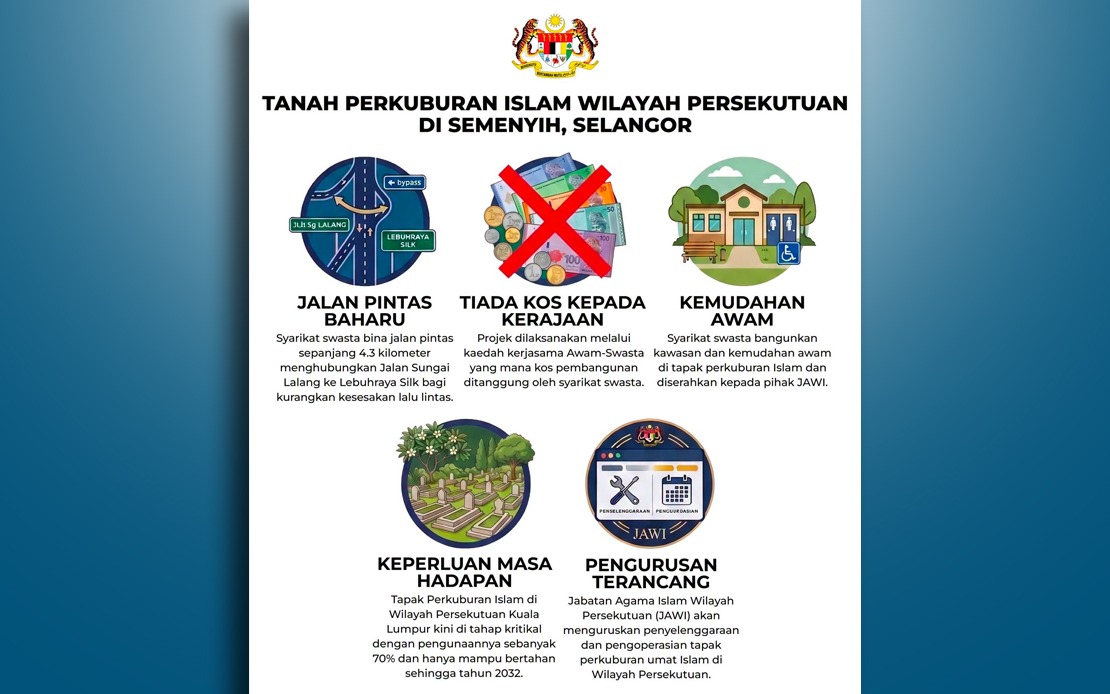
The Malaysian government has moved to dispel confusion surrounding the Federal Territory Muslim Cemetery Development Project in Hulu Semenyih, Selangor, emphasising that preparations for the initiative stretch back nearly two decades. Minister in the Prime Minister's Department (Federal Territories) Hannah Yeoh released a statement through social media to address viral misinformation, underscoring that the project represents a long-standing response to genuine infrastructure needs rather than a recent decision.
The urgency of the cemetery project becomes clear when examining burial capacity figures across Kuala Lumpur. Existing Islamic burial grounds throughout the Federal Territory have now exceeded 70 per cent occupancy, leaving only approximately 29 per cent of plots available as of June 2023. With just 34,496 remaining plots in the current system, projections indicate these will satisfy demand only until around 2032, creating a pressing need for immediate expansion to prevent future shortages.
The proposed development will occupy a 332.6-acre site already held by the Federal Lands Commissioner, providing space for 104,470 Muslim burial plots dedicated to residents of the Federal Territory of Kuala Lumpur. Beyond serving the capital's Muslim community, the project incorporates broader regional considerations, with 10 per cent of cemetery capacity reserved for burials of residents from surrounding Selangor areas. This allocation reflects recognition that death and funeral arrangements cross administrative boundaries and that neighbouring communities share overlapping infrastructure needs.
Implementation will proceed through a public-private partnership model where the developer absorbs all infrastructure costs, including staff facilities, prayer space, administrative structures, amenities and earthworks. Critically, Yeoh emphasised that ownership of the land itself remains with the Federal Lands Commissioner, with operational control vesting exclusively with the Federal Territories Islamic Religious Department (JAWI). This arrangement prevents private commercial management of the burial ground, ensuring religious governance remains in public hands despite private sector involvement in physical development.
A complementary infrastructure element involves construction of a 4.3-kilometre link road connecting Jalan Sungai Lalang to the SILK Highway, estimated at RM93.89 million in total project costs. The Selangor state government has mandated that the developer fund this road construction as a condition of development approval, placing the financial burden squarely on the private partner rather than the public treasury. This linkage addresses longstanding traffic congestion affecting Semenyih residents while simultaneously providing operational access to the cemetery facility.
The project has navigated multiple approval layers before reaching implementation stage. Technical assessments have been completed, evaluation through a Value Management Lab has occurred, and authorisation has been secured from both Selangor state authorities and the Federal Government. These sequential reviews suggest substantive scrutiny beyond perfunctory approval, though they have clearly not fully eliminated public scepticism or confusion about the initiative's necessity and implications.
From a Malaysian governance perspective, the cemetery project illuminates several broader considerations about urban planning and religious infrastructure. As Malaysia's capital city experiences demographic growth and changing settlement patterns, burial facilities rank among essential services requiring forward planning. The shortage situation—with existing capacity projected to last only nine years from the 2023 assessment point—demonstrates the consequences of underprovision and the critical importance of long-range infrastructure thinking in religious affairs.
The involvement of private sector financing, while maintaining public ownership and religious management, represents a practical approach to funding constraints affecting many government departments. Rather than absorbing construction costs within limited capital budgets, shifting these expenses to private developers through partnership arrangements preserves government resources for other priorities. However, such arrangements require robust oversight to ensure private partners do not attempt inappropriate influence over operations or financial management.
Regional implications extend beyond Selangor and Kuala Lumpur, as other Malaysian states and federal territories face similar burial capacity challenges driven by urban growth, improved living standards extending average lifespans, and changing burial customs. Hulu Semenyih may serve as a model for other jurisdictions considering major cemetery expansion or relocation. The project's scale—104,470 plots—and sophisticated planning offer lessons for neighbouring states contemplating similar infrastructure investments.
The social dimension of burial grounds deserves recognition as governments address these provisions. Muslim communities across Malaysia view cemetery facilities not merely as utilitarian land uses but as spaces imbued with religious significance and community identity. Planning such projects requires sensitivity to these cultural dimensions alongside technical infrastructure considerations. The allocation of capacity for surrounding Selangor residents reflects acknowledgement that cemetery planning transcends administrative convenience to address genuine community needs.
Public communication challenges evident from viral social media confusion suggest the government requires more proactive engagement when advancing large infrastructure projects, particularly those touching religious sensibilities and lifestyle concerns. Earlier, more transparent communication about the project's two-decade planning horizon and capacity rationale might have prevented misunderstandings. As Malaysia navigates increasingly complex urban development, clearer government messaging about project necessity and benefits becomes essential for maintaining public confidence.
The Hulu Semenyih cemetery project ultimately reflects contemporary challenges facing Malaysian governance: accommodating population growth, managing religious community needs, financing infrastructure sustainably, and building public trust through transparent planning processes. By securing private sector partnership while maintaining public stewardship, Malaysia attempts to balance efficiency with accountability. How successfully this balance translates into community satisfaction and functional infrastructure will shape perceptions of similar arrangements in future projects across the nation.

