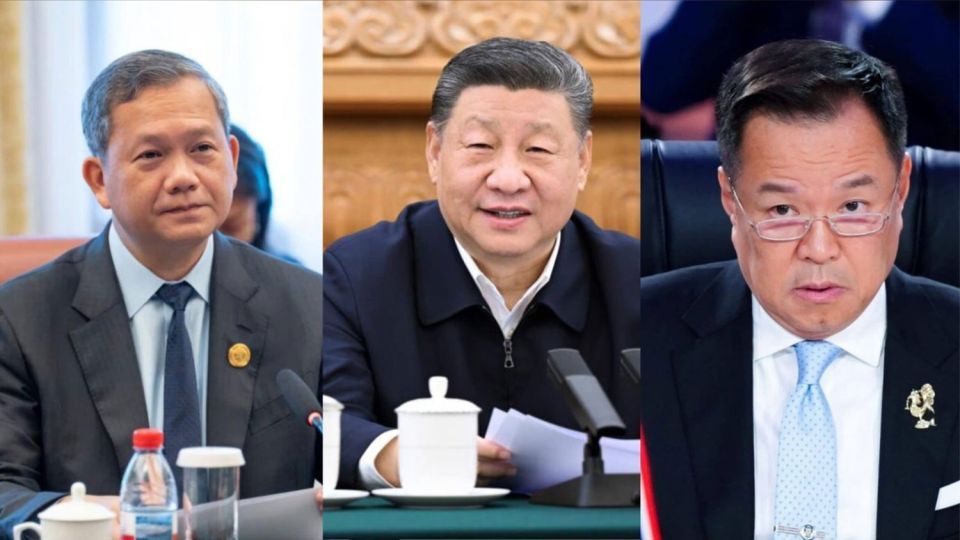
Cambodia's Prime Minister Hun Manet and his Thai counterpart Anutin Chanvirakul are set to converge on Shanghai this month for the World AI Conference 2026: WAIC opening session, attending at the personal invitation of Chinese President Xi Jinping. The dual attendance of both leaders at the July 17 event marks a rare high-level gathering that comes as their nations remain locked in a longstanding territorial dispute, with the two premiers having avoided substantive negotiations since last December. The Shanghai visit offers potential diplomatic opening, though observers remain cautious about whether Beijing will leverage its considerable economic influence to push the neighbours toward resolving their contentious border issues.
Hun Manet's delegation will be substantial, departing Cambodia on July 15 and returning three days later with Foreign Minister Prak Sokhonn, Defence Minister Tea Seiha, and Sun Chanthol, the first vice-chairman of the Council for the Development of Cambodia, in tow. Thailand's Anutin is expected to travel with Foreign Minister Sihasak Phuangketkeow. Beyond the conference proceedings themselves, both premiers have scheduled bilateral meetings with Xi and Chinese Premier Li Qiang, suggesting that discussions extending beyond artificial intelligence will form part of the agenda. The composition of the Cambodian delegation, notably including both the foreign and defence ministers, hints that broader strategic issues may be under consideration.
The Cambodian foreign ministry framed the visit as an affirmation of deepening ties with China, emphasising the advancement of their Comprehensive Strategic Partnership of Cooperation and reinforcing what officials describe as the Diamond Cooperation Framework. Such language reflects Phnom Penh's consistent positioning of China as a cornerstone of its foreign policy architecture. The ministry statement underscored Cambodia's vision of building an all-weather community with a shared future alongside Beijing in what it characterises as a new era of cooperation. Bangkok similarly pitched the Shanghai gathering as an opportunity to strengthen the Thailand-China Comprehensive Strategic Cooperative Partnership, indicating that both capitals view the engagement primarily through the lens of bilateral China relations rather than trilateral or regional cooperation mechanisms.
Yet beneath the diplomatic pleasantries lurks a more pressing concern. Both Hun Manet and Anutin were present at the 3rd ASEAN Future Forum held in Hanoi during early June, where photographs captured them shaking hands before cameras. However, those images belied the absence of any substantive dialogue addressing their nations' festering border dispute. The staged cordiality suggests a continued reluctance to engage directly on the issue, despite mounting international attention and growing domestic pressure, particularly from Cambodia's side. The failure to translate photogenic moments into actual negotiations underscores the complexity of the territorial question and the political constraints facing both governments.
Analysts increasingly view China's position as potentially decisive in breaking the current impasse. As a dominant trading partner for both Cambodia and Thailand, and wielding considerable soft power throughout the region, Beijing possesses significant leverage to incentivise resolution. The Shanghai conference therefore presents an unusual opportunity for Chinese diplomacy to actively intervene, whether through quiet bilateral pressure during the Xi and Li meetings or through broader signalling that border stability serves Beijing's strategic interests in mainland Southeast Asia. China's engagement would carry particular weight given that the two nations previously reached the Fuxian Consensus in December 2025 through Chinese mediation, suggesting that Beijing retains channels and credibility with both parties.
However, structural obstacles may prove more intractable than diplomatic pressure alone can overcome. According to Kin Phea, director of the Royal Academy of Cambodia's International Relations Institute, the core problem extends beyond disagreements between national governments. Phea identifies Thailand's military establishment as the primary impediment, arguing that Bangkok's armed forces have systematically failed to implement commitments made by Thailand's civilian administration to their Cambodian counterparts. This civil-military divide within Thailand represents a fundamental challenge that even Chinese mediation may struggle to bridge, as it involves questions of institutional control and domestic political balance within Thailand itself. The military's capacity to act unilaterally, including through continued encroachments on Cambodian territory, effectively vetos progress negotiated at the prime ministerial level.
The human cost of this deadlock remains substantial and largely overlooked in regional discourse. Approximately 20,000 Cambodian civilians continue to be displaced from their homes in occupied border areas, representing an ongoing humanitarian consequence of the territorial dispute. These communities exist in a state of protracted displacement, unable to return to their property or rebuild their lives, whilst international attention focuses on high-level diplomatic choreography. The accumulation of such grievances over years of failed negotiations creates domestic pressure within Cambodia that eventually constrains Hun Manet's room for compromise, even if he were inclined toward concessions.
Phea has articulated a clear formula for progress that reflects Cambodian expectations. He calls for China to assume a more activist arbitration role, specifically pressing both nations to resume formal negotiations and compelling Thailand to honour the Fuxian Consensus reached in December 2025. Critically, Phea demands that Thai forces withdraw from occupied Cambodian territory and that both nations commit to working through the Joint Boundary Commission without further delay. Such prescriptions, while diplomatically sound, ultimately require a shift in Thailand's political will that external pressure alone may not produce. The burden of implementation rests fundamentally with Bangkok's decision to subordinate military interests to civilian diplomacy and regional stability.
The Shanghai gathering thus carries significance beyond its ostensible purpose as an artificial intelligence conference. For regional observers, particularly in Southeast Asia, the meetings between Hun Manet, Anutin, Xi, and Li will be scrutinised for signs of whether China intends to deploy its diplomatic capital toward border resolution. The absence of announced bilateral Cambodia-Thailand meetings during the Shanghai visit would itself signal continued diplomatic distance. Conversely, any indication that China has catalysed direct negotiations would represent a meaningful shift from the current stasis. Given the humanitarian dimensions and the broader implications for regional stability, the Shanghai visit deserves attention not merely as a ceremonial gathering of leaders but as a potential turning point, however modest, in one of Southeast Asia's most intractable territorial disputes.

