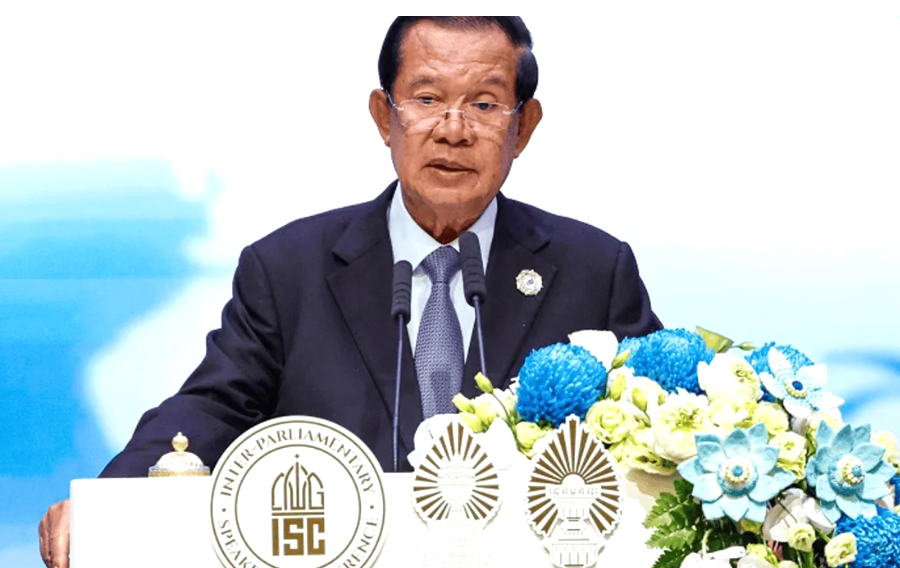
Cambodia's Senate president Hun Sen has levelled a serious allegation against Thailand, declaring at an international parliamentary conference that the neighbouring kingdom weaponised the cross-border online scam crisis to justify military action and territorial occupation along their disputed border. Speaking Thursday at the 2nd Inter-Parliamentary Speakers' Conference in Phnom Penh, Hun Sen presented what he termed a troubling pattern in contemporary geopolitics, where transnational criminal issues become convenient justifications for violations of sovereignty and occupation of foreign land.
The remarks illuminate a simmering regional tension that has periodically flared into armed clashes along the Cambodia-Thailand frontier. Cambodian officials have long contended that Thai forces occupy portions of disputed border territory, while Bangkok maintains its own historical claims to the same areas. Hun Sen's comments during the conference, attended by parliamentary delegations from Pakistan, Malaysia, Myanmar, Australia, Russia and other nations, suggest Cambodia views the online scam narrative as diplomatic cover for what it considers outright territorial expansion.
According to Hun Sen, modern conflict has fundamentally transformed from conventional military confrontation to a multifaceted assault on state sovereignty and civilian infrastructure. He articulated a vision of contemporary warfare that targets the very systems sustaining public life—roads, bridges, schools, religious sites, and economic infrastructure like oil refineries all become potential battlegrounds. This characterisation reflects anxieties shared across Southeast Asia about how geopolitical competition is increasingly prosecuted through channels beyond traditional military means, affecting ordinary citizens' daily security and prosperity.
The Senate president specifically identified what he called "extra-territorial jurisdiction over cross-border crimes" as a modern warfare tactic. By invoking international law enforcement concerns—in this case, online scam networks allegedly operating from Cambodian soil—nations can ostensibly justify extraordinary measures, including military occupation of foreign territory. This framing resonates with broader Southeast Asian concerns about how powerful actors leverage global challenges to advance narrow strategic interests, a particularly sensitive issue for smaller nations in the region vulnerable to external pressure.
Hun Sen also referenced what he characterized as Thailand's casual dismissal of ceasefire agreements, suggesting Bangkok treats such accords as mere formalities rather than binding commitments. While he did not specify which agreements he referenced, the accusation underscores Cambodia's frustration with what it views as inconsistent Thai compliance with international arrangements meant to stabilise their volatile border region. For Malaysian policymakers and those of other Southeast Asian nations, such allegations raise troubling questions about the reliability of bilateral and multilateral agreements in an era when powerful states selectively honour their commitments.
Extending his analysis beyond the immediate border dispute, Hun Sen identified multiple contemporary conflict mechanisms reshaping global competition. Trade wars employing tariff barriers and sudden withdrawal of preferential access represent one category; technology competition over semiconductors and cyber-infrastructure another; and resource protectionism surrounding energy supplies and rare earth minerals a third. These observations reflect anxieties across Southeast Asia about how economic interdependence and technological dependencies create new vulnerabilities that rival states can exploit for geopolitical advantage.
A particularly striking element of Hun Sen's argument concerns the selective application of international standards and legal frameworks. He contended that powerful nations violate international law with impunity while invoking human rights, environmental standards, and cross-border crime concerns as justifications for pressuring weaker states. This critique resonates across the developing world, where nations perceive double standards in how international law is interpreted and enforced—a complaint that has occasionally strained relationships within Asean and complicated regional consensus on security matters.
Hun Sen warned that the erosion of a rules-based international order is triggering a dangerous arms race among vulnerable nations desperate to acquire defensive capabilities when international treaties prove inadequate protection. This observation carries significant implications for Southeast Asia, where several nations face security dilemmas amid great power competition and territorial disputes. If countries increasingly doubt that international law provides meaningful security guarantees, regional militarisation could accelerate, straining resources and redirecting government spending from development priorities.
The Senate president specifically cautioned that systematic security anxiety threatens to collapse the international non-proliferation framework itself. Should vulnerable nations conclude that nuclear weapons or advanced military capabilities offer the only credible deterrent against external aggression, the global non-proliferation regime could unravel with potentially catastrophic consequences. This warning holds particular relevance for Southeast Asia, a region largely free from nuclear weapons but situated amid states with varying nuclear capabilities and proliferation concerns.
Hun Sen's fundamental critique centres on what he characterises as rule-erosion by those who established international systems. He accused powerful actors of rewriting global arrangements unpredictably, creating perpetual uncertainty for nations seeking to navigate international relations according to established principles. This complaint reflects broader frustrations across the developing world about asymmetrical power in international institutions and the perception that established powers maintain authority to redefine rules whenever doing so serves their interests.
Calling for restoration of the rules-based order, the UN Charter, and the Asean Charter, Hun Sen essentially advocated for greater consistency and fairness in international law application. For Malaysia and other Southeast Asian nations, such appeals resonate with long-standing commitments to regional multilateralism and the principle that stronger nations should be bound by the same legal frameworks constraining weaker ones. Whether such restoration proves achievable amid contemporary geopolitical fragmentation remains profoundly uncertain.
The Cambodian leader's comments ultimately articulate a broader anxiety pervading Southeast Asia: that globalisation and technological change have created new pretexts for old patterns of great power competition, and that international institutions designed to constrain such competition are proving inadequate to the task. For a region that has invested heavily in rules-based frameworks and multilateral cooperation as mechanisms for managing interstate relations, this represents a sobering assessment of the challenges ahead.

