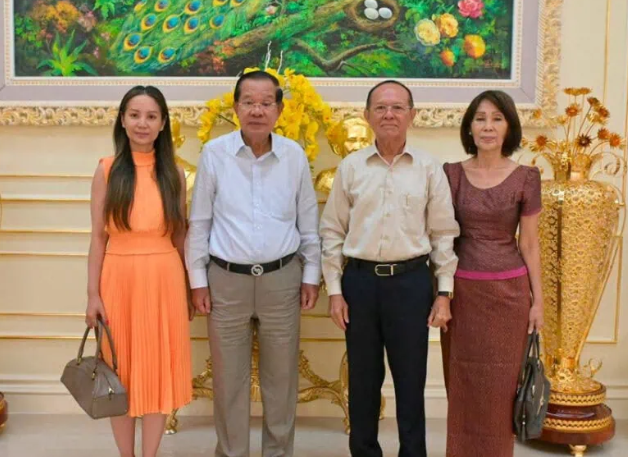
In a striking moment of political rapprochement, Senate president Hun Sen welcomed former opposition leader Kem Sokha to his private residence on Sunday morning for an extended conversation that underscores a dramatic thaw in one of Southeast Asia's most consequential political rivalries. The encounter, which lasted three hours from 9am until noon and included Sokha's wife and daughter, represents a visible softening of relations between two men who once stood at the centre of Cambodia's most bitter political divisions. Hun Sen's subsequent public remarks about the meeting, particularly his effusive praise for Sokha's daughter Kem Monovithya, carry significant implications for Cambodia's political trajectory and the prospects for reconciliation after years of antagonism.
The meeting itself was not entirely unexpected, as Hun Sen had disclosed that Sokha had visited his home several weeks prior, before the former opposition leader embarked on a humanitarian mission to Cambodia-Thailand border areas affected by ongoing conflicts. That earlier visit appeared to have established a channel of communication that has now resumed with greater visibility. While Hun Sen declined to specify the substance of their three-hour discussion, deliberately maintaining ambiguity about whether political matters featured in their talks, the very act of hosting Sokha at home and announcing it publicly represents a calculated political signal to Cambodia's fractious political landscape and the international community observing developments in the kingdom.
Monovithya's prominence in Hun Sen's public remarks carries particular weight given her family's history at the helm of Cambodia's opposition movement. As the daughter of Sokha and a notable figure within the dissolved Cambodia National Rescue Party, she had become synonymous with the CNRP's challenge to ruling party dominance. Hun Sen's description of her as "an excellent human resource for the nation," offered after extensive conversation during Sunday's meeting, suggests a potential recalibration of how Cambodia's political establishment views the younger generation of opposition figures. The Senate president's characterisation was sufficiently careful to avoid explicit commitment to any future political role for Monovithya, yet substantial enough to signal approval and recognition of her capabilities in terms the Cambodian political establishment would clearly understand.
Sokha's gradual rehabilitation represents one of the most dramatic reversals in recent Cambodian politics. Detained in 2017 immediately following the dissolution of the CNRP by the Supreme Court, he languished under legal restrictions for years despite international criticism of his treatment and calls for his release. A treason conviction in 2023 on charges of alleged conspiracy with foreign powers resulted in a 27-year prison sentence that appeared to have ended his political participation permanently. However, the trajectory shifted considerably when King Norodom Sihamoni issued a royal pardon on May 25, effectively terminating Sokha's house arrest and prison sentence, though political restrictions remained nominally in place. A subsequent royal decree issued on July 24 further liberalised his circumstances by rescinding a five-year overseas travel ban, creating space for the kind of public movements Sokha has begun undertaking.
Sokha's re-emergence into public view has proceeded methodically and carefully. His July 28 visit to Banteay Meanchey province to engage with families displaced by border hostilities represented his most significant public appearance since imprisonment, and notably he framed his involvement as that of a private citizen rather than political actor or state representative. During these interactions, Sokha indicated that he had raised humanitarian concerns regarding displaced Cambodians with international contacts, suggesting a possible role in civil society advocacy rather than party politics. This measured approach appears calculated to avoid triggering renewed restrictions while establishing his relevance in Cambodia's public discourse during an extended period of controlled reintegration.
The historical context underlying these interactions cannot be overstated for understanding their significance. Hun Sen and Sokha spent decades as principal antagonists in Cambodia's political arena. The CNRP's emergence represented the most serious challenge to Cambodia People's Party dominance since its consolidation of power, demonstrating considerable electoral appeal in both the 2013 national elections and 2017 commune elections. The party's dissolution in November 2017 appeared to settle the question definitively in Hun Sen's favour, yet the pathway to reconciliation now being cautiously navigated suggests that Cambodia's political establishment may have determined that indefinite confrontation and marginalisation of Sokha and his political base carries greater costs than managed accommodation.
For regional observers and international analysts following Cambodia's political development, these interactions between Hun Sen and Sokha carry implications extending beyond bilateral reconciliation. Sokha's treatment and gradual rehabilitation have attracted sustained international scrutiny, with democratic advocates and human rights organisations repeatedly highlighting his case as emblematic of Cambodia's constraints on political freedom. Any visible movement toward normalization of his status and potential roles within Cambodia's public life could address some international concerns while potentially signalling Hun Sen's confidence in managing any renewed political challenges. The careful staging of these meetings and public statements suggests sophisticated management of perceptions among multiple audiences including Cambodia's fractious political factions, international diplomatic missions, and the broader Cambodian public.
The absence of any official announcement regarding political agreements or reconciliation frameworks is itself revealing. Neither side has framed these interactions as part of structured dialogue or formal process, allowing maximum flexibility and maintaining deniability regarding political intentions. This opaqueness may reflect genuine uncertainty about future directions, or alternatively, it may represent deliberate strategic ambiguity serving multiple purposes simultaneously. Hun Sen's domestic position remains secure, rendering dramatic concessions unnecessary, yet accommodating Sokha at a managed pace may represent a more sophisticated approach to cementing ruling party dominance through apparent magnanimity rather than continued suppression.
Monovithya's positioning within these evolving dynamics warrants particular attention for observers of Cambodia's generational political transitions. The younger generation of opposition figures often lacks the baggage of their parents' generation while potentially commanding loyalty among constituencies responsive to newer forms of political mobilisation. Hun Sen's explicit recognition of Monovithya's capacities, framed in language suggesting future utility for the nation, opens interpretative space regarding whether Cambodia's establishment envisages roles for opposition figures that fall short of direct political confrontation but exceed complete marginalisation. Such arrangements have precedent in other Southeast Asian contexts where managed opposition participation within circumscribed roles has facilitated regime stability while providing outlets for political ambitions.
The implications for Malaysian and broader Southeast Asian readers involve understanding how authoritarian or semi-authoritarian systems navigate succession crises and potential rival power bases. Cambodia's experience with the CNRP and its leadership demonstrates both the challenges such movements pose to entrenched power structures and the mechanisms available to established elites for containing or accommodating them. Hun Sen's apparent strategy of gradual rehabilitation coupled with maintained restrictions on political activity represents a middle path between previous hard-line suppression and full restoration of opposition capacity. Similar dynamics have played out across the region where aging authoritarian leaders have grappled with succession questions and the management of rival constituencies that cannot be indefinitely suppressed but present genuine challenges to ruling interests.
As Cambodia moves forward, the trajectory of Hun Sen and Sokha's evolving relationship will provide crucial indicators regarding the kingdom's political future. If these private meetings signal the beginning of a structured reconciliation process, they could presage significant constitutional or political arrangements that might reshape Cambodia's competitive landscape. Alternatively, they may represent limited tactical adjustments designed to neutralise Sokha as a political threat by incorporating him and his family within the establishment's orbit without fundamentally altering power distributions. The careful language Hun Sen has employed, particularly regarding Monovithya, suggests that Cambodia's political leadership remains actively calculating how to manage opposition figures and alternative power bases in ways that consolidate rather than challenge existing hierarchies. For regional observers, these developments warrant sustained attention as they unfold, as they may establish precedent for how Southeast Asian regimes navigate the increasingly complex terrain between democratic opening and authoritarian continuity.

