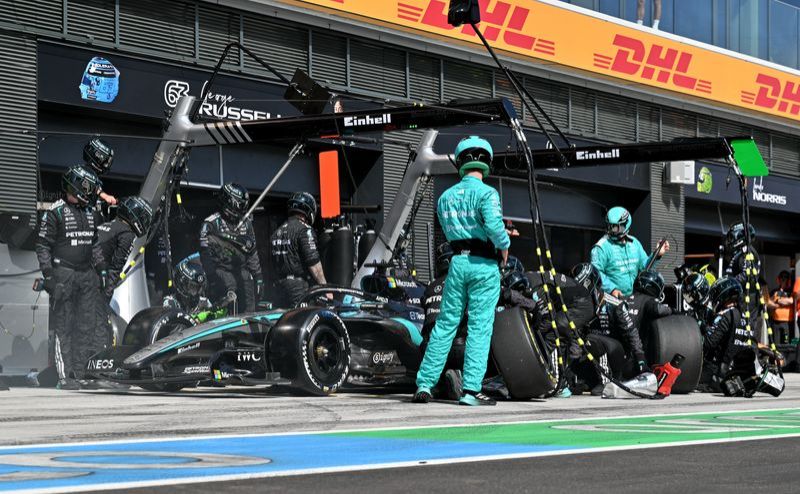
George Russell emerged from the paddock at Budapest's Hungaroring emotionally spent, his patience exhausted by yet another catastrophic technical failure that transformed what should have been a recovery weekend into another chapter of frustration. The Mercedes driver, who lined up sixth on the grid on Sunday with a genuine opportunity to claw back points, found himself deposited to the back of the field when an anti-stall malfunction triggered on the opening lap, undoing months of optimism and derailing a season that has become increasingly surreal in its cruelty. "I am past the point of disappointment now," Russell told gathered reporters, his tone betraying a man who has moved beyond conventional frustration into something closer to resignation. The brittle composure in those words reflected not mere frustration with machinery, but a deeper exhaustion born from relentless setbacks that have plagued his 2024 campaign.
Russell's predicament stands in stark contrast to the preseason narrative that painted him as a championship contender. The British driver enters the sport's traditional August break 59 points behind his teammate Kimi Antonelli, an astonishing reversal of fortune for someone who was once considered among the season's favourites. With eleven of twenty-three rounds completed, Russell has claimed two victories compared to Antonelli's six, while finishing three races without scoring points—a statistical reality that undersells the deeper mechanical patterns that have systematically undermined his campaign. The championship math has become brutally unforgiving, yet the numbers obscure a more troubling picture of systemic technical failures that have disproportionately targeted Russell's car rather than reflecting genuine performance deficiency.
Sunday's incident exemplified the maddening precision with which these gremlins strike. Russell described the moment with clinical detail: positioned on the throttle to hold engine revs in the final seconds before the lights extinguished, he felt the engine suddenly lose response to his inputs, the power delivery becoming erratic and unpredictable. Just four seconds remained before the start sequence would begin, yet those crucial moments proved sufficient for a brand-new power unit to malfunction in a fashion Russell admitted left him bewildered. The anti-stall system, designed as a safety mechanism, activated and pushed him backwards into the field chaos, forcing an ungainly fight through the order that ultimately yielded only seventh place—hollow consolation when his teammate secured third and extended the gap further.
Mercedes team principal Toto Wolff offered no excuses, accepting responsibility for the recurring nightmare with uncomfortable candour. "It is fully on us as a team and it isn't good enough," Wolff stated, acknowledging that Russell "has suffered too many of these problems." The admission carried weight not because it was unexpected, but because it underscored an uncomfortable reality: one of motorsport's most prestigious organisations has struggled to diagnose and resolve issues that continue to multiply. Wolff's commitment to solving the problems rang hollow against the mounting evidence that whatever root cause underlies these failures, the team's engineering resources have thus far proven insufficient to arrest the pattern. For Russell, such institutional acknowledgement offers little solace when the consequences accumulate in lost championship points and eroded mental resilience.
The cumulative weight of this season's setbacks has clearly penetrated Russell's psychological defences. He articulated a philosophy attempting to embrace stoicism, insisting he must "stay positive" and extract whatever performance advantages remain available. Yet the contradiction was evident in his next breath: he conceded that he genuinely craves a break, something he has rarely required in his career, acknowledging that the relentless drumbeat of mechanical misfortune has crossed a threshold from professional frustration into genuine psychological fatigue. This admission carries significance beyond the individual driver—it signals how sustained technical failure can erode even well-conditioned athletes accustomed to the pressures of elite motorsport competition.
The broader context of this season's dysfunction becomes clearer when examining the specific incidents that have accumulated. Russell's Belgium retirement last weekend involved contact with Lewis Hamilton and Ferrari's machinery on the opening lap, an incident for which the seven-time champion faced penalties. Yet even when circumstances placed blame elsewhere, Russell bore the consequence. Such compounding misfortune—a blend of mechanical failures genuinely outside his control and racing incidents that occasionally involved other competitors—has created a season where no single catastrophe becomes definitively responsible, instead suggesting an almost cosmically aligned series of setbacks. Russell himself recognised this distinction, noting pointedly that he refuses to express disappointment about circumstances genuinely beyond his influence, a subtle but important assertion of perspective about his own accountability.
The technical nature of these failures matters considerably for understanding what Mercedes faces moving forward. Russell's description of the anti-stall malfunction on a brand-new engine raises questions about whether the team has adequately understood the relationship between its latest power-unit specifications and the systems designed to protect them. That this occurred on fresh equipment rather than an older unit suggests the problem may embed itself within recent development rather than representing straightforward component degradation. Such diagnostic challenges become more pressing as the season advances, with summer break providing limited opportunity for comprehensive investigation when the next race calendar resumes at the end of August.
For Malaysian and Southeast Asian motorsport enthusiasts, Russell's travails carry particular resonance given the region's deep investment in Formula One's future. The Mercedes struggles against Antonelli, himself an Italian talent representing the kind of emerging driver development that concerns established teams worldwide, underscore how quickly championship momentum can shift and how machinery reliability remains determining rather than secondary. The narrative arc of a preseason favourite disintegrating through technical misfortune rather than performance deficit offers uncomfortable lessons about the sport's current technical complexity and the unforgiving mathematics of contemporary grand prix competition.
Russell's comment about lacking a season like this in his entire career carried an implicit warning about the fragility of championship aspirations when machinery proves unreliable. Mercedes has constructed its identity on technical excellence and engineering superiority, yet 2024 has revealed vulnerabilities in that foundation that money and personnel alone cannot instantly repair. As the grid pauses for its August recess, Russell faces five weeks to decompress from a campaign that has tested his resilience in ways he never anticipated. Whether that break translates into renewed determination or signals a deeper shift in his relationship with a team that has failed to deliver the consistency he requires remains uncertain. What seems beyond dispute is that when racing resumes in late August, Russell will require not merely improved machinery but restored psychological equilibrium—a commodity that repeated technical failure has rendered increasingly scarce.

