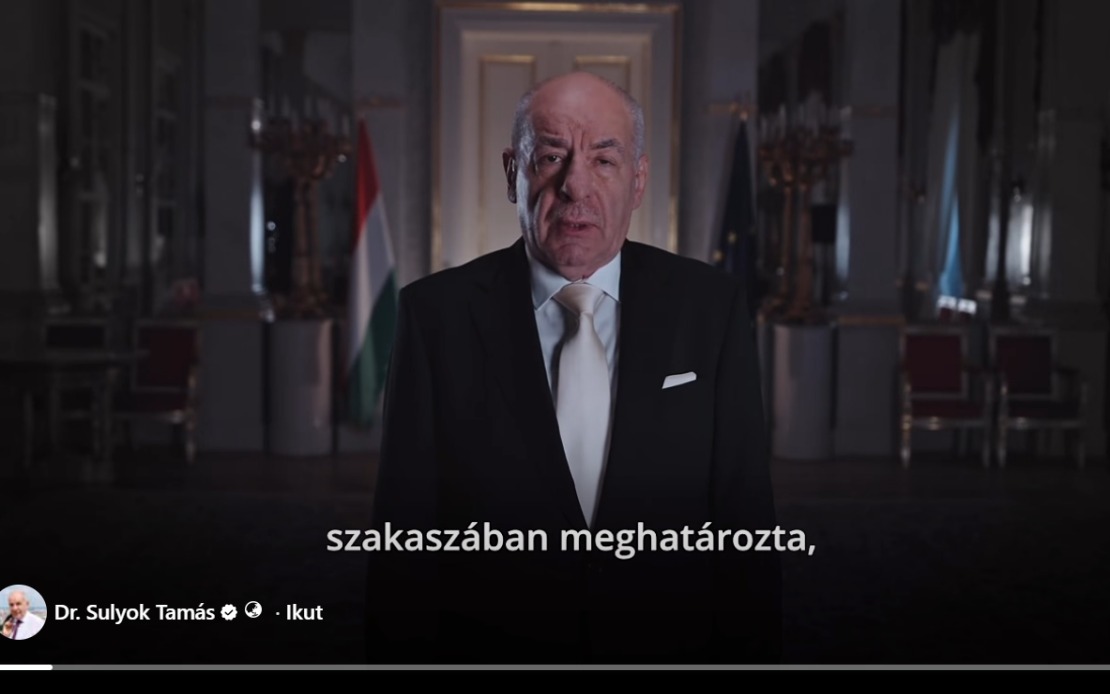
Hungarian President Tamás Sulyok has capitulated to mounting political pressure, agreeing to countersign constitutional amendments that will effectively remove him from office. The decision marks a dramatic reversal by the Orbán ally after days of deliberation, and opens the door to sweeping political reforms under the administration of newly installed Prime Minister Péter Magyar, who had issued an ultimatum threatening impeachment if Sulyok refused to comply.
Sulyok's capitulation came after Parliament passed the constitutional amendment on Monday, with Magyar subsequently granting the president five days to ratify the changes. Facing the prospect of impeachment proceedings if he continued to resist, Sulyok ultimately chose to countersign, clearing legal obstacles to the amendments taking effect. Magyar publicly confirmed the president's acceptance, announcing that Sulyok's office would be declared vacant beginning Monday.
The constitutional changes themselves represent far-reaching political reform that Magyar's government views as essential to reversing what it characterises as systematic abuses of power during Orbán's tenure as Prime Minister. In a Facebook statement, Magyar cast the removal in terms of democratic restoration, stating that the government was returning to Hungarian citizens freedoms that the previous regime had systematically eroded. He emphasised that the constitutional reforms would restore limits on executive authority, recover state assets allegedly misappropriated during Orbán's years in power, and reorient the state apparatus toward serving citizens rather than entrenching political patronage networks.
Despite acquiescing to the amendment, Sulyok maintained that the parliamentary decision to remove him violated constitutional principles. He expressed his conviction that the amendment represented an unconstitutional overreach by the legislative branch, yet acknowledged that he possessed no viable legal mechanisms to challenge the decision. In a recorded video message posted to Facebook, Sulyok articulated concerns about the broader implications of his removal, suggesting that the constitutional changes would fundamentally weaken the office of the presidency. He warned that future heads of state would now operate entirely at the discretion of the executive and parliament, stripped of any meaningful oversight function.
Legal scholars and constitutional experts had previously assessed that Hungary's Constitutional Court retained limited scope to intervene. While analysts suggested the court could theoretically object to the parliamentary process on procedural grounds, they concluded that substantive review of the amendment's content lay beyond the court's jurisdiction. This assessment effectively foreclosed Sulyok's hopes for judicial intervention, leaving him with no credible mechanism to block the amendment. The constitutional framework itself thus appeared to constrain any institutional resistance to the parliamentary majority's will.
Under the transitional arrangements prescribed by the constitutional amendment, parliamentary speaker Agnes Forsthoffer will assume and exercise all presidential powers until a new head of state can be elected. Parliament is required to conduct the election for a successor within thirty days of the sitting president's departure. In the Hungarian system, the president is elected by parliamentary vote rather than popular franchise, meaning that the incoming prime minister's coalition controls the selection process. This concentration of authority in parliamentary hands during both the interim and the election for a permanent replacement underscores Sulyok's concerns about the diminished independence of the presidency.
The episode reflects broader tensions within Hungary's political system following Orbán's electoral loss in April. Though Orbán retained considerable political influence through his Fidesz party, voters decisively rejected his continued tenure as prime minister, clearing the way for Magyar's coalition government. Yet tensions remained over the institutional architecture that Orbán's government had constructed during its tenure, raising questions about whether new leadership could dismantle that apparatus or whether deep structural constraints would persist.
Sulyok's removal carries particular symbolic weight because his elevation to the presidency had been widely understood as Orbán's attempt to place a trusted ally in a position that could constrain the incoming government. By removing Sulyok and weakening the presidency's independence, the Magyar administration has signalled its intent to reconfigure the balance of power between executive and legislative branches. The new constitutional framework, by rendering the presidency subordinate to parliamentary and executive will, reflects the coalition's determination to prevent future abuse of state institutions.
For Malaysian observers, the Hungarian situation illuminates complexities surrounding institutional checks and balances in democratic systems. The case demonstrates how constitutional amendments can rapidly reshape power structures and how legislative supermajorities can override executive or judicial resistance when they command sufficient parliamentary support. The experience underscores the importance of robust constitutional protections that cannot be unilaterally altered, and the vulnerability of institutional safeguards when political consensus shifts decisively.

