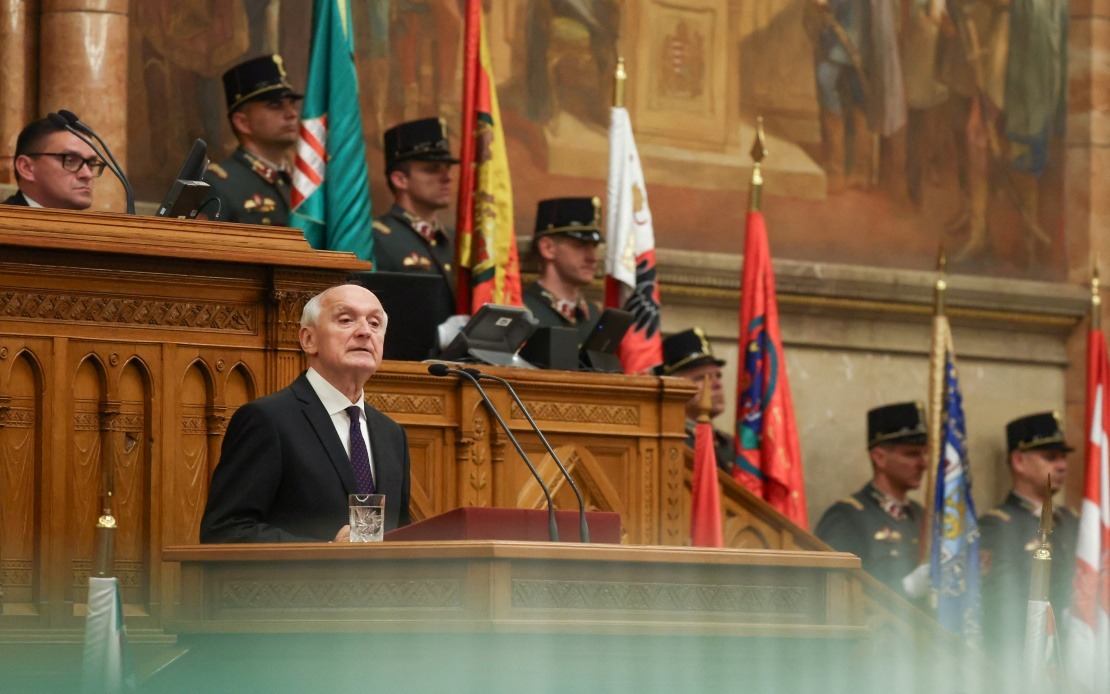
Hungary has inaugurated Andras Baka as its new president, marking a significant shift in the country's political leadership. The formal assumption of office occurred on August 19, 2026, following the Hungarian Parliament's election of Baka on August 11. Prime Minister Peter Magyar publicly affirmed the transition through a social media statement, extending wishes for the incoming president's success and emphasising the importance of humanitarian values in Baka's approach to the ceremonial head of state role.
Baka's appointment represents a return to the political spotlight for a jurist whose career has been closely intertwined with Hungary's contentious judicial reforms. The incoming president previously served as president of Hungary's Supreme Court from 2009 to 2011, a tenure that ended abruptly when he resigned in protest against sweeping reforms implemented under the government of then-Prime Minister Viktor Orbán. These reforms fundamentally restructured the Hungarian judiciary, reflecting the broader institutional changes that have shaped Central European politics over the past decade and a half.
Before his appointment as Supreme Court president, Baka gained international experience working at the European Court of Human Rights in Strasbourg, an institution responsible for interpreting the European Convention on Human Rights across the continent. This background suggests his jurisprudence has been shaped by European human rights jurisprudence and comparative constitutional law. Following his resignation from the Supreme Court, Baka served as chairman of the Hungarian Curia from 2012 to 2020, the institution that replaced the Supreme Court under the reformed judicial structure. His tenure at the helm of the Curia positioned him as a key figure navigating Hungary's evolving legal landscape during a period of significant institutional change.
The election of Baka to the presidency, however, has not proceeded without controversy. Both major opposition parties—Fidesz and the Christian Democratic People's Party—boycotted the presidential election entirely, signalling their disapproval of the process and the broader constitutional amendments that preceded it. The opposition parties' absence from the ballot was primarily driven by objections to the manner in which the previous president, Tamas Szujok, was removed from office. The use of constitutional amendments to effect the removal of a sitting president proved sufficiently contentious to prompt opposition parties to withdraw from participation in the electoral process, a dramatic gesture that underscores the depth of political divisions within Hungary's legislative chamber.
This constitutional crisis reflects deeper tensions within Hungarian politics regarding institutional legitimacy and the proper methods for managing leadership transitions. The removal of a president through constitutional amendment, rather than through impeachment or electoral defeat, raises questions about the separation of powers and the appropriate checks on executive action within parliamentary systems. For Malaysian and Southeast Asian observers, the situation offers lessons on how democratic institutions can be tested when political disagreements extend to the fundamental procedures governing leadership change.
The political context surrounding Baka's ascension is particularly significant given Hungary's position within the European Union and NATO. The country has faced considerable scrutiny from Brussels over concerns regarding judicial independence, press freedom, and democratic norms. Baka's background as a Supreme Court judge who ultimately rejected Orbán's judicial reforms could be interpreted as a signal that Hungary is seeking to restore confidence in its institutions among international observers. His experience with the European Court of Human Rights may also inform his approach to protecting constitutional safeguards and individual rights.
Yet the boycott by opposition parties complicates any narrative of institutional renewal or democratic stabilisation. The refusal to participate in presidential elections suggests that at least a significant portion of Hungary's parliamentary opposition views the legitimacy of current constitutional arrangements as fundamentally compromised. This fracture in political consensus creates uncertainty regarding how effectively Baka's presidency can serve as a unifying national institution, particularly given the ceremonial but symbolically important role that a president occupies in a parliamentary democracy.
For regional observers, Hungary's institutional dynamics carry implications beyond its borders. The country's willingness to amend constitutional structures to achieve political objectives, combined with the opposition's response, illustrates broader patterns visible across Central and Eastern Europe regarding the contested nature of post-Cold War democratic development. The balance between majority rule and constitutional protection remains unresolved, creating ongoing tensions within the region's political systems.
Baka's assumption of office thus occurs against a backdrop of unresolved constitutional disputes and partisan divisions. While his appointment may represent an attempt to restore international confidence in Hungarian institutions, the simultaneous boycott by opposition parties indicates that significant sections of Hungary's political establishment view the constitutional process as tainted. The test for Baka's presidency will be whether his experience and background enable him to exercise the largely ceremonial powers of the Hungarian head of state in ways that gradually rebuild institutional trust across political divides, or whether the presidency remains a focal point for continued constitutional controversy.

