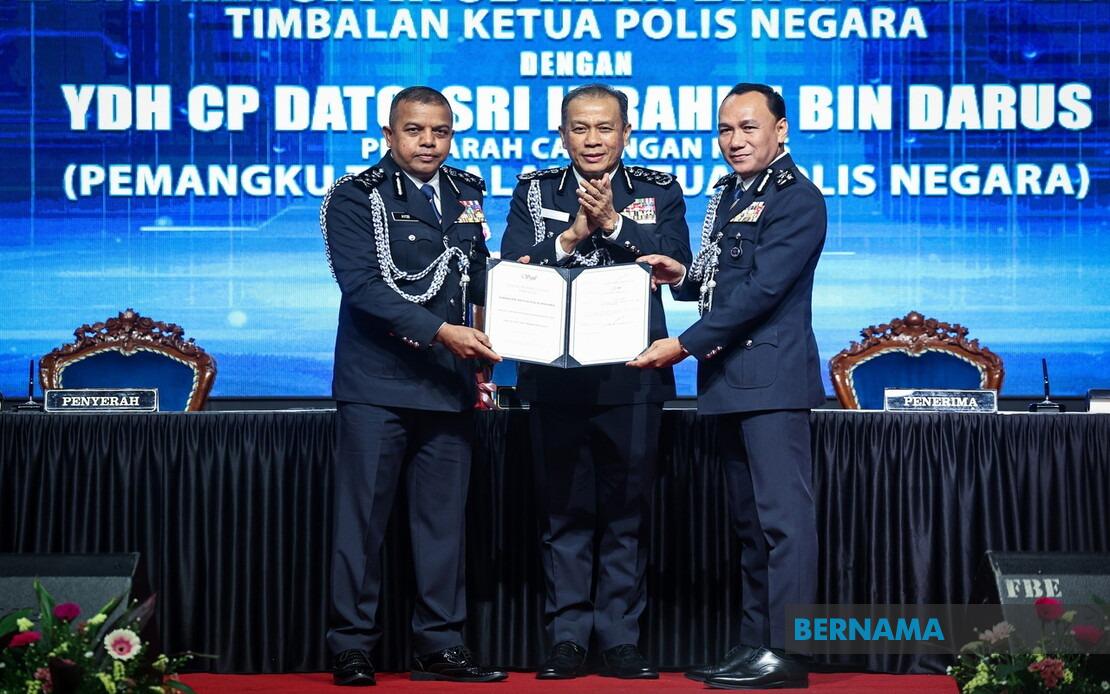
The Royal Malaysian Police leadership bid farewell to Deputy Inspector-General Tan Sri Ayob Khan Mydin Pitchay on July 26, with Inspector-General Tan Sri Mohd Khalid Ismail delivering a tribute to the veteran officer's three-decade tenure marked by unwavering commitment to institutional integrity and the rule of law. During a formal handover ceremony at police headquarters in Kuala Lumpur, the IGP characterised Ayob Khan's leadership as exemplifying the values that anchor PDRM's operational integrity in an increasingly complex security environment.
Ayob Khan's career arc reflects the progression typical of Malaysia's highest-ranking police officers, yet his path stood out for consistency in principle-driven decision-making across varied portfolios. Beginning in the Special Branch, he navigated roles spanning counterterrorism operations, narcotics enforcement, and criminal investigation before ascending to the deputy's office in June 2023. His tenure as Johor's police chief and subsequent direction of the Narcotics Criminal Investigation Department demonstrated tactical acumen in combating organised crime and transnational trafficking—critical concerns for Malaysian security. The Special Branch assignments, widely viewed as sensitive positions requiring political astuteness alongside law enforcement rigour, particularly underscore his reputation for maintaining independence within the force's hierarchy.
Mohd Khalid's characterisation of Ayob Khan as someone who "did not waver easily in upholding the rule of law" carries weight given PDRM's evolving relationship with civilian accountability mechanisms and public scrutiny. At a time when police forces across Southeast Asia face mounting pressure to balance security imperatives with human rights compliance, the IGP's emphasis on principled leadership signals institutional commitment to lawful conduct. The phrase also implicitly addresses longstanding concerns about political interference in policing decisions—a recurrent tension in Malaysian governance where public confidence in law enforcement depends substantially on demonstrable independence from partisan influence.
Ayob Khan's background as a Universiti Kebangsaan Malaysia graduate positioned him within an intellectual cadre increasingly visible in PDRM's senior echelons. The appointment of university-educated officers to top posts reflects a deliberate effort to professionise the force and embed contemporary standards of governance within its command structure. This educational orientation may have sharpened his approach to complex matters spanning terrorism investigation, organised crime suppression, and the delicate balance between intelligence gathering and civil liberties protection.
The incoming Acting Deputy Inspector-General, Datuk Seri Ibrahim Darus, assumes command from his current position as director of Bukit Aman Special Branch—the intelligence and internal security division housed within police headquarters. Ibrahim's background in Special Branch operations suggests continuity in the force's strategic direction, though his elevation marks a generational transition within the upper leadership. The IGP's expression of confidence in Ibrahim's capacity to "shoulder this trust with full dedication" reflects institutional confidence in the management of ongoing operations, from counterterrorism to organised crime investigations, amid evolving threats including cybercrime and transnational human trafficking.
The handover occurs amid PDRM's broader engagement with regional security architecture and international partnerships. Malaysian police increasingly coordinate with counterparts across ASEAN on transnational crime, cybersecurity threats, and militant activity that transcends borders. Deputy Inspector-Generals function as key strategic advisors to the IGP on these external engagements, making the transition significant beyond headquarters corridors. Ayob Khan's long experience in Special Branch operations equipped him with deep knowledge of intelligence networks and bilateral relationships that Ibrahim will inherit and must sustain.
The ceremonial nature of the handover underscores institutional continuity and the professional protocols governing PDRM's internal succession. Unlike civilian bureaucracies where leadership transitions sometimes occasion public controversy, police command structures typically emphasise seamless operational continuity. The IGP's public commendation of his deputy's character serves multiple functions: acknowledging Ayob Khan's contributions while legitimising the successor's readiness and reassuring personnel and public constituencies that institutional values transcend individual tenure.
Ayob Khan's 35-year career also reflects the stability expected within Malaysia's security establishment. Unlike some regional militaries and police forces prone to rapid leadership rotations, PDRM typically allows senior commanders substantial tenure, permitting policy implementation and institutional reforms to mature. Ayob Khan's 14-year stretch in various critical portfolios prior to his deputy appointment enabled him to champion specific initiatives, from counter-narcotics strategy to criminal investigation methodology, imparting his mark on institutional practice and personnel development.
The emphasis on Ayob Khan's role in "combating militant elements and safeguarding integrity" reflects contemporary security preoccupations dominating Malaysian public discourse. Counterterrorism remains a paramount concern following years of activity by Islamic State-affiliated groups and returnee foreign fighters. Criminal investigation integrity, meanwhile, addresses perennial public concerns about case management and the evidentiary standards that underpin prosecutions. These domains represent the force's most visible accountability points and areas where leadership credibility determines public confidence in outcomes.
As PDRM navigates demands for modernisation—encompassing cybercrime units, data analytics, and international cooperation protocols—the succession of Ayob Khan's deputy post signals continuity in these strategic domains. Both the departing and incoming deputy representatives carry backgrounds suggesting technological sophistication and exposure to international best practices, essential credentials for leading a force whose operational scope extends far beyond traditional street-level policing. Their successive appointments reflect deliberate institutional selection of leaders equipped to guide PDRM through evolving 21st-century security challenges while maintaining the fundamental principle that law enforcement serves constitutional democracy and rule of law rather than partisan interests.

