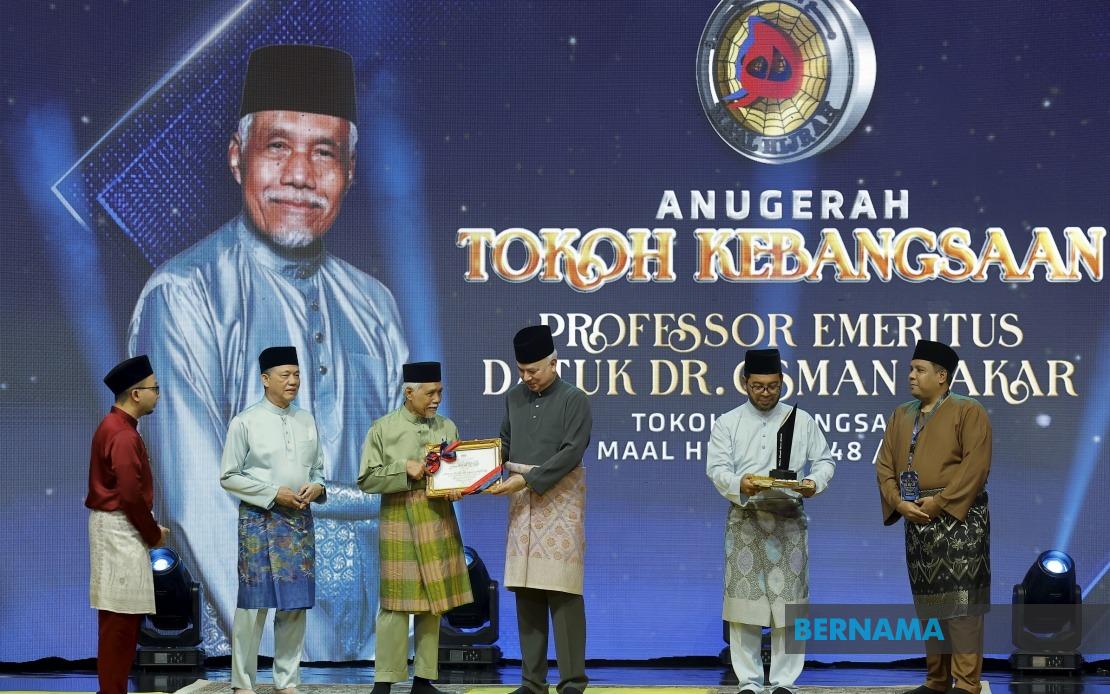
Prof Emeritus Datuk Dr Osman Bakar, the Rector of International Islamic University Malaysia (IIUM), was conferred the National Tokoh Maal Hijrah award during Malaysia's national-level celebration of Maal Hijrah 1448H/2026 held at Putra Mosque in Putrajaya on June 17. The recognition acknowledges his significant contributions to Islamic scholarship and leadership within Malaysia's educational landscape. Alongside Bakar's honour, the ceremony also distinguished Dr Ahmad Al-Raysuni, a prominent Islamic scholar from Morocco, as the International Tokoh Maal Hijrah, elevating the recognition to a transnational level that reflects the interconnectedness of Islamic intellectual traditions across continents.
The presentation of both awards was conducted by Sultan Nazrin Shah, the Sultan of Perak, underscoring the ceremonial significance and official endorsement of these honours. Recipients were presented with monetary prizes, physical trophies, and formal certificates recognising their achievements. This dual recognition—one national, one international—demonstrates Malaysia's commitment to celebrating not only local Islamic intellectual contributions but also fostering dialogue with respected scholars from other Muslim-majority nations. The presence of high-ranking government officials at the event reinforced the importance the government places on honouring those who advance Islamic values and education.
This year's observance centred on the theme "MADANI Dihayati, Ummah Diberkati", which translates to emphasising the lived practice of Malaysia's MADANI framework while securing blessings for the wider Muslim community. The thematic direction reflects contemporary national priorities focused on deepening societal commitment to compassion, fostering unity across diverse populations, and prioritising collective welfare. By linking Maal Hijrah—the Islamic New Year celebration that marks Prophet Muhammad's migration to Medina—with these broader social values, the ceremony positioned religious observance as inseparable from practical community service and nation-building efforts.
The dignitaries present at Putra Mosque included Deputy Prime Minister Datuk Seri Fadillah Yusof and his wife Datin Ruziah Mohd Tahir, as well as Dr Zulkifli Hasan, who serves as Minister in the Prime Minister's Department (Religious Affairs). Their participation signalled high-level government recognition of the event and the awardees' standing. Such attendance typically indicates that the government views these individuals as exemplars whose work aligns with or supports official policy directions, particularly regarding religious affairs and Islamic education.
Osman Bakar's recognition carries particular significance given IIUM's role as Malaysia's premier institution for Islamic higher learning and research. The university operates under a unique dual mission to combine Islamic values with modern academic rigour, preparing graduates for leadership roles across government, business, and civil society. As Rector, Bakar has overseen institutional development during a period of expanding regional influence, with IIUM increasingly positioning itself as a centre of excellence for Islamic scholarship that engages with global academic standards and contemporary challenges. His award thus extends recognition beyond his individual scholarly achievements to encompass the institutional vision he has helped advance.
The selection of Dr Ahmad Al-Raysuni for the international honour reflects growing Malaysian engagement with Islamic thought leaders from North Africa, particularly Morocco. Al-Raysuni is recognised internationally for his work in Islamic jurisprudence, Islamic governance theory, and contemporary Islamic ethics. His recognition at a Malaysian national ceremony suggests efforts to strengthen intellectual connections between Malaysia and the Moroccan Islamic scholarly tradition, potentially supporting dialogue on shared challenges facing Muslim societies in navigating modernity while preserving Islamic values.
Maal Hijrah celebrations serve a dual function in Malaysia's Islamic calendar—they mark a pivotal moment in Islamic history while providing occasions for the government and civil society to reaffirm commitment to national values framed within Islamic tradition. The awarding of Tokoh Maal Hijrah designations annually identifies individuals whose contributions exemplify the ideals the nation seeks to promote. For Malaysian readers and institutions, these recognitions serve as benchmarks indicating the qualities and accomplishments the government considers exemplary in leaders and scholars.
The MADANI framework, referenced in this year's theme, represents the government's broader vision for societal development emphasising prosperity, integrity, trust, and accountability. By explicitly linking this framework to Maal Hijrah celebrations, officials are signalling that Islamic principles and MADANI values are not separate domains but rather mutually reinforcing. The implication is that advancing Islam in Malaysia necessarily involves embodying virtues of good governance, community responsibility, and ethical conduct—qualities that both Bakar and Al-Raysuni presumably exemplify in the government's assessment.
For Malaysia's higher education sector, Bakar's recognition sends a message about institutional priorities and the value placed on academic leaders who can articulate Islamic perspectives on contemporary issues while maintaining academic credibility. IIUM's prominence in this national recognition elevates the profile of Islamic higher education within the broader Malaysian academic ecosystem, where research-intensive, internationally-engaged institutions are increasingly important to national competitiveness and soft power. The award implicitly endorses the model of Islamic education that IIUM represents—one that balances doctrinal integrity with intellectual openness.
More broadly, the ceremony reflects Malaysia's positioning as a Muslim-majority nation engaged with global Islamic scholarship networks. The international dimension—honouring a Moroccan scholar alongside a Malaysian academic leader—demonstrates that Malaysia sees itself not as insular but as part of a transnational Islamic intellectual community. This is particularly relevant for regional dynamics, as Malaysia maintains significant educational and cultural ties throughout Southeast Asia while also engaging with Islamic centres of learning in the Middle East and North Africa. Such international recognition of Malaysian scholars and vice versa supports soft power narratives that Malaysia promotes.
The awarding of cash prizes alongside trophies and certificates indicates financial recognition of both the individuals and implicitly the institutions they represent. For IIUM, this official acknowledgement and material support reinforce government backing for the institution's mission. For scholars in Malaysia and the region, such ceremonies provide motivation and public validation that scholarly work in Islamic fields commands respect and resources at the highest policy levels. This has implications for attracting talent to Islamic studies and ensuring that such fields remain attractive career paths for intellectually ambitious individuals.