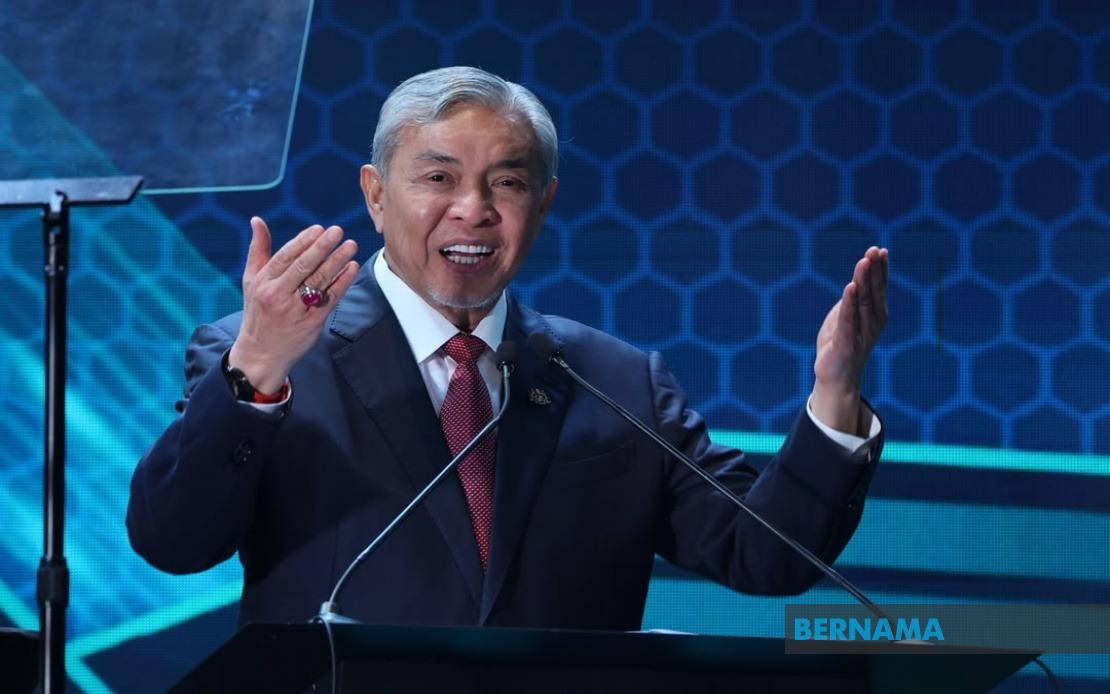
Malaysia's Deputy Prime Minister Datuk Seri Dr Ahmad Zahid Hamidi has called for a fundamental reimagining of the Immigration Department's role in national development, emphasising that JIM must evolve from a traditional gatekeeping function into a strategic economic catalyst while simultaneously strengthening national security. Speaking at the 2026 Immigration Day celebration in Cyberjaya on July 21, Ahmad Zahid presented a four-point mandate designed to guide the department's transformation and reposition it as a trusted institution central to Malaysia's competitive standing in the region.
The vision outlined by the Deputy Prime Minister represents a significant policy shift in how Malaysia conceptualises immigration administration. Rather than viewing border control and economic facilitation as competing priorities, Ahmad Zahid framed them as complementary objectives that must be pursued simultaneously. He underscored that transformational change cannot occur through ad-hoc initiatives or temporary adjustments but requires a coherent philosophical framework embedded throughout the organisation's operations, policies and decision-making processes. This integrated approach addresses a long-standing tension in immigration governance across Southeast Asia, where security concerns have historically taken precedence over economic enablement.
The first pillar of the mandate targets economic competitiveness, with Ahmad Zahid articulating a direct connection between immigration efficiency and national prosperity. He pointed out that bureaucratic delays, convoluted procedures and unnecessary complexity in immigration processing create friction that undermines Malaysia's attractiveness to international investors and skilled professionals. The Deputy Prime Minister cited the United Arab Emirates as a comparative benchmark, highlighting how that nation has deliberately aligned its immigration framework with foreign direct investment strategies through mechanisms such as the Golden Visa programme, which extends residency of up to ten years. This deliberate integration has yielded tangible results for the UAE, which attracted RM196.6 billion in foreign direct investment during 2025, securing its position as the ninth most attractive foreign investment destination globally for the fourth consecutive year.
This comparative analysis carries particular significance for Malaysian policymakers seeking to enhance the country's competitive position within ASEAN and the broader Indo-Pacific region. Malaysia's own efforts to attract talent and capital compete directly with regional peers including Singapore, Thailand and Vietnam, each pursuing aggressive strategies to position themselves as investment hubs. Ahmad Zahid's invocation of the UAE model suggests that immigration policy itself can function as an economic tool rather than merely a regulatory constraint. The implication for Malaysian readers is that inefficiencies within JIM directly impact the nation's ability to compete for the globally mobile capital and expertise that drive modern economic growth.
The second mandate element addresses evolving national security challenges, with Ahmad Zahid emphasising that contemporary threats operate across borders with unprecedented complexity and speed. He outlined how transnational criminal networks engaged in migrant smuggling have become increasingly sophisticated, while human trafficking operations have grown more intricate and difficult to intercept. This evolution in threat landscape demands corresponding sophistication in enforcement approaches. Rather than reactive border policing, Ahmad Zahid advocated for intelligence-driven security measures underpinned by inter-agency coordination and technological innovation. This distinction reflects international best practices in border security, where predictive analytics and information sharing among agencies have proven more effective than traditional checkpoint-based enforcement.
The deployment of advanced technologies constitutes the third pillar of the transformation mandate. Ahmad Zahid specifically referenced big data analytics, artificial intelligence, predictive analytics, digital identity systems, biometrics and smart border infrastructure as critical tools for enhancing both security and operational efficiency. These technologies enable faster decision-making, greater accuracy and stronger security assurance than traditional manual processes. The Deputy Prime Minister articulated an important distinction between technological adoption merely for speed versus utilising technology to achieve qualitatively superior outcomes through smarter analytical capacity. For Malaysian authorities managing migration flows through multiple entry points including airports, seaports and land borders, this technological integration offers significant potential to simultaneously improve service delivery and security posture.
The fourth mandate element emphasises integrity, professionalism and humanitarian values as foundational to JIM's institutional character. Ahmad Zahid explicitly called upon department personnel to adhere rigorously to established procedures, exercise sound professional judgment and demonstrate the moral courage necessary to act ethically even when facing pressure. He characterised JIM's reputation as dependent not merely on firm law enforcement but on the demonstration of principled conduct, technical competence and respect for human dignity. This emphasis on values-based leadership reflects broader efforts within Malaysian civil service to strengthen institutional credibility and public trust, particularly important given periodic concerns about corruption or inconsistency in immigration administration across the region.
Ahmad Zahid's articulation of these four integrated priorities represents an attempt to resolve a fundamental tension inherent in immigration governance: the need to simultaneously facilitate legitimate movement and commerce while preventing smuggling, trafficking and security threats. Many Southeast Asian nations struggle to strike this balance, often tilting toward restrictive approaches that impede economic efficiency. Malaysia's explicit adoption of a dual-mandate framework suggests recognition that economic competitiveness in the 21st century requires immigration systems calibrated to attract talent and investment while maintaining robust security. This approach aligns with emerging best practices among developed economies that have discovered economic benefits from well-designed immigration policies.
The transformation initiative also reflects internal dynamics within Malaysian government, with the presence of Chief Secretary to the Government Tan Sri Shamsul Azri Abu Bakar, Public Service Department director-general Tan Sri Wan Ahmad Dahlan Abdul Aziz and Immigration director-general Datuk Zakaria Shaaban indicating high-level institutional commitment to implementation. Such visible commitment from senior government figures suggests this represents a genuine strategic priority rather than rhetorical positioning. For Malaysian businesses, particularly those engaged in cross-border operations, foreign recruitment or supply chain management, the successful implementation of this mandate could materially improve operational efficiency and reduce compliance burdens.
The economic implications of this transformation extend beyond immediate business convenience to Malaysia's broader regional positioning. Southeast Asia is experiencing intense competition for foreign direct investment and skilled migration, with Singapore, Thailand and Indonesia pursuing aggressive strategies to attract talent and capital. Malaysia's adoption of a business-friendly immigration framework could enhance its appeal as a regional headquarters location and investment destination. Many multinational corporations consider immigration processing efficiency and talent acquisition pathways when selecting headquarters locations, making this institutional evolution potentially significant for national economic trajectory.
Implementation will determine whether this mandate translates from policy vision into operational reality. Ahmad Zahid explicitly acknowledged that transformation requires consistent application across all policies, systems and actions, not merely symbolic gestures. The success of this initiative will likely depend on whether JIM receives adequate resources, technological investment and training to operationalise the four-point framework. Additionally, sustained political commitment will be necessary to maintain momentum through inevitable institutional resistance and operational challenges. For Malaysia's business community and international investors, tracking JIM's implementation progress over coming months will provide crucial signals regarding the government's seriousness about improving the immigration environment.
The Deputy Prime Minister's vision positions immigration policy as central to national competitiveness rather than peripheral to economic strategy. This reframing carries significant implications for how Malaysia approaches regional competition and global talent attraction. By explicitly linking immigration administration to economic growth and security objectives, Ahmad Zahid has created a mandate that encourages JIM personnel to view themselves as contributors to national prosperity and security rather than mere bureaucratic functionaries. Whether this aspirational framing drives meaningful institutional transformation will substantially influence Malaysia's ability to compete effectively for investment and talent within an increasingly competitive regional environment.

