In a quiet village in the Czech Republic's eastern reaches, one man has dedicated his life and home to Argentina's national football team. Miloslav Urbanec, a 51-year-old music promoter living in Bukovka, 90 kilometres east of Prague, has created what may well be Europe's most singular tribute to the South American giants. His three-storey residence stands as a physical monument to his passion, painted entirely in the sky-blue and white of the Argentine flag, with architectural and artistic flourishes that leave no doubt about where his sporting allegiances lie.
The house itself functions as a open-air gallery of Argentine football history and mythology. A life-size statue of Diego Maradona stands sentinel in the courtyard, while a towering mural of Lionel Messi dominates the rear facade. The front wall features a colossal sun emblem—the central symbol of Argentina's national flag—positioned prominently for all passersby to witness. Every surface speaks to Urbanec's unwavering devotion, a testament constructed in paint, stone, and conviction across the Bohemian countryside.
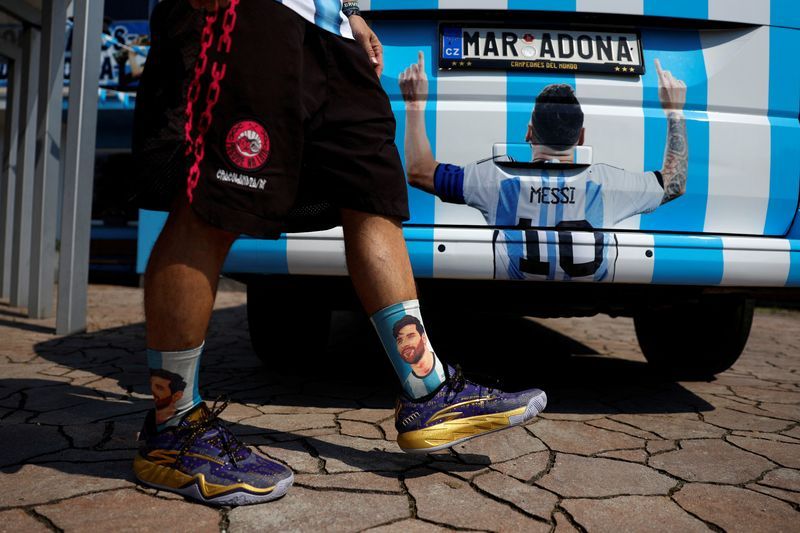
Beyond the main residence, Urbanec's commitment extends to an all-weather football pitch positioned behind the house, surrounded by placards featuring Boca Juniors players. The choice to highlight this particular Buenos Aires club reflects a deeper layer of Urbanec's fandom, as it represents the institution most closely associated with Maradona's playing career. Even his personal vehicle—a van painted in the same sky-blue and white—carries the declaration "In Messi we trust" alongside images of both Maradona holding the World Cup and Messi in his prime, while sporting a custom number plate reading simply "MARADONA".
The origins of this extraordinary devotion trace back to Urbanec's childhood in 1978. At just four years old, he watched Argentina's maiden World Cup victory alongside his father, an experience that crystallised into lifelong passion. The flowing hair and attacking style of players like Mario Kempes captivated the young Czech boy, establishing connections that would shape his identity for decades to come. What began as a child's fascination with distant sporting heroes evolved into a comprehensive worldview centred on Argentine football culture and aesthetics.
Urbanec's commitment manifests in deeply personal ways that extend beyond decoration and merchandise. He named his second son, now seven years old, Lionel—a choice he justified by noting that seven years ago, when the child was born, "this guy is absolutely special" in reference to Messi. The decision to give his son a name forever linked to one of football's greatest modern players reveals how thoroughly Urbanec has integrated his passion into family life and future generations.
For Urbanec, the current iteration of Argentina's national team represents the culmination of decades of hope and investment. He speaks with certainty about the squad's prospects, describing them as "absolutely amazing" and expressing complete confidence in their ability to secure victory. His assessment goes beyond tactical analysis or statistical probability; rather, it reflects a believer's conviction. He articulates a conviction that Argentina "play the most beautiful football," suggesting that his appreciation transcends mere winning but extends to questions of style, aesthetics, and footballing philosophy.
The phenomenon of Urbanec's devotion raises intriguing questions about how globalised sports fandom operates in the contemporary world. His home in rural Czech Republic, hundreds of kilometres from the nearest Argentine community of significant size, demonstrates how football—and particularly the exploits of transcendent players—can generate passionate followings across geographical and cultural boundaries. The specificity of his focus on Argentina, rather than a more accessible European football tradition, underscores how individual narratives of connection and family memory can override proximity and convenience.
Urbanec's vision of an Argentina victory extends beyond personal satisfaction, encompassing a global celebration. He imagines that success would prompt "a beautiful party, not only in Bukovka—around the world," acknowledging that Argentina's sporting achievements resonate across continents and cultural contexts. This perspective reflects how major international tournaments create moments of collective joy that transcend national borders, uniting people across vast distances through shared emotional investment in particular teams and players.
At the time of these comments, Argentina faced Cape Verde in the round of 32 on July 3, a fixture that would determine their progression in the tournament. For Urbanec, watching from his blue-and-white house in the Czech countryside, the match represented far more than a sporting encounter—it embodied the realisation of a passion cultivated since childhood, now expressed through his home, his family, and his unwavering belief in Argentina's footballing destiny.

