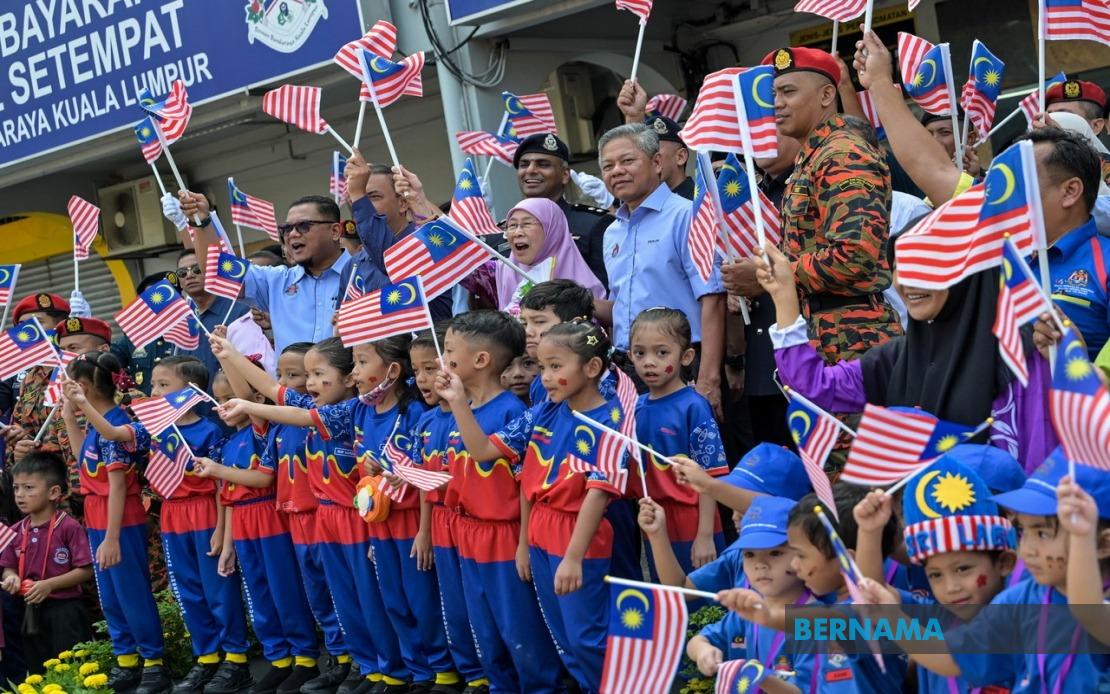
During the Semarak Merdeka Programme in Kuala Lumpur on August 12, Datuk Seri Dr Wan Azizah Wan Ismail, wife of the Prime Minister and Member of Parliament for Bandar Tun Razak, delivered a pointed message about the true meaning of national independence. Rather than viewing Merdeka as merely an occasion for patriotic rhetoric and flag-waving, she characterised independence as a foundational responsibility shared by all citizens to maintain the nation's delicate equilibrium of peace, unity and harmony. The remarks came amid broader national conversations about how Malaysia can sustain social cohesion whilst navigating economic pressures and demographic complexities in an increasingly volatile regional environment.
Dr Wan Azizah underscored that genuine independence transcends surface-level celebrations. The concept encompasses the profound freedoms secured through decades of struggle by earlier generations, as well as the sacrifices those pioneers made in forging a sovereign nation from colonial rule. By reframing independence in these historical and philosophical terms, she sought to reconnect contemporary Malaysians with the foundational principles that underpinned the nation's founding, particularly at a time when younger generations have limited direct memory of pre-independence conditions. This intergenerational bridge proves especially significant in Malaysia's multi-ethnic society, where shared national narratives can either strengthen or fracture social bonds depending on how they are articulated and received.
The event itself was anchored by the government's chosen theme for this year's National Day celebrations: "Malaysia Madani: Jiwa Merdeka" — a slogan designed to encapsulate the administration's policy vision. Dr Wan Azizah explicitly connected this thematic framework to tangible governance priorities including enhancing overall quality of life for ordinary citizens, ensuring equitable distribution of opportunities across regions and demographic groups, and fortifying the foundations of national unity. The Malaysia Madani concept, introduced by the Prime Minister's administration, seeks to position development not merely as economic growth but as a holistic improvement in how citizens experience daily life and access public services.
Bandar Tun Razak, her parliamentary constituency, serves as a microcosm of Malaysia's ethnic diversity. With approximately 191,000 residents distributed across multiple communities — roughly 60 per cent Malay, 24 per cent Chinese, and 8 per cent Indian populations according to the latest Malaysian Population and Housing Census data — the constituency exemplifies the kind of harmonious coexistence that national unity rhetoric frequently invokes. Yet diversity on paper does not automatically translate to functional harmony in practice. Dr Wan Azizah's decision to highlight these demographic specifics alongside her independence message suggests an awareness that maintaining peace in ethnically plural societies requires sustained conscious effort and institutional support, not merely goodwill.
Following the formal proceedings, Dr Wan Azizah conducted welfare visits to residents in two low-cost public housing developments: Seri Pulau Pinang and Desa Tun Razak People's Housing Projects. These grassroots interactions reveal the practical dimensions of her independence message — that national cohesion depends on concrete support systems reaching vulnerable populations. The visits centred on distributing assistance from two key social welfare bodies: the Social Security Organisation (PERKESO) and the Federal Territories Islamic Religious Council (MAIWP). This combination of secular social security and faith-based welfare provision reflects Malaysia's distinctive institutional ecosystem, where religious bodies play defined roles in social safety nets alongside government agencies.
One primary beneficiary was K. Moganavalli, a 39-year-old widow whose household circumstances exemplify the economic precarity facing many Malaysian families. Following the sudden death of her husband, Edwin Anthony Dass, on August 2, Moganavalli found herself responsible for three young children with no independent income stream. Her late husband had worked in occupations typical of Malaysia's informal and gig economy — operating as a commercial driver and delivering food through the Grab platform. The absence of stable employment meant minimal accumulated savings to cushion the family against income shock. PERKESO provided a one-time funeral benefit of RM3,000 and a recurring survivor's pension of RM1,118.33 monthly, supplemented by separate Kotak Prihatin aid. These interventions, while modest in absolute terms, can represent the difference between basic stability and severe hardship for households at the economic margins.
Another welfare recipient, Khalijah Binti Nazir, represents a different vulnerability profile common across Malaysian PPR communities. At 64 years old, Khalijah functions as a single parent supporting two children, one of whom experiences hearing impairment. Caring for a disabled child whilst managing sole household income responsibility compelled her to exit formal employment entirely. She receives RM800 monthly through Baitulmal assistance channels, complemented by RM300 monthly via the Boost eWallet scheme and RM150 under the Sumbangan Asas Rahmah programme. Her son receives an additional RM100 monthly in SARA support. Collectively, these transfers total approximately RM1,350 monthly — substantially below Malaysia's official poverty line but essential to household survival. The fragmentation of assistance across multiple schemes (Baitulmal, Boost, SARA) reflects Malaysia's somewhat dispersed approach to social safety nets, which can create administrative complexity even as it attempts comprehensive coverage.
The cases of Moganavalli and Khalijah illustrate why Dr Wan Azizah's emphasis on independence as shared responsibility carries particular resonance for lower-income Malaysians. For families living in federal territories public housing, independence means little without reliable access to income support, healthcare, and child welfare services. The structural vulnerabilities these households face — sudden loss of income earners, caring responsibilities for disabled family members, age-related exit from labour markets — require institutional safeguards that extend well beyond symbolic celebrations of national sovereignty. This ground-level perspective on what independence means to ordinary Malaysians provides ballast to abstract discussions about national unity conducted in policy forums.
The inclusion of both PERKESO and MAIWP in welfare distribution activities underscores how Malaysia's institutional architecture integrates secular and religious frameworks in social provision. PERKESO, as the statutory body managing Malaysia's social security system, operates on actuarial insurance principles covering employment-related risks. MAIWP, by contrast, distributes zakat and Islamic charitable funds according to religious jurisprudence. That both institutions coordinated in this assistance indicates intentional effort to ensure comprehensive coverage whilst respecting Malaysia's constitutional position of Islam and maintaining secular governance structures. For non-Muslim beneficiaries like K. Moganavalli, this hybrid approach ensures access to support regardless of religious affiliation.
Dr Wan Azizah's framing of independence as requiring active civic participation and institutional support systems represents a significant analytical shift from purely ceremonial or nationalistic interpretations. She implicitly argues that Merdeka celebrations have meaning only insofar as the nation's structures deliver genuine security and opportunity to all residents. This performance of political concern — the welfare visits, the specific statistics about constituency demographics, the connection to government policy themes — suggests an administration attempting to demonstrate that independence day messaging extends beyond rhetoric into material support for vulnerable populations. Whether such initiatives reach sufficient scale and consistency to generate sustained improvement in lived experiences for PPR residents remains an ongoing empirical question, but the framing at least acknowledges that national unity requires institutional delivery, not merely patriotic sentiment.

