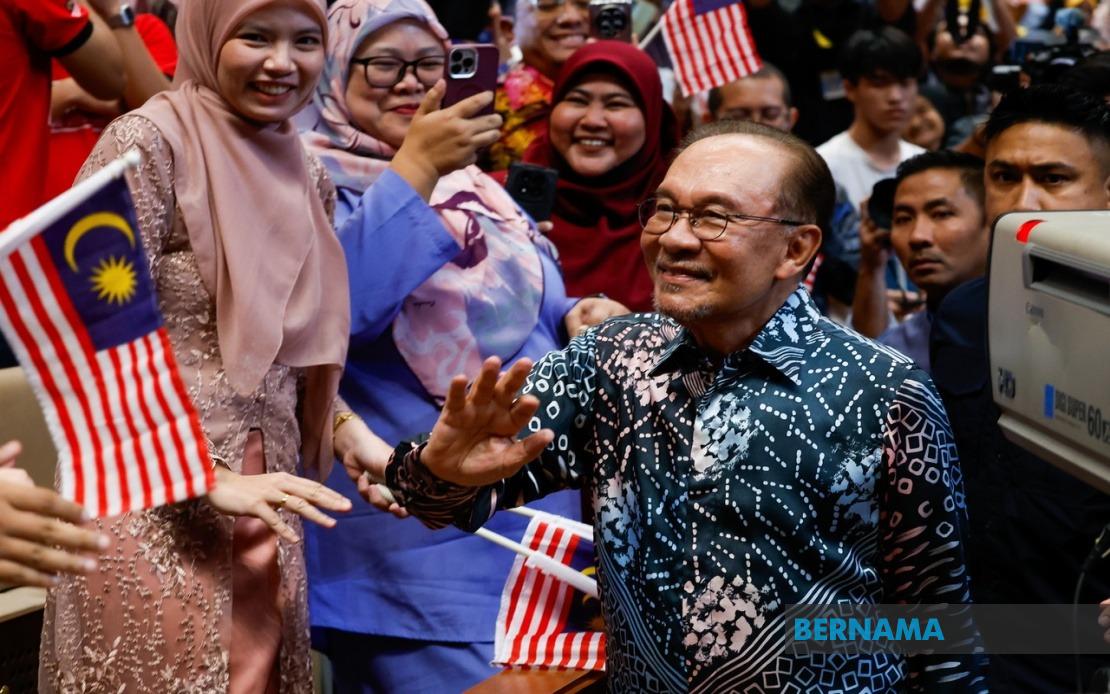
Prime Minister Datuk Seri Anwar Ibrahim has called for Malaysians across all communities to cultivate a deep sense of independence within themselves, positioning this as the cornerstone for national rebuilding and social cohesion. Speaking at the Putrajaya International Convention Centre during the National Day address, Anwar articulated a vision of independence that extends far beyond constitutional autonomy or institutional frameworks, instead emphasising the psychological and moral dimensions of self-determination that must characterise each citizen's approach to civic life.
Anwar's framing of independence as fundamentally an internal disposition rather than merely a political status reflects a nuanced understanding of nation-building in contemporary Malaysia. He suggested that while the country achieved formal independence decades ago, the deeper challenge lies in ensuring that the populace internalises the values and responsibilities that come with self-governance. This interpretation positions independence not as a historical milestone to be commemorated passively, but as an ongoing endeavour requiring active cultivation across generations.
The Prime Minister emphasised that reconstructing the nation from its current difficulties demands a deliberate effort to plant and sustain this spirit of independence in the collective consciousness. His language of rebuilding carries implicit acknowledgment of the governance challenges and social fractures that Malaysia has confronted in recent years, suggesting that renewed national purpose depends upon citizens viewing themselves as independent actors accountable for the nation's trajectory rather than passive subjects awaiting direction from above.
Central to Anwar's message was an inclusive vision of unity that deliberately transcends traditional divisions. He rejected the notion that cohesion must be organised along lines of ethnicity, geography, or administrative boundary, instead invoking the foundational principles articulated by Malaysia's independence-era leaders. His reference to forefathers and their vision suggests a return to the foundational social contract that underpinned the nation's birth, one premised on multiethnic cooperation and mutual respect for diverse communities' roles in the national project.
Anwar specifically highlighted the constitutional position of Malays and Bumiputera as the core foundation of the national framework while simultaneously asserting that all communities bear responsibility for defending rights and upholding justice. This formulation attempts to balance acknowledgment of constitutionally enshrined communal arrangements with an expansive vision of collective citizenship. By framing Malays and Bumiputera leadership as compatible with broader communal participation in nation-building, Anwar sought to position the constitutional settlement not as a source of division but as a platform for shared endeavour.
The emphasis on defending rights and upholding justice suggests that Anwar perceives the nation's contemporary challenges as partly rooted in insufficiently vigilant protection of fundamental freedoms and institutional integrity. His invocation of justice as a collective responsibility indicates that merely establishing systems is insufficient; citizens must actively guard against erosion of these principles through complacency or partisan interests. This framing calls Malaysians to a higher standard of civic engagement than passive enjoyment of rights.
The gathering of senior government figures at the event, including Deputy Prime Minister Datuk Seri Dr Ahmad Zahid Hamidi, Communications Minister Datuk Seri Fahmi Fadzil, and Chief Secretary to the Government Tan Sri Shamsul Azri Abu Bakar, underscored the government's investment in National Day messaging as a moment for articulating its governing philosophy and vision for national direction. The presence of the communications apparatus suggests deliberate effort to ensure the Prime Minister's message reaches and resonates with the broader Malaysian public.
For Malaysian readers navigating an increasingly complex political and social landscape, Anwar's emphasis on independence as an internal state of mind offers a particular reading of citizenship. Rather than independence being something granted or maintained by institutions alone, it becomes something each individual must cultivate through their own commitment to ethical conduct, defence of collective rights, and participation in justice. This distributes responsibility for national wellbeing across the entire population rather than concentrating it in government hands.
The resonance of this message extends across Southeast Asia, where many nations similarly grapple with balancing diverse communal interests within postcolonial frameworks. Malaysia's experience with multiethnic nation-building has long attracted regional attention, and Anwar's articulation of inclusive independence offers a model emphasising continuity with founding principles while projecting forward to contemporary challenges. His framing suggests that the path to addressing current national difficulties lies not in abandoning the constitutional arrangements that undergird the nation, but in revitalising the spirit of shared purpose that ideally animated them from inception.
Looking forward, the Prime Minister's emphasis on generational transmission of independence values carries implications for how Malaysia cultivates citizenship among younger cohorts increasingly distant from the independence struggle itself. By situating the independence spirit as something requiring continuous nurturing rather than historical assumption, Anwar positioned the government's educational and cultural institutions as responsible for ensuring that each new generation internalises the civic virtues and commitment to justice that he identified as essential to national survival and prosperity.

