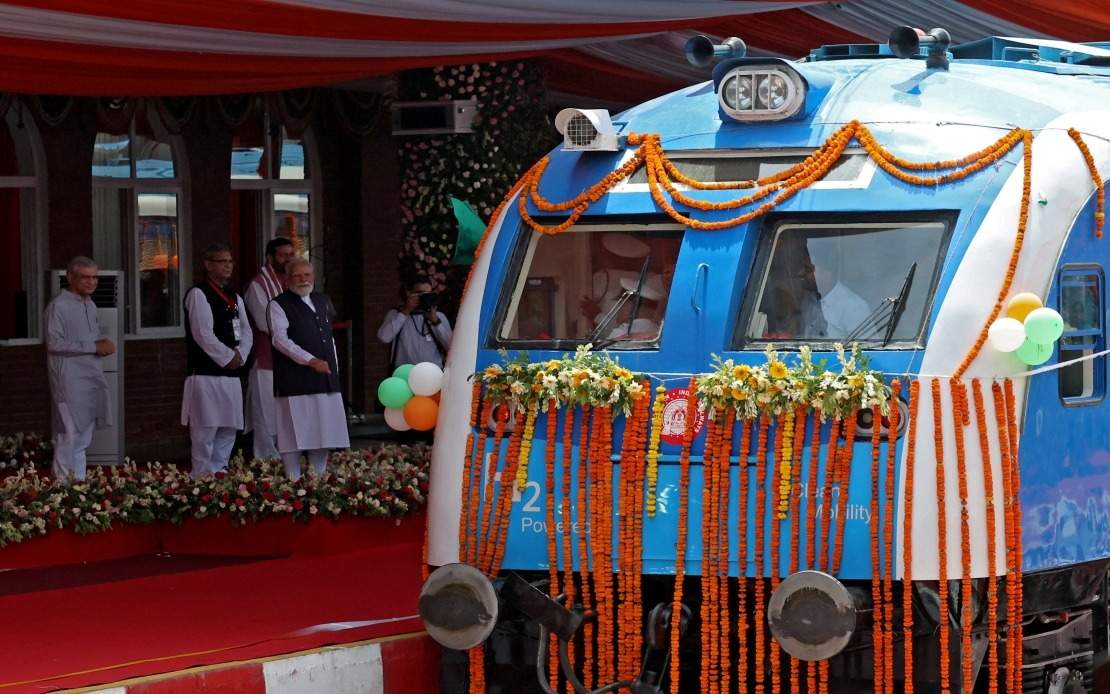
India has entered the hydrogen-powered rail era with the inauguration of its first operational hydrogen train, a milestone that positions the country alongside developed nations in sustainable transport technology. Prime Minister Narendra Modi formally launched the service on Friday, marking a pivotal moment for Indian railways as they transition away from traditional diesel-powered rolling stock. The 10-coach train will operate along the 89-kilometre corridor connecting Jind and Sonipat in Haryana state, a region in northern India with significant freight and passenger traffic potential.
The development represents more than a symbolic achievement for India's infrastructure ambitions. This is the first instance of indigenously developed hydrogen fuel cell technology being deployed in Indian railway operations, signalling a growing capability in advanced clean-tech manufacturing and engineering within the country. The successful implementation on a domestic route underscores India's capacity to design, build, and operate frontier technologies without complete reliance on foreign expertise or imports, a consideration that resonates across the region where countries are increasingly focused on localising green technology capabilities.
At the technical core of this system sits a 1,200-kilowatt Proton Exchange Membrane Fuel Cell, which functions through an electrochemical process combining hydrogen and oxygen to generate electricity. The elegance of this approach lies in its simplicity and environmental benefit: the only exhaust products are water vapour and heat, eliminating the particulate matter, nitrogen oxides, and carbon emissions that characterise conventional diesel locomotives. This represents a fundamental shift in how Indian railways can address air quality concerns in densely populated urban and industrial areas along rail corridors.
The hydrogen train has been certified for operation at maximum speeds of 75 kilometres per hour, though its design specification permits velocities up to 110 km/h, providing operational flexibility for future route deployments or performance enhancements. This conservative initial approach reflects prudent engineering practice for emerging technologies, allowing operators to accumulate real-world performance data and build maintenance expertise before expanding the fleet or increasing operational demands. The speed parameters make this particularly suitable for the Jind-Sonipat route, which serves as an intermediate corridor rather than a high-speed express line.
India's entry into hydrogen rail technology places it within an exclusive cohort of nations that have successfully deployed such systems at operational scale. China, Germany, Japan, and the United States have all progressed beyond pilot projects to integrate hydrogen trains into their respective rail networks. Each nation pursued this technology for distinct reasons: Germany prioritised reducing diesel emissions in rural areas with electrification-resistant routes; Japan leveraged its hydrogen infrastructure development; the US focused on freight applications; and China rapidly scaled deployment across multiple regions. India's approach appears calibrated to address both urban air quality challenges and the logistics demands of its rapidly expanding economy.
The implications for Southeast Asia extend beyond India's borders. Regional countries watching India's experience with hydrogen technology will gain valuable insights into operational costs, maintenance requirements, and reliability metrics that could inform their own transport decarbonisation strategies. Malaysia, Indonesia, Thailand, and Vietnam—all grappling with urban air quality and the need to modernise ageing rail infrastructure—will likely monitor this deployment closely. Should the Jind-Sonipat service prove economically and operationally viable, it could establish a credible regional alternative to imported European hydrogen train systems, potentially lowering adoption barriers for neighbouring nations.
The economic context is equally important. Hydrogen infrastructure remains underdeveloped across South Asia, presenting both a constraint and an opportunity. For India, advancing hydrogen train technology simultaneously creates pressure and incentive to develop hydrogen production, distribution, and storage capabilities—industries that could generate employment and attract investment. The railway sector's adoption of hydrogen could serve as an anchor demand that justifies infrastructure investment in green hydrogen production, potentially using renewable electricity to generate hydrogen through electrolysis at competitive costs within the next decade.
Operational sustainability presents another consideration. Hydrogen trains require different maintenance protocols, training requirements, and supply chain logistics compared to diesel or electrified rail. Indian Railways will need to develop new competencies within its workforce and establish protocols for safe hydrogen handling and storage at depot facilities. The learning curve from this initial 10-coach train will be critical for scaling to larger, more complex multi-unit formations that could eventually replace diesel traction across broader sections of the Indian rail network.
The environmental calculus depends significantly on how the hydrogen is produced. If generated from natural gas through conventional steam reforming, the lifecycle emissions reduction compared to diesel is substantial but not revolutionary. However, if powered by green hydrogen produced through renewable-powered electrolysis, the environmental credentials become transformative. India's ambitious solar and wind capacity expansion provides a potential pathway toward genuinely carbon-neutral hydrogen production, though current costs remain elevated compared to conventional methods. The trajectory of this technology's carbon footprint will largely determine its long-term strategic value in India's broader decarbonisation framework.
From a geopolitical perspective, India's advancement in hydrogen rail technology reinforces its positioning as a technology innovator and manufacturing hub within Asia. In an era where clean technology leadership increasingly defines strategic influence, demonstrating indigenous capability in hydrogen systems—a technology domain long dominated by developed economies—enhances India's soft power and credibility in climate commitments. This becomes particularly significant given India's prominent role in global climate negotiations and its emphasis on technology transfer to developing nations.
The path forward remains contingent on multiple factors. Commercial viability will depend on hydrogen fuel costs remaining competitive with diesel over the operational lifetime of the equipment. Passenger and freight operators must perceive clear advantages in switching to hydrogen, whether through reduced operating costs, improved service quality, or environmental credentials that justify premium pricing. Regulatory frameworks will need to evolve to accommodate hydrogen handling and safety standards across rail networks.
India's hydrogen train represents a measured but meaningful step toward transforming one of Asia's largest rail networks. Whether this becomes a transformative precedent or remains a isolated showcase will depend on sustained investment, infrastructure development, and demonstrated operational success. For the broader region, this development serves as a tangible proof point that hydrogen rail technology is not merely a distant aspiration for wealthy nations, but an achievable near-term reality for large, resource-constrained emerging economies navigating the transition to sustainable transport systems.

