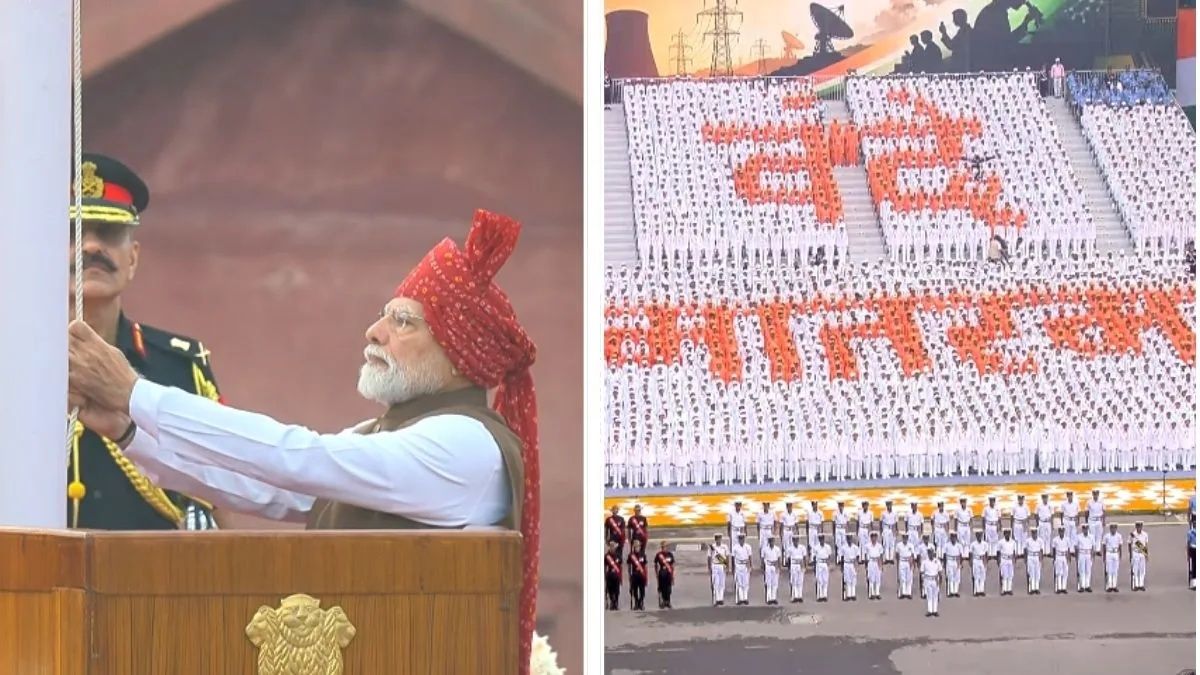
Prime Minister Narendra Modi has articulated a sweeping long-term development agenda for India, positioning 2047—the centennial year of the nation's independence—as the target date for transforming the country into a fully developed economy. Speaking from the Red Fort during India's 80th Independence Day celebrations on August 15, Modi positioned this aspiration as a defining national mission that would reshape how the world perceives India and mobilise its 1.4 billion citizens around a common purpose.
The framing of this goal carries particular resonance for the region. As Southeast Asian nations grapple with their own developmental trajectories, India's explicit commitment to developed-nation status by 2047 signals a geopolitical realignment that could reshape regional power dynamics and economic structures. For Malaysia and other ASEAN economies competing for investment and technological partnerships, this declaration underscores India's determination to graduate from its current position as a developing economy into the upper echelon of global powers within the next two decades.
Modi's central message emphasised psychological transformation as much as material progress. He exhorted Indians to abandon modest ambitions and embrace expansive thinking, arguing that incremental goals would prove inadequate for a nation of India's scale and potential. This rhetorical pivot—from accepting India's place within the existing global order to demanding a fundamentally elevated position—reflects a strategic recalibration of national priorities that extends beyond conventional economic planning. The Prime Minister's assertion that "small dreams will no longer suffice" encapsulates a philosophical repositioning of how India views itself and its role internationally.
The government's economic record over the preceding twelve years provided the statistical foundation for Modi's optimistic vision. Defence manufacturing capacity has quadrupled, whilst Khadi and Village Industries production increased five-fold. Electronic goods manufacturing expanded seven-fold, demonstrating India's capacity to establish competitive advantages in sectors beyond traditional agricultural export. Mobile phone production surged by one-third, and digital transaction volumes doubled—metrics suggesting India's ongoing digitalisation and integration into modern economic frameworks.
These sectoral achievements carry significance for regional supply chain integration. India's expanding defence production capacity and electronics manufacturing prowess position it as a potential alternative to China-dominated manufacturing networks, an consideration of direct relevance to ASEAN members seeking to diversify trade partnerships. The emphasis on digital transactions reflects India's deployment of technological infrastructure that could facilitate financial inclusion and cross-border commerce throughout South Asia and potentially across the broader Indo-Pacific region.
Modi acknowledged India's earlier vulnerability to economic volatility, referencing the country's past classification among the "Fragile Five"—a designation applied to emerging markets perceived as susceptible to capital outflows and currency depreciation. By explicitly noting this transition from precarious positioning to secure major-economy status, the Prime Minister framed the 2047 vision not as utopian fantasy but as a natural extension of recent trajectory and demonstrated capacity. This contextual grounding provided rhetorical credibility to long-term projections that might otherwise appear speculative.
A symbolic dimension of the address involved the complete rendition of "Vande Mataram," India's national song, at the Red Fort—described as occurring for the first time since independence in 1947. Modi characterised this musical moment as historically significant, suggesting that cultural elements retained contemporary relevance to national identity formation and collective mobilisation. For regional observers, such symbolic politics indicate India's commitment to ideological cohesion alongside economic restructuring, reflecting a holistic conception of national development that encompasses cultural preservation and political consciousness.
The Prime Minister's remarks incorporated acknowledgment of immediate humanitarian challenges, specifically flooding affecting multiple regions. By connecting long-term visionary goals with present-day crisis response, Modi attempted to establish governmental competence across temporal scales—demonstrating capacity to manage both immediate emergencies and multi-decade strategic planning. This framing suggested that the 2047 vision remained grounded in practical governance rather than abstract theorising, though the balance between grand aspiration and ground-level implementation remained implicit rather than detailed.
The political implications of this announcement extend beyond India's borders. By articulating a specific timeline for achieved developed status, Modi established measurable benchmarks against which government performance could be evaluated—a potentially risky rhetorical strategy if economic growth falters or geopolitical circumstances deteriorate. Conversely, the declaration mobilises political support around a unifying objective transcending regional, religious, and ideological divisions within India's complex political landscape.
For Malaysia and Southeast Asia more broadly, India's development vision carries practical implications. An India successfully transitioning to developed-nation status would represent the world's largest economy achieving such transformation, with consequences for labour markets, capital flows, and technological competition. ASEAN economies would encounter either heightened competition for foreign direct investment and skilled workers, or alternatively, enhanced opportunities through technology transfer and deepened economic integration should India pursue regional partnership frameworks.
The 2047 vision also reflects implicit demographic recognition. India's large youthful population represents both opportunity and challenge—successful development requires channeling youth into productive economic participation rather than unemployment or social discontent. Modi's emphasis on bigger ambitions potentially appeals to generational aspirations, positioning development goals as vehicles for individual opportunity rather than abstract national objectives.
Underlying the Independence Day address lay an assumption that national consensus could be maintained around a development-focused agenda spanning multiple electoral cycles and political administrations. Whether subsequent governments sustain this strategic focus, and whether economic policies effectively translate rhetoric into measurable progress across development indicators, will determine whether 2047 represents achievable milestone or unfulfilled aspiration. For regional observers monitoring India's trajectory, the coming years will reveal whether this declared vision reshapes economic geography or joins the historical catalogue of ambitious but unrealised national projects.

