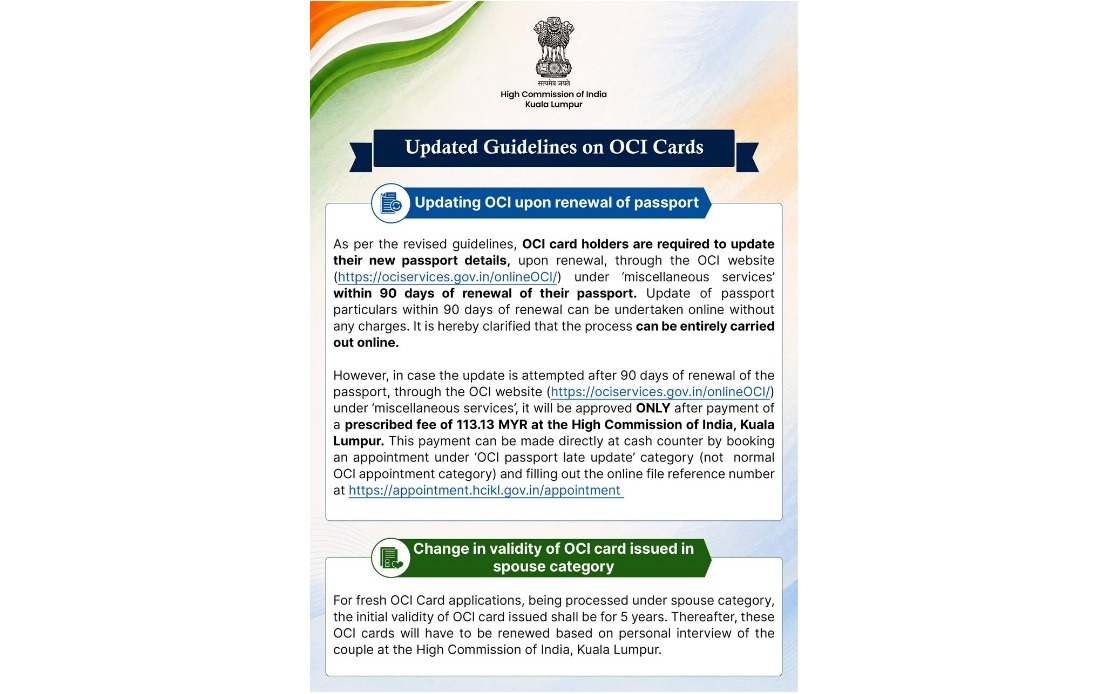
The High Commission of India in Kuala Lumpur has rolled out a revised set of administrative procedures governing how Overseas Citizen of India (OCI) cardholders must manage their documentation following passport renewal. The new guidelines, announced through the mission's official social media channels, introduce clearer timelines and cost structures that will affect the substantial population of Indian diaspora members residing in Malaysia who hold this visa-free travel status.
At the heart of the updated requirements is a 90-day grace period during which OCI cardholders can update their passport information at no cost. This administrative window begins from the date of passport renewal and allows cardholders to synchronise their OCI records with their new travel document entirely through the online portal. The High Commission emphasises that this process requires no physical visit to the mission, representing a modernisation of procedures that previously involved more cumbersome in-person requirements.
Cardholders who fail to meet this 90-day deadline will face financial penalties. Any passport updates attempted beyond this window incur a prescribed fee of RM113.13, payable at the High Commission's cash counter in Kuala Lumpur. This fee structure creates a meaningful incentive for timely compliance, though it remains substantially less burdensome than some previous administrative penalties. The payment process requires applicants to first secure an appointment specifically categorised as "OCI passport late update" rather than the standard OCI appointment category, and they must provide the online file reference number generated during their initial update application.
The updated guidelines specify that all modifications to passport particulars should be processed through the OCI website under the "miscellaneous services" section. This digital-first approach reflects broader trends across Indian government services to reduce dependency on physical infrastructure and expedite processing. For Malaysian residents who may find themselves geographically distant from the High Commission's office or managing their documentation across multiple jurisdictions, the entirely online option represents meaningful convenience.
Beyond passport update procedures, the High Commission has introduced significant changes to the OCI card validity structure for applications submitted under the spouse category. Historically, OCI cards issued to spouses of Indian citizens or OCI cardholders have operated under different renewal protocols than standard OCI applications. Under the revised framework, newly approved spouse-category OCI applications will receive an initial validity period of five years, a modification from previous arrangements that may have offered longer or indefinite terms.
The shift to a five-year initial validity period introduces an important structural change in how spousal applications are processed. Rather than permitting straightforward renewal through standard online mechanisms, the High Commission now mandates that both spouses appear together for a personal interview at the mission's office when seeking renewal after the initial five-year validity expires. This requirement underscores the mission's commitment to verifying the continued validity of spousal relationships and ensuring that OCI status remains appropriately held.
The personal interview requirement for spouse-category renewals has practical implications for couples living in Malaysia or splitting time between multiple countries. Unlike the streamlined online procedures available for standard OCI renewals, this mandate necessitates coordinated travel to Kuala Lumpur and scheduling around the High Commission's appointment availability. For couples where one spouse may be travelling extensively or where logistical coordination proves challenging, this represents a more rigorous administrative engagement than previously required.
These revised guidelines were communicated directly through the High Commission's official appointment portal and the centralised OCI website, ensuring that applicants can access comprehensive information about both procedural changes and implementation dates. The mission has positioned these revisions as clarifications rather than dramatic policy reversals, though the introduction of fees for late updates and the interview requirement for spousal renewals do represent material changes to the operational framework governing OCI status in Malaysia.
For the Indian expatriate community in Malaysia—comprising professionals, business owners, academics, and retirees who have chosen to maintain OCI status rather than seek permanent settlement—these changes introduce new administrative rhythms that require attention. The 90-day window for free updates essentially requires that cardholders maintain awareness of their passport renewal dates and process updates promptly, a discipline that may be unfamiliar to those accustomed to indefinite OCI validity. The shift toward mandatory interviews for spousal renewals also suggests a recalibration of how India's government weights administrative efficiency against verification of eligibility criteria.
From a broader regional perspective, these procedural updates reflect how Indian consular services throughout Southeast Asia are modernising their administrative infrastructure while simultaneously introducing more structured compliance mechanisms. Malaysia, as home to one of Southeast Asia's larger Indian diaspora populations and a major hub for regional business and professional activity, represents a significant jurisdiction where such changes have meaningful implications. The High Commission's communications approach—emphasising the free, online nature of compliant updates while imposing fees and interview requirements for non-compliance—suggests a deliberate effort to encourage proactive engagement from cardholders.
The practical timeline for these changes remains important for affected individuals. Those holding OCI cards in any category should verify whether their passport renewal falls within the 90-day window or requires late-update procedures, and those seeking spouse-category applications or renewals should understand the new interview requirements. The High Commission has positioned its official website and appointment portal as the primary information resources, though applicants may benefit from directly contacting the mission for clarification on individual circumstances given the specificity of the requirements.

