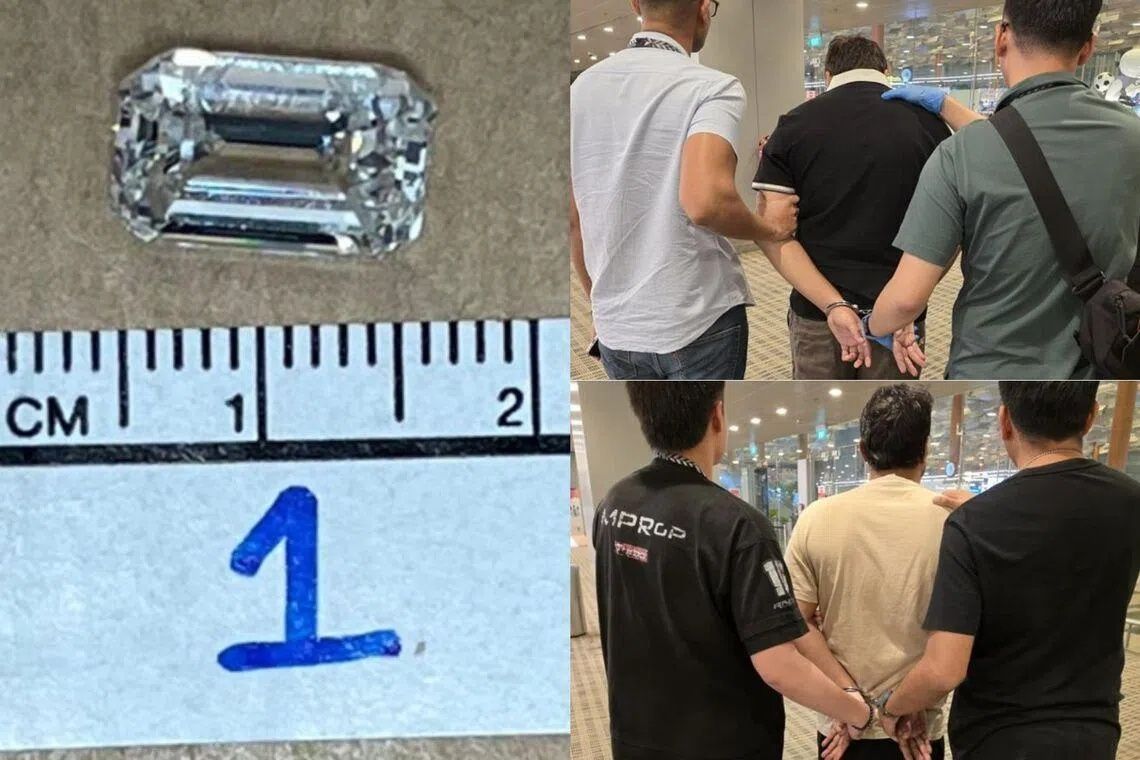
An Indian national has been sentenced to more than two years in prison following his conviction in a meticulously planned jewellery heist that unfolded in Singapore's Chinatown district. Mangroliya Manojkumar Kurjibhai, 41, received a sentence of two years, two months and two weeks on Friday, July 17, after entering a guilty plea to theft charges stemming from the June 19 incident at Dianoche jewellery store located on Kreta Ayer Road. The case highlights the increasing sophistication of international jewellery theft operations and the security challenges facing retail establishments in major tourist destinations across Southeast Asia.
The elaborate scheme involved meticulous preparation spanning weeks before the pair arrived in Singapore. According to court documents presented by State Prosecuting Officer Yip Cheng Yee, Kurjibhai and his accomplice Serasiya Milan Ramnikbhai, 30, had commissioned a counterfeit diamond in India that precisely matched the specifications and serial number of the genuine 4.95-carat stone they intended to steal. While the method by which they identified the specific diamond at the Chinatown store was not disclosed in court, the level of detail in their planning suggests prior reconnaissance or information from insiders familiar with the jewellery establishment's inventory.
The two tourists executed their plan on the same day they arrived in Singapore, demonstrating the time-sensitive nature of their operation. Court records indicate both men entered the country on June 19 and proceeded directly to the Dianoche store at approximately 3pm that afternoon. Serasiya had concealed the fabricated diamond inside his mouth before they entered the premises, a technique that evaded initial visual detection and allowed them to proceed with their scheme without raising suspicion from store staff during their initial interaction.
Once inside the store, Kurjibhai engaged the sales manager by expressing interest in examining the diamond, which carried a valuation of US$154,000, equivalent to over S$199,000. The accused tourist then deliberately extended the viewing process by requesting to inspect several additional items from the store's collection. This calculated behaviour served a dual purpose: it kept the sales manager engaged in multiple trips to retrieve merchandise whilst the genuine diamond remained unattended and vulnerable to substitution. The strategy reveals an understanding of retail operations and the patterns of jewellery store staff during customer interactions.
According to the prosecutor's account, Kurjibhai signalled to Serasiya to execute the swap at an opportune moment. Serasiya then expelled the counterfeit diamond from his mouth and successfully substituted it for the genuine gemstone, which he then concealed in the same manner. The brazen nature of the exchange, occurring within the store's premises whilst staff attended to other customers, underscores the audacity of the perpetrators. After completing the substitution, Kurjibhai informed the sales manager that they would deliberate on the purchase and both men casually departed the store with the real diamond hidden in Serasiya's mouth.
The store's security systems ultimately proved instrumental in exposing the theft. The jewellery establishment's closed-circuit television captured the entire exchange, providing prosecutors with clear visual documentation of the criminal activity. When the sales manager subsequently examined the diamond left behind using an optical gemstone identification machine, the device immediately revealed the substitution. The manager recognised that the stone in his possession was indeed a sophisticated counterfeit, triggering a notification to authorities about the theft.
Despite their careful planning, the criminals' exit strategy proved insufficient to evade law enforcement. After leaving the store, both men checked out of their hotel accommodation and proceeded to book return flights to India, clearly intending to leave the country with their stolen prize that same evening. However, officers from Singapore's security forces apprehended them at Changi Airport Terminal 3 at approximately 9pm, just hours before their scheduled departure. The prompt recovery of the genuine diamond from Serasiya's haversack confirmed the authorities' suspicions and provided the physical evidence necessary to prosecute the case.
The sentencing of Kurjibhai carries significant implications for organised retail crime across Southeast Asia's major commercial centres. The case demonstrates that international tourist networks engaged in high-value theft operations are not deterred by the sophisticated security measures typical of reputable jewellery retailers in the region. The use of counterfeit materials, advance coordination, and rapid execution suggests this may represent one component of a larger criminal operation targeting luxury goods across multiple jurisdictions and tourist destinations.
Under Singapore law, the offence of theft carries a maximum penalty of seven years imprisonment and fines, making Kurjibhai's sentence relatively lenient given the circumstances and premeditation involved. The fact that his accomplice Serasiya's case remains pending suggests prosecutors may be negotiating further cooperation regarding any broader criminal network connections or similar schemes. For Malaysian business operators and jewellery retailers, this case serves as a cautionary reminder regarding the necessity of rigorous staff training, enhanced verification procedures for gemstone authenticity, and coordination with law enforcement regarding suspicious customer behaviour.
The incident underscores the growing complexity of transnational crime affecting Southeast Asian tourism hubs and commercial districts. As luxury retail establishments across the region continue expanding their operations to cater to increasing tourist footfall, security protocols and detection technologies must evolve correspondingly. The successful apprehension and prosecution of Kurjibhai represents a notable victory for regional law enforcement cooperation, yet the sophistication of the attempted theft suggests similar schemes may be attempted elsewhere throughout Southeast Asia unless jewellery retailers collectively strengthen their defences against such organised criminal activities.

