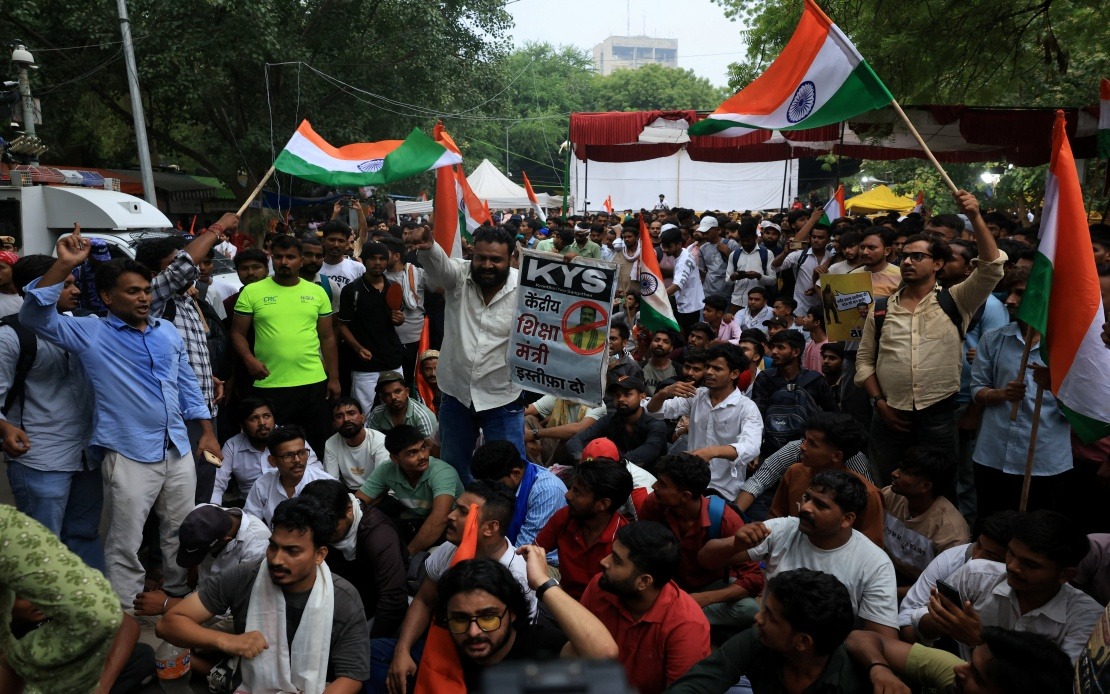
Thousands of demonstrators descended on New Delhi on Monday in a coordinated push toward the Indian parliament building, testing the limits of police tolerance as officers deployed crowd-control tactics to prevent the crowds from breaching security perimeters. The march, organized under the banner of "Sansad Chalo" (a direct translation meaning to proceed toward parliament), highlighted the increasingly vocal demands from India's youth constituency for substantial restructuring of the nation's academic framework. Police had previously imposed restrictions on public gatherings in the capital, making the protesters' determination to proceed with their demonstration a deliberate act of civil defiance against administrative barriers.
The movement driving the demonstration represents an emerging political force in Indian politics—a digitally-connected youth coalition claiming millions of online adherents across social platforms. This demographic, energized through internet organizing and social media mobilization, has chosen to escalate beyond virtual activism to physical protest, suggesting a deepening frustration with the current state of India's educational infrastructure. The protesters' specific grievances center on systemic deficiencies they argue plague the academic system, though the movement has articulated these concerns primarily through digital channels before translating them into street action.
Timing proved particularly significant, as the confrontation occurred on the opening day of the Monsoon Session of the Indian Parliament, when political institutions are conducting full operations and legislative activity is at peak intensity. Prime Minister Narendra Modi's departure from the parliament complex in a secure convoy underscored the security implications authorities assigned to the gathering, demonstrating that even routine parliamentary proceedings were disrupted by the need to manage external crowd dynamics. The coordination between protest timing and parliamentary schedule suggests strategic planning by organizers intent on maximizing political visibility.
The tension between protesters and law enforcement escalated as demonstrators pressed beyond established police barricades, creating scenes of physical friction that required sustained police intervention. These crowd-control operations underscore the recurring challenge facing Indian authorities managing public dissent in the capital, particularly when demonstrations target the symbolic center of democratic governance. The scale of attendance—thousands strong—indicates substantial popular support for the education reform agenda, even among segments willing to endure police confrontation to voice their concerns.
India's academic system has faced mounting criticism from multiple quarters in recent years, with concerns spanning curriculum relevance, teacher training standards, examination pressures, and alignment between educational outcomes and employment market demands. Young Indians increasingly perceive the existing framework as outdated and insufficiently responsive to emerging skill requirements in rapidly evolving sectors like technology and digital innovation. The education sector remains a politically resonant issue across Indian society, touching middle-class aspirations, parental concerns, and youth employment prospects simultaneously.
For Malaysian observers, India's education protest movements carry instructive parallels and contrasts worth examining. Like India, Malaysia maintains centralized national education frameworks and periodic calls for systemic reform, yet the mechanisms through which such demands are articulated differ substantially across the two nations. The Indian protest demonstrates how youth movements can mobilize substantial numbers through digital organization before transitioning to institutional pressure through direct action, a pattern increasingly evident across South Asian democracies grappling with generational change and institutional adaptation.
Security assessments triggered by the protest extended across multiple key locations throughout New Delhi, reflecting official concerns that education-focused dissent might spark broader political mobilization or inspire similar demonstrations by other constituencies with grievances. The tightening of security measures signals official wariness about the potential contagion effects of successful protest movements, particularly those claiming extensive online constituencies that could rapidly scale participation if initial demonstrations achieve visibility and perceived legitimacy.
The Monsoon Session itself typically addresses significant legislative business, including parliamentary discussions on budgetary allocations and policy initiatives. The timing of the education protest, therefore, forces parliamentarians to engage with constituent demands at precisely the moment when education funding and policy remain under active deliberation. This convergence between protest action and legislative scheduling amplifies the political pressure on decision-makers to acknowledge and respond to the academic reform agenda.
Looking forward, the success or failure of this protest movement to extract substantive policy commitments will likely influence both the trajectory of India's education reform debate and the appetite of youth movements to engage in similar parliamentary-targeted demonstrations. The Indian government's response—whether dismissive, accommodating, or repressive—will signal the political space available for institutional challenges and could catalyze either escalation or demobilization of the emerging youth political formation. For regional observers including those in Southeast Asia, the Indian experience provides a case study in how digitally-native youth constituencies are reshaping political engagement and institutional pressure tactics across democratic systems.

