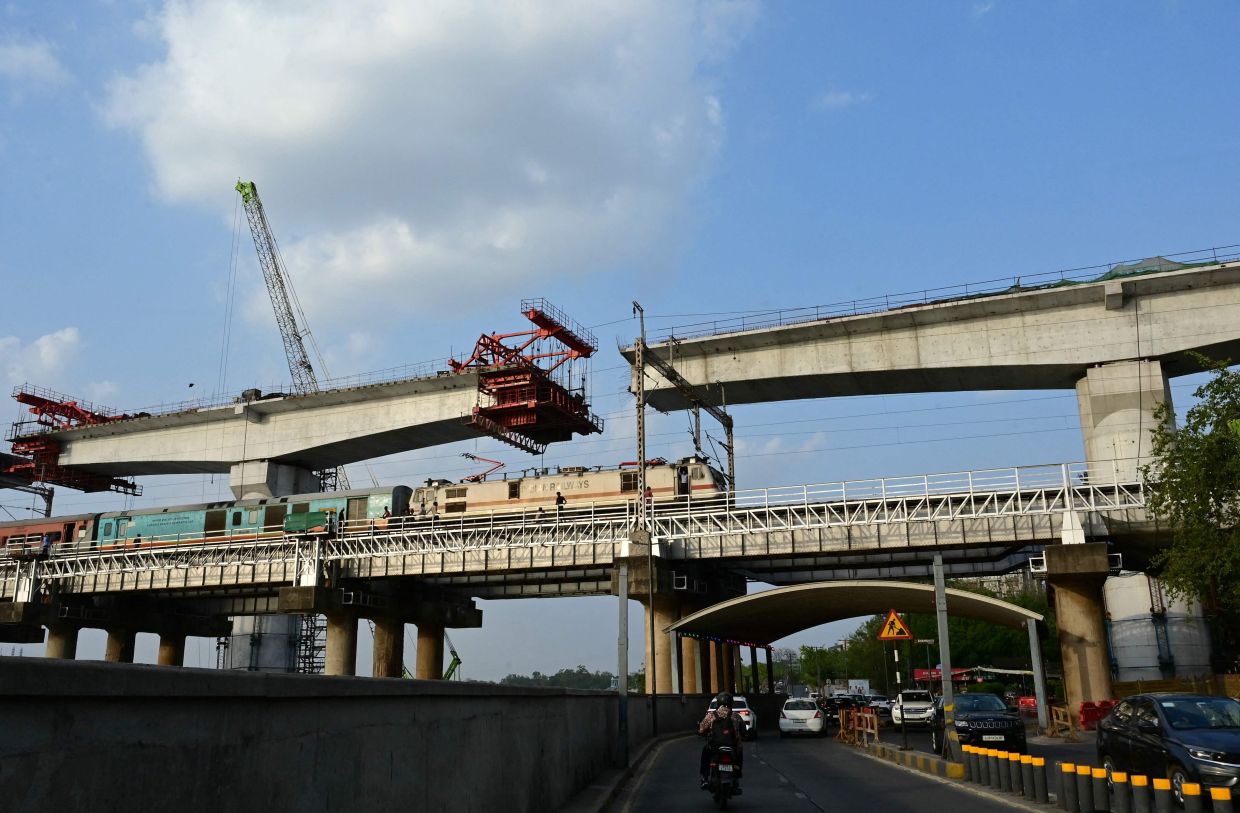
India's ambitious venture into high-speed rail is finally gathering momentum after nearly a decade of construction delays and cost complications. Railway officials have confirmed that the inaugural segment of the Mumbai-Ahmedabad High Speed Rail Corridor will commence operations in 2027, representing a watershed moment for the country's infrastructure aspirations. This partial opening, set between the industrial cities of Surat and Vapi—separated by roughly 100 kilometres—will serve as the testing ground for Japan's renowned Shinkansen technology adapted to Indian conditions, according to Dharmendra Tewari, additional director general of Indian Railways.
The broader 508-kilometre west coast corridor has been envisioned as a transformative project for India's transport landscape since its formal launch in 2017 by then-Prime Minister Narendra Modi and Japanese counterpart Shinzo Abe. What was originally scheduled for completion in 2023 has slipped significantly, reflecting the inherent complexities of executing megaprojects in a densely populated nation. The government pegs the total cost at US$17 billion, with Japan extending an 81 per cent loan through the Japan International Cooperation Agency (Jica), though Indian media sources suggest land acquisition expenses and project postponements may inflate the final bill considerably.
For Southeast Asian observers, India's high-speed rail ambitions carry broader regional significance. The project demonstrates how major emerging economies are investing in modern transport infrastructure to support economic growth and regional integration—a pattern increasingly visible across Asia. When fully operational, the bullet train will drastically compress travel time between Mumbai, India's financial powerhouse with 22 million residents, and Ahmedabad, the industrial heartland of Gujarat state. The journey that currently requires six hours by conventional rail or four to five hours by air—factoring in airport procedures—will be reduced to just under two hours at design speeds of 350 kilometres per hour.
Surat, the nexus of India's global diamond-cutting industry, and Vapi, a chemicals and manufacturing hub, represent precisely the kind of inter-city economic corridors that high-speed rail is designed to unlock. The completion of the full route by end-2028 has been strategically timed to coincide with Ahmedabad hosting the 2030 Commonwealth Games, an event widely perceived as a stepping stone towards India's stated objective of hosting the 2036 Olympics. This synchronisation between infrastructure development and major sporting events reflects how governments leverage such occasions to drive modernisation.
The technical challenges undertaken in this corridor are formidable and instructive for other nations planning similar projects. The route incorporates a 21-kilometre tunnel burrowing through mountainous terrain, alongside India's first undersea rail tunnel—an engineering undertaking still in progress. These specifications underscore the investment magnitude and complexity involved in establishing true high-speed rail networks within geographically challenging landscapes. The successful completion of these segments will generate valuable technical expertise and operational knowledge that India aims to leverage across subsequent corridors.
India's railway sector has undergone extraordinary transformation since the first steam locomotive departed from what is now Mumbai in 1853. Contemporary Indian Railways operates one of the world's most extensive networks, spanning approximately 85,000 kilometres with roughly 80 per cent of lines now capable of speeds exceeding 110 kilometres per hour. The system transported 7.41 billion passengers and 1.67 billion tonnes of freight in the previous year alone, making it a critical backbone for a nation of 1.4 billion people. The government has channelled vast resources into modernising this inheritance from the colonial period, addressing safety deficiencies that historically plagued the network.
The domestically developed Vande Bharat trains, capable of reaching 180 kilometres per hour, have become flagship symbols of India's manufacturing prowess in rail technology. Nearly 40 million passengers utilised these services in the past year, validating the market appetite for improved speed and comfort. However, the bullet train with its 320-kilometre-per-hour operational speed represents a qualitative leap—a demonstration that India can operate world-class high-speed systems rather than merely adopting foreign technology passively. This distinction matters for Indian policymakers seeking to position the nation as a technological peer within Asia.
The government's vision extends substantially beyond the Mumbai-Ahmedabad corridor. Officials have outlined ambitions for seven high-speed rail corridors spanning approximately 4,000 kilometres, networks they describe as "growth connectors" intended to integrate key metropolitan zones and facilitate seamless movement of people and commerce. These proposals remain primarily conceptual at present, lacking defined timelines or committed funding, yet they signal the scale of India's aspirations. The network would include an east-west axis linking New Delhi to Varanasi—Modi's parliamentary constituency and Hinduism's holiest city—extending through to Siliguri, the crucial juncture connecting India's northeastern states to the broader nation.
A north-south route from Ahmedabad to Mumbai would subsequently branch southeastward through Pune, connecting the technology hubs of Hyderabad and Chennai. Such a network would fundamentally reshape inter-regional travel patterns and economic interactions across Indian states. For regional analysts, these projections demonstrate how India is attempting to construct an integrated transport backbone comparable to high-speed rail systems in East Asia and Europe—a aspiration that, if realised, would redefine mobility and commerce across the subcontinent.
The knowledge, capabilities and operational expertise acquired through constructing and managing the initial corridor will prove instrumental in executing these subsequent phases, government planners contend. The Surat-Vapi opening thus represents far more than a single railway segment; it constitutes the foundational validation of India's capacity to build, operate and maintain world-standard high-speed rail infrastructure. The project's progression over coming years will offer crucial insights into whether India can successfully replicate this model across multiple corridors and diverse geographical terrains.
Timing remains crucial, particularly with Japanese Premier Sanae Takaichi, identified as protégé of original project champion Shinzo Abe, scheduled for a three-day visit from Wednesday. Such diplomatic engagement typically reaffirms bilateral commitment to flagship collaborative projects and may signal Japanese confidence in the corridor's ultimate completion despite accumulated delays. The 2027 partial opening and target 2028 completion would vindicate the enormous investment—financial and diplomatic—expended thus far, while positioning India as a serious regional player in high-speed rail technology and operations. For the broader Indo-Pacific region, successful execution would demonstrate that emerging economies can execute infrastructure projects of comparable sophistication to developed nations, a message with implications extending well beyond railways.

