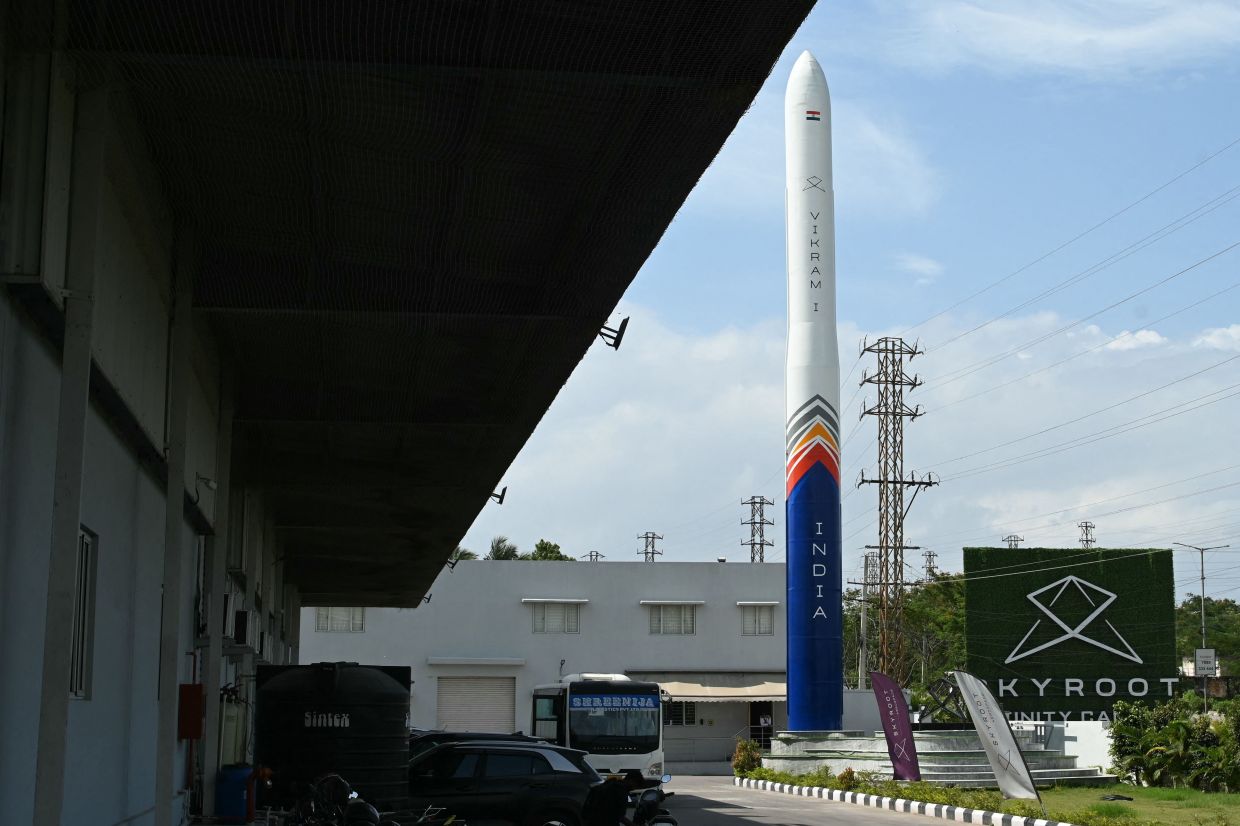
India is on the cusp of a defining moment for its commercial space ambitions. Within weeks, Skyroot Aerospace plans to conduct a maiden test flight of the Vikram-1 rocket from the Sriharikota launch facility, a milestone that would crown nearly two decades of steady progress in the Indian space programme and signal the maturation of a private sector that barely existed five years ago.
The timing underscores how dramatically India's space economy has evolved since the government opened the sector to private investment in 2020. What was once the exclusive domain of the Indian Space Research Organisation (ISRO) has transformed into a thriving ecosystem attracting over 400 space startups and venture capital investment. The sector, currently valued at US$8.4 billion, now represents a significant engine for technological innovation and economic growth. This transformation reflects a broader strategic calculation: that private competition and entrepreneurship can accelerate India's ambitions in space while generating commercial returns and employment.
Skyroot Aerospace's Vikram-1 represents the culmination of this transition. The orbital-class vehicle is engineered to deploy small satellites into low-Earth orbit, a capability that opens commercial possibilities across telecommunications, Earth observation, and scientific research. The launch window between July 12 and August 4 has drawn intense focus from India's space community, investors, and policymakers. Success would position India alongside a handful of nations that have developed indigenous commercial launch capability, a technological threshold that carries both economic and strategic significance in the twenty-first century.
India's broader space programme provides compelling context for this private sector moment. The nation has demonstrated sophisticated capabilities across multiple domains. Its Mars Orbiter Mission achieved a historic first for Asia in 2014, establishing India's credentials as a deep-space actor. The Chandrayaan lunar programme has produced successive advances: an orbiter launched in 2008, a landing attempt in 2019 that, while unsuccessful, proved valuable for engineering learning, and finally a successful 2023 rover deployment that made India only the fourth nation—after Russia, the United States, and China—to land an unmanned spacecraft on the lunar surface. Upcoming missions, including a sample-return Chandrayaan mission planned for 2027 and a Venus orbit expedition scheduled for 2028, demonstrate sustained ambition in exploring the inner solar system.
This scientific foundation rests on decades of cost-efficient operations. Since launching its first satellite aboard a Soviet rocket in 1975, ISRO cultivated a reputation for delivering space missions at a fraction of Western costs. The organization has lofted over 430 foreign satellites for commercial clients, generating more than US$600 million in revenue, while simultaneously deploying more than 144 indigenous satellites. This dual capability—serving as both a national space agency and a commercial launch provider—positioned India to capitalize on the expanding global market for affordable access to orbit.
The infrastructure supporting these ambitions is expanding visibly. The primary launch complex at Sriharikota on Andhra Pradesh's southeast coast is undergoing significant expansion to accommodate increased launch frequency. A second spaceport is under construction at Kulasekarapattinam in Tamil Nadu, reflecting confidence that Indian launch demand will grow substantially. These facilities represent substantial capital commitments by the government, signalling determination to sustain and accelerate the nation's space trajectory.
Indian officials project transformative growth ahead. The space industry is forecast to reach US$44 billion by 2033 and potentially US$100 billion by 2040, figures that would position India as a major player in the global space economy. Achieving these targets depends partly on private sector dynamism but also on international partnerships. India collaborates with NASA, the European Space Agency, France, Germany, Italy, Japan, and Saudi Arabia across various scientific and commercial projects, partnerships that strengthen India's technological capabilities and market access.
Beyond Skyroot, a diverse ecosystem of ambitious companies is emerging. Pixxel develops Earth observation satellites for applications spanning agriculture to environmental monitoring, sectors where India possesses both technical expertise and significant domestic demand. Bellatrix Aerospace specializes in satellite propulsion systems, a critical capability for satellite operations and constellation management. Agnikul Cosmos manufactures small-lift launch vehicles powered by innovative 3D-printed rocket engines, demonstrating the design flexibility that entrepreneurial ventures can bring to aerospace manufacturing. These firms collectively represent not merely business ventures but expressions of India's technological ambitions.
Yet India's space sector development cannot be disentangled from security considerations. The civil and defence industries maintain deep institutional connections, with multiple government and private entities supplying both sectors with rockets, propulsion systems, satellites, avionics, and guidance technology. These systems serve dual purposes: advancing scientific exploration and supporting India's expanding military capabilities, including missile programmes and military drone development. ISRO maintains close coordination with the Defence Research and Development Organisation and maintains links with the BrahMos missile programme, a joint venture with Russia. Private firms supplying guidance and avionics systems to ISRO increasingly benefit from surging military procurement, a dynamic that reflects India's geopolitical positioning and regional security concerns.
This convergence of civilian ambition and military application shapes how the Indian government perceives space investment. Enhanced space capabilities directly support India's position as a major regional power with interests spanning the Indian Ocean and beyond. The technical expertise resident in the space sector—rocket engineering, satellite manufacturing, orbital mechanics—carries immediate defence applications. This explains government emphasis on space development as central to India's strategic positioning alongside its broader artificial intelligence and technology ambitions.
The imminent Skyroot launch thus represents more than a commercial milestone. It symbolizes India's transition from a space power dependent on its government agency to a diversified ecosystem where private innovation complements state capacity. The Vikram-1 rocket, if successful, would demonstrate that Indian entrepreneurs can master complex aerospace technologies and operate commercially viable space businesses. For Southeast Asian nations watching India's trajectory, the development offers both inspiration and competitive reference points. India's cost-efficient approach to space access has already proven attractive to regional partners seeking satellite launch services, and successful private Indian launch capabilities could intensify that competition while creating new partnership opportunities across Asia's growing space sector.

