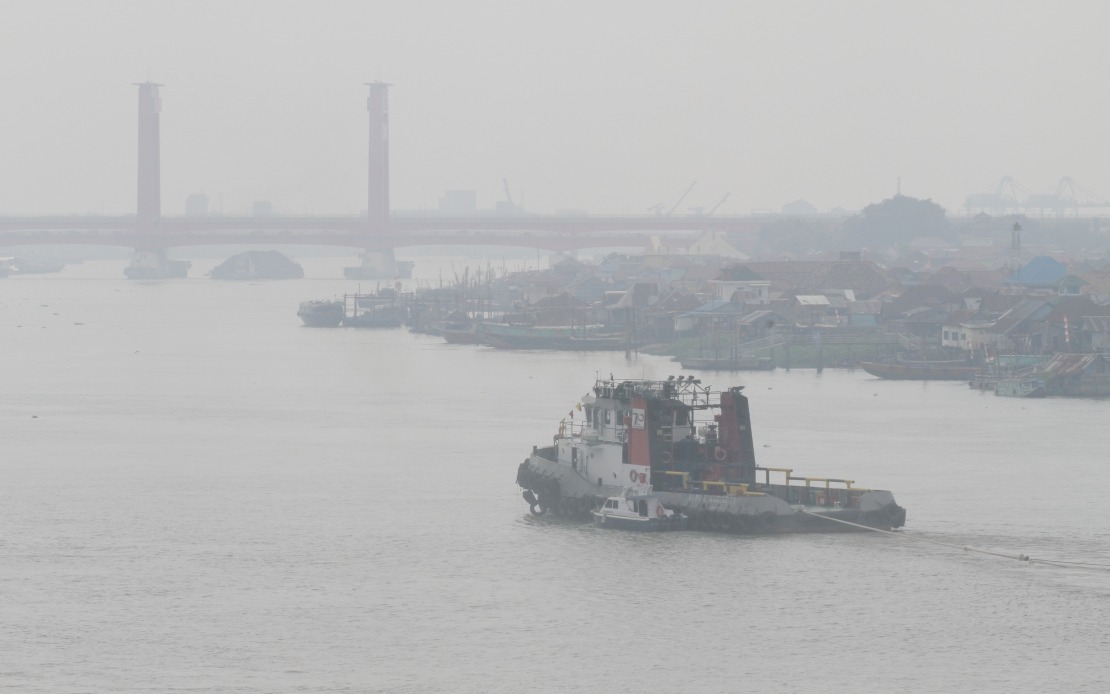
The Indonesian government has formally acknowledged ongoing coordination with Malaysia to address the escalating transboundary haze crisis, marking a significant diplomatic response to smoke from uncontrolled forest and land fires spreading across Southeast Asia's borders. Berton Panjaitan, Acting Head of the National Disaster Mitigation Agency (BNPB) Data, Information, and Disaster Communication Centre, confirmed that both nations have moved beyond preliminary discussions to concrete action plans centred on weather modification initiatives in border zones. This development reflects the urgency felt by both governments as air quality deteriorates rapidly across affected regions, prompting residents and officials alike to seek immediate relief from hazardous atmospheric conditions.
The severity of the current situation becomes evident when examining real-time pollution data from affected areas. West Kalimantan, the epicentre of the fires, has generated smoke so dense that Air Pollutant Index readings have soared to 195 in certain locations as of Friday morning, approaching the 201-plus threshold that constitutes very unhealthy air conditions. This escalation represents a marked departure from recent years, with the Malaysian Consulate in Pontianak noting that the 2024 and 2025 periods experienced remarkably clear conditions, making the sudden deterioration particularly jarring for residents and policymakers accustomed to regional stability. The haze extends well beyond Kalimantan's borders, now encompassing major population centres across Malaysia including Kuala Lumpur, Selangor, Penang, Kedah, and Perak, each recording unhealthy air quality indices that threaten public health across the peninsula and East Malaysia.
The bilateral framework underpinning current cooperation underwent formal consolidation on August 24, when Malaysian Natural Resources and Environmental Sustainability Minister Datuk Seri Arthur Joseph Kurup and Indonesian Environment Minister Jumhur Hidayat concluded substantive discussions aimed at intensifying prevention and firefighting mechanisms. During these talks, Indonesia granted Malaysia critical airspace clearance to execute cloud-seeding operations, a permission that carries significant symbolic weight regarding sovereignty and demonstrates Indonesia's commitment to cooperative problem-solving despite the operational complexities involved. Panjaitan elaborated that conversations between the two neighbours encompass a broader operational spectrum including prevention strategies, real-time monitoring systems, and direct weather modification support—indicating that officials view this not merely as an emergency response but as an opportunity to establish durable institutional mechanisms for future haze seasons.
Weather modification represents a technological frontier in transboundary environmental management, offering promising but unproven solutions to atmospheric degradation. Cloud-seeding operations, which introduce particles into clouds to encourage precipitation, operate on sound meteorological principles but depend entirely on favourable atmospheric conditions and precise timing for effectiveness. Malaysia's access to Indonesian airspace for such operations suggests a level of trust and pragmatism that transcends routine diplomatic relations, allowing Malaysian technicians to conduct operations in foreign territory to address a shared atmospheric problem. However, the success of these initiatives remains contingent on sustained funding, technical expertise, and coordination protocols that must be refined through practical experience. The acknowledgement of weather modification as a central plank of bilateral strategy signals recognition that traditional firefighting alone cannot adequately address the scale and intensity of current blazes.
While official requests for direct Malaysian firefighting assets such as water-bombing aircraft have not yet materialised, Panjaitan indicated that Jakarta remains receptive to such requests should circumstances warrant escalation. This cautious approach reflects diplomatic protocol and the complexities of international military and civilian asset deployment, yet simultaneously demonstrates flexibility within existing cooperation frameworks. Malaysia previously offered material support, with the consulate contributing six water pumps to the West Kalimantan Governor's Office in 2023, establishing precedent for tangible cross-border humanitarian assistance. The willingness of Malaysian officials to consider advanced firefighting interventions suggests a recognition that the current trajectory of uncontrolled fires may eventually necessitate regional resource mobilisation beyond current capacity limits. This positioning keeps diplomatic channels open whilst governments assess whether existing efforts prove sufficient.
The humanitarian dimension of the crisis extends beyond abstract air quality metrics to encompass immediate threats facing vulnerable populations. The Malaysian Consulate in Pontianak, responsible for monitoring the welfare of 577 registered Malaysian nationals dispersed across West Kalimantan largely as expatriate workers and their families, has issued guidance emphasising mask-wearing, online education for children, and minimisation of unnecessary outdoor exposure. These practical directives reflect the tangible health impacts that smoke inhalation poses to affected communities, particularly children, elderly persons, and those with pre-existing respiratory conditions. The consulate's explicit focus on this population group underscores how transboundary environmental challenges transform into direct welfare concerns for governments responsible for their citizens abroad, adding another layer of motivation for diplomatic cooperation beyond abstract principles of regional stability.
The timing of this haze emergence after years of relative atmospheric clarity carries psychological and policy implications for Malaysian and Indonesian decision-makers. The absence of severe haze throughout 2024 and 2025 had perhaps lulled both societies into assuming improved land management practices or changed weather patterns had permanently mitigated this recurring seasonal threat. The sudden return to dangerous conditions serves as a stark reminder that transboundary haze remains a structural vulnerability within the region, driven by underlying factors including agricultural expansion, palm oil production practices, and inadequate fire prevention enforcement across vast Indonesian territories. This reality necessitates moving beyond crisis response protocols toward systematic mitigation strategies that address root causes rather than merely alleviating symptoms when fires inevitably emerge.
The institutional mechanisms established through this latest round of bilateral engagement deserve examination for their durability and adaptability. Both nations possess formal coordination structures through ASEAN frameworks and bilateral environmental agreements, yet the specific prioritisation of weather modification represents a contemporary approach that differs from traditional firefighting-centric strategies. This evolution suggests that officials recognise atmospheric science as offering tools unavailable through conventional methods, even whilst acknowledging the inherent limitations and uncertainties involved. The consulate's reference to compliance with local Indonesian directives regarding masks and activity restrictions simultaneously highlights how transnational cooperation operates at multiple levels, from high-level ministerial negotiations down to community-level implementation of practical protective measures.
The implications of this coordinated response extend beyond immediate haze mitigation to encompass broader questions about regional environmental governance and Malaysia's capacity to project influence regarding transboundary issues. By securing airspace permission for weather modification operations and maintaining diplomatic channels receptive to expanded cooperation, Malaysia has positioned itself as an active stakeholder in addressing a crisis not entirely within its territorial control. This approach contrasts with passive reception of transboundary pollution, instead positioning Malaysia as a capable partner capable of offering technological solutions and sustained diplomatic engagement. For Malaysian policymakers and citizens, this signals institutional competence in managing environmental crises through multilateral mechanisms, even when external factors remain beyond domestic control.
The ongoing coordination between Jakarta and Kuala Lumpur ultimately reflects recognition that transboundary environmental challenges require responses transcending national borders and sovereign jurisdiction limitations. Weather modification operations in Indonesian airspace, coordinated monitoring efforts, and potential future firefighting asset deployment all represent practical acknowledgements that environmental degradation affecting one nation inevitably impacts neighbours, rendering unilateral responses inadequate. As the 2024-2025 haze season unfolds, the effectiveness of these collaborative measures will largely determine whether this operational framework becomes a model for future regional environmental cooperation or remains an isolated episode of crisis-driven coordination. The investment of diplomatic capital and institutional resources by both governments suggests confidence that sustained cooperation offers superior outcomes compared to independent national responses, a calculation that could reshape how Malaysia and Indonesia approach transboundary environmental management across multiple domains beyond atmospheric pollution.

