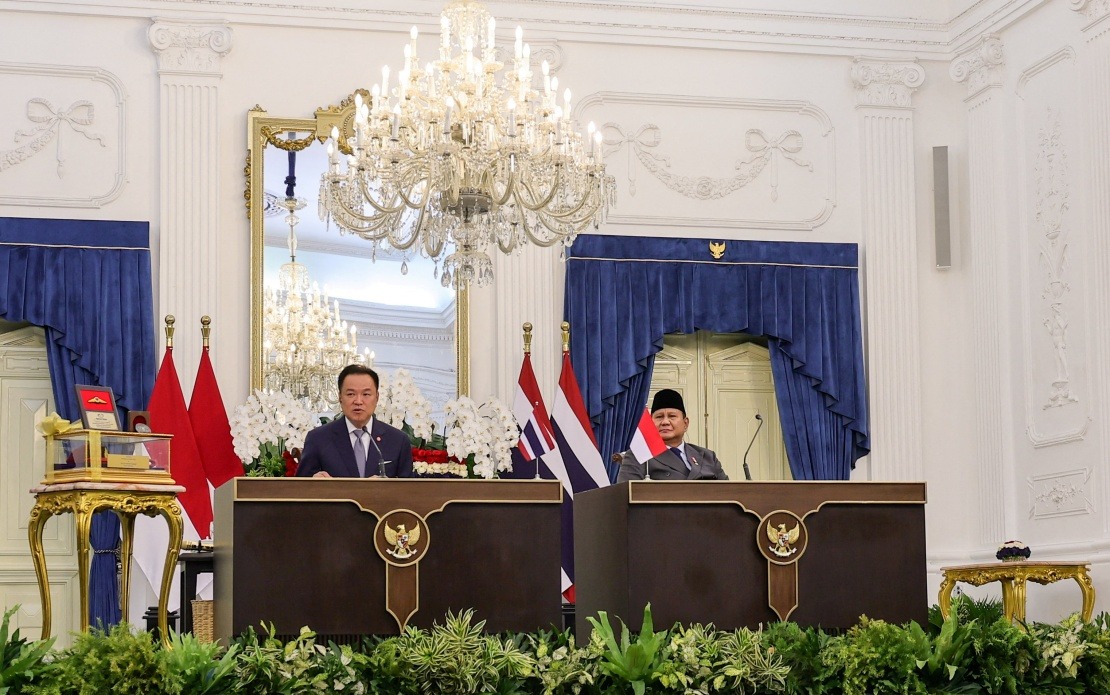
Indonesia and Thailand have reaffirmed their commitment to supporting ASEAN's ongoing efforts to restore stability in Myanmar, with both nations pledging to strengthen implementation of the Five-Point Consensus through dialogue, violence reduction, and humanitarian assistance. This commitment emerged from the second Leaders' Consultation between Indonesian President Prabowo Subianto and Thai Prime Minister Anutin Charnvirakul, held at Jakarta's Merdeka Palace on Monday, signalling renewed diplomatic momentum on one of Southeast Asia's most pressing geopolitical challenges.
The crisis in Myanmar has tested ASEAN's unity and centrality principles since the military coup in February 2021. The Five-Point Consensus, established as the bloc's framework for addressing the conflict, encompasses cessation of violence, dialogue among Myanmar parties, humanitarian aid delivery, and ASEAN's mediation role. However, implementation has proven difficult, with fighting between the military junta and armed resistance groups continuing to devastate the country. Indonesia and Thailand's reaffirmation of support suggests they recognise that maintaining a united ASEAN front remains essential for any credible peace pathway, even as individual member states pursue their own diplomatic channels.
Prabowo emphasised that sustaining ASEAN unity and centrality serves as the bedrock for broader regional peace and development. This framing reflects recognition among major ASEAN economies that the Myanmar situation threatens collective stability and that ad-hoc or unilateral approaches risk fracturing the bloc's credibility. Thailand, as Myanmar's closest neighbour, bears direct consequences from the conflict in the form of refugee flows, border security concerns, and economic disruption. Indonesia, as the region's largest economy and ASEAN chair in 2023, carries responsibility for mediating between member states with divergent interests regarding Myanmar.
Beyond Myanmar, the bilateral partnership expanded significantly into defence and security cooperation, with both nations agreeing to intensify efforts against transnational crime networks that have increasingly destabilised the region. This focus reflects a critical shift in how Southeast Asian governments prioritise threats—from traditional military challenges to the complex, shadow networks of organised crime that operate across borders with sophisticated digital infrastructure. The agreement encompasses closer intelligence sharing, joint investigations, financial tracking, and coordinated law enforcement operations designed to dismantle these criminal organisations at their roots rather than addressing symptoms.
Online scam syndicates emerged as a priority area for bilateral cooperation, underscoring the digital dimension of modern transnational crime affecting the region. These networks, which often operate from bases in Southeast Asia while targeting victims across Asia-Pacific, have extracted billions of dollars and caused devastating personal and social harm. Indonesia has particularly suffered, with nearly 1,000 of its citizens rescued from scam operations after Thailand facilitated their repatriation—a concrete measure of the bilateral cooperation already underway and a template for expanded efforts.
The two nations committed to developing a Transnational Referral Mechanism to accelerate identification, protection, and dignified repatriation of trafficking victims. This institutional innovation represents a maturation of regional cooperation, moving beyond crisis management to systematic, formalised procedures that recognise the rights and vulnerabilities of victims. Such mechanisms address a longstanding gap in Southeast Asian responses to trafficking, where victims often faced re-victimisation or inadequate support upon repatriation. By establishing clear protocols for victim identification and care, Indonesia and Thailand are creating a model that other ASEAN members may adopt.
Thai Prime Minister Anutin proposed expanded defence industry collaboration, including provision of 36 amphibious wheeled armoured vehicles to Indonesia. This defence procurement dimension deepens strategic alignment and creates economic linkages between the countries' military-industrial bases. For Indonesia, acquiring Thai-supplied vehicles reflects operational considerations but also signals openness to expanding defence partnerships beyond traditional suppliers. For Thailand, such defence exports strengthen bilateral ties and support its own defence sector development.
Thailand further committed to regular joint military training exercises, enhanced information sharing, and expanded maritime security cooperation with Indonesia. These measures address genuine security challenges in Southeast Asian waters, where piracy, illegal fishing, arms trafficking, and drug smuggling persist despite national and regional efforts. The Strait of Malacca and surrounding waters remain critical for global trade and require sustained bilateral and multilateral coordination to maintain freedom of navigation and maritime safety.
Cooperation to combat human trafficking and drug trafficking featured prominently in the bilateral agenda, reflecting the gravity of these challenges across the region. Human trafficking networks exploit economic desperation and inadequate border controls to supply forced labour and sexual exploitation industries worth billions annually. Drug trafficking, particularly of synthetic drugs like methamphetamine produced in clandestine laboratories across Southeast Asia, fuels addiction crises, organised crime, and violence. Enhanced law enforcement, intelligence sharing, and capacity building represent practical steps toward degrading these networks' operational effectiveness.
Anutin's visit marked his first official trip to Indonesia since becoming Thailand's 32nd prime minister in September 2025, and notably represented the first visit by a Thai prime minister to Indonesia in 15 years. This diplomatic gap underscores how Indonesia-Thailand relations, despite geographic proximity and shared challenges, had drifted into lower-profile engagement. The restoration of high-level visits signals intentional re-prioritisation and recognition that bilateral cooperation serves both nations' strategic interests more effectively than pursuing separate tracks.
For Malaysian readers, these developments carry implications for regional stability and cooperation frameworks. As ASEAN members, Malaysia shares stakes in both Myanmar peace efforts and transnational crime prevention. The Indonesia-Thailand partnership's emphasis on intelligence sharing, joint investigations, and victim protection mechanisms offers models for Malaysia's own bilateral and multilateral security cooperation. Additionally, the successful repatriation of Indonesian victims from scam networks resonates directly with Malaysia, where online fraud and scam operations similarly victimise citizens and require enhanced regional coordination.
The strengthening of Indonesia-Thailand cooperation also influences the balance within ASEAN, where personal relationships between leaders and regular high-level consultations shape collective decision-making. By elevating their bilateral engagement, Prabowo and Anutin are potentially creating a stronger axis within the bloc that can drive policy priorities on Myanmar, transnational crime, and maritime security. This dynamic affects the broader regional architecture and Malaysia's positioning within various ASEAN initiatives.
The bilateral commitments also underscore that Southeast Asian responses to transnational crime and regional instability increasingly require sophisticated, formalised cooperation mechanisms beyond traditional diplomacy. The Transnational Referral Mechanism, joint investigations, financial tracking, and capacity building represent hard institutional innovation that addresses modern security challenges. Malaysia, facing similar threats from online scams, human trafficking, and drug networks, stands to benefit from participating in and potentially adopting similar frameworks that Indonesian and Thai officials are pioneering.

