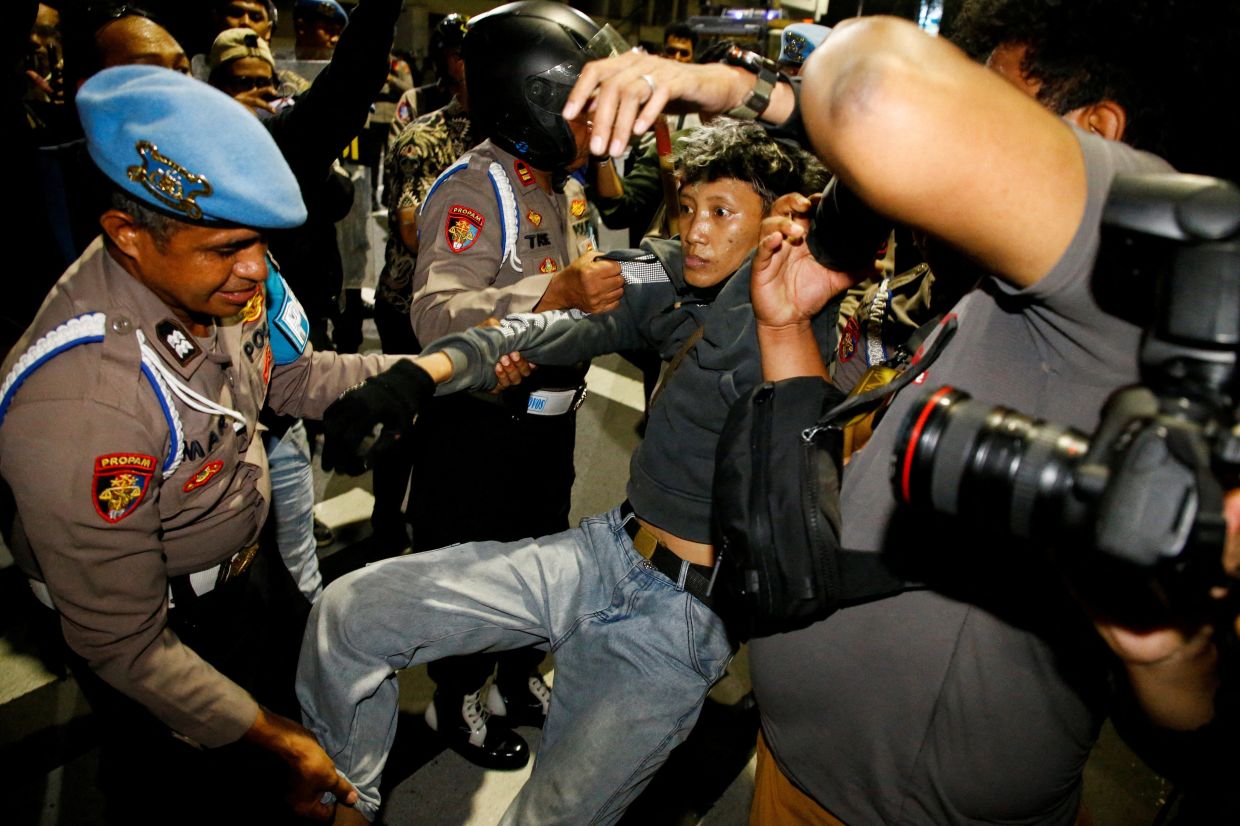
Indonesian police have formally charged four people in connection with an anti-government demonstration held in Surabaya, the country's second-largest city, marking a fresh instance of authorities taking legal action against protesters. The charges were announced by Surabaya police chief Luthfie Sulistiawan on Sunday, just two days after the Friday rally drew approximately 100 participants to protest outside a government complex.
The demonstration reflected growing public discontent over two major policy decisions that have stirred considerable unease across Indonesian society. The first flashpoint centres on the government's decision to substantially increase the price of non-subsidised petrol by roughly 30 per cent, a move intended to ease fiscal constraints as geopolitical tensions in the Middle East continue to disrupt global energy markets. The second involves the administration's flagship free school meals programme, which has become mired in controversy following widespread reports of food poisoning affecting tens of thousands of beneficiaries and allegations of systemic corruption within the scheme's implementation.
According to Luthfie, some members of the crowd engaged in destructive and confrontational behaviour, throwing objects such as firecrackers and stones at officers during the gathering. These actions prompted police to employ what the chief described as "firm actions" to break up the assembly. The specific nature of the police response and the circumstances that triggered the escalation remain subjects of scrutiny given the sensitivity surrounding protest management in Southeast Asia's largest economy.
The charging of the four individuals came after authorities initially arrested 24 people on the day of the rally. However, most of those detained were released without facing formal charges, reflecting a distinction between operational detentions for crowd control purposes and actual criminal prosecution. The four now charged face accusations of property destruction and assaulting law enforcement officers. Additionally, Luthfie disclosed that six other people remain under investigation after authorities determined they had drugs in their systems, suggesting the incident may have involved a broader cross-section of social actors than initially apparent.
The Surabaya protest represents merely one flashpoint in a widening wave of public opposition to the fuel price adjustment. Since the government announced the price hike earlier in June, demonstrations have erupted across multiple Indonesian urban centres, reflecting the nationwide impact of this economically significant decision. For a nation heavily dependent on fuel subsidies as a social safety net, price increases carry profound implications for millions of ordinary Indonesians whose household budgets already face considerable strain.
Indonesia's position as an oil producer paradoxically masks a critical vulnerability: despite having substantial domestic petroleum reserves, the country imports more crude than it exports, making it exposed to international price fluctuations and geopolitical supply shocks. The government's subsidy mechanism has long served as a crucial policy tool for maintaining social stability and preventing consumer prices from spiking dramatically. However, the decision to permit prices to rise reflects Jakarta's assessment that continuing unlimited subsidies is fiscally unsustainable given current budgetary constraints and the elevated cost of crude on world markets.
Meanwhile, in the capital Jakarta, student movements have mobilised against both the fuel price hikes and the controversial free meals initiative. Young demonstrators have specifically called for the termination or comprehensive reform of the multi-billion-dollar school feeding programme, which the government promoted as a targeted intervention to address childhood malnutrition across Indonesian society. These parallel protests underscore how multiple policy grievances have coalesced into broader expressions of public dissatisfaction with government direction.
The meal scheme has proven particularly contentious because it has been substantially suspended following mass food poisoning incidents that sickened tens of thousands of participants. Beyond the immediate public health crisis, critics have highlighted what they characterise as endemic corruption within programme administration, suggesting that intended beneficiaries have not received promised benefits while resources have been diverted through inefficient or fraudulent channels. These accusations have eroded public confidence in the government's capacity to execute large-scale social initiatives competently.
The decision to formally charge participants in the Surabaya protest illuminates the tensions between the government's desire to maintain order and public demands for space to voice political dissent. Indonesia's protest landscape remains complex, with security forces balancing directives to prevent disorder against democratic expectations for freedom of assembly. The distinction between releasing most detainees without charge while prosecuting a select few suggests authorities may be attempting to target individuals they view as organisers or primary agitators rather than casual participants.
As these demonstrations continue across Indonesian cities, the incidents highlight how economic policies can trigger cascading political consequences when they intersect with broader social anxieties. The fuel price increase, arriving alongside the free meals controversy, has created conditions where multiple constituencies—from working-class commuters to students and families concerned about child welfare—have found common cause in questioning government priorities and implementation competence. For Malaysia and other Southeast Asian economies similarly dependent on subsidy mechanisms and facing comparable budget pressures, Indonesia's experience offers cautionary insights into the political risks accompanying austerity-oriented policy shifts without adequate public preparation or alternative support structures.

