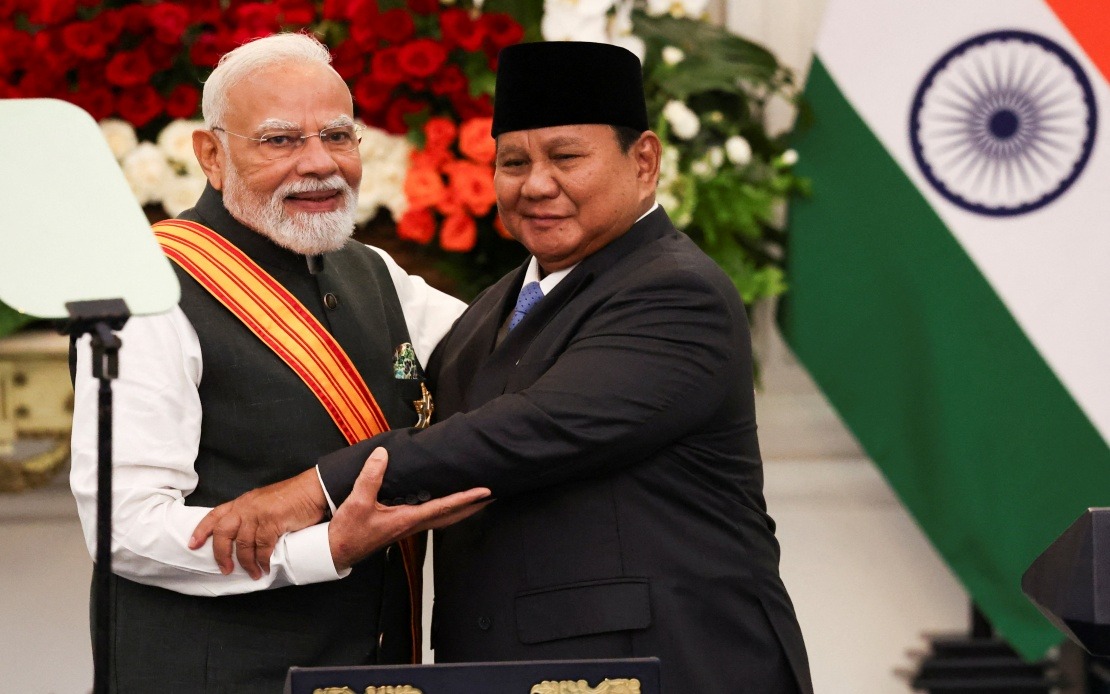
Indonesian President Prabowo Subianto conferred the nation's highest state honour on visiting Indian Prime Minister Narendra Modi on Tuesday at the Merdeka Palace in Jakarta, marking a symbolic pinnacle in the two countries' deepening diplomatic relationship. The prestigious award acknowledges Modi's instrumental leadership in elevating Indonesia-India relations to a Comprehensive Strategic Partnership, while also honouring his consistent commitment to expanding cooperative ventures that benefit both nations across multiple sectors.
During a joint press statement following bilateral talks, Prabowo emphasised that the award recognises not merely Modi's personal achievements but his tangible contributions toward Indonesia's development agenda. The Indonesian president specifically highlighted Modi's backing for numerous programmes and initiatives that have directly supported Indonesia's growth trajectory, underscoring how high-level political commitment translates into concrete developmental outcomes. This recognition reflects a deliberate Indonesian strategy to deepen ties with a major regional power at a moment when Southeast Asian nations are carefully calibrating their relationships amid shifting geopolitical dynamics.
The honour carries considerable historical weight within Indonesian diplomatic tradition. Prabowo drew a direct parallel to the previous award of this same honour to India's first prime minister, Jawaharlal Nehru, a towering figure who helped establish the foundational principles of non-aligned diplomacy that Indonesia itself championed. By conferring the same distinction on Modi, Prabowo positioned the current Indian leadership within a continuum of visionary statesmanship, suggesting that Modi's approach to regional engagement and strategic autonomy resonates with Indonesia's own historical commitments and contemporary interests.
Modi's visit to Indonesia operates within a reciprocal diplomatic framework that has accelerated in recent months. The Indian prime minister arrived at Prabowo's personal invitation, reciprocating the Indonesian president's visit to India earlier in the year. This cycle of high-level visits demonstrates a conscious effort by both leaderships to maintain momentum in their strategic partnership, signalling to regional and global actors that the Indonesia-India axis remains a priority despite competing demands on both nations' diplomatic calendars.
The bilateral relationship has evolved significantly beyond traditional diplomatic courtesies. The Comprehensive Strategic Partnership framework encompasses cooperation across defence, economic, technological, and cultural domains. For Malaysia and other Southeast Asian nations watching these developments, the Indonesia-India partnership represents an important counterweight in regional geopolitics, particularly as various powers compete for influence in the Indo-Pacific. Indonesia's elevation of this relationship sends clear signals about New Delhi's significance to ASEAN's largest economy and its de facto regional leader.
Prabowo's explicit mention of India's support for Indonesia's bid for permanent membership in BRICS added another dimension to the state visit. This endorsement carries practical weight, as India's backing enhances Indonesia's credentials within the broader developing nations' bloc. For Malaysia, this development underscores how bilateral partnerships increasingly intertwine with multilateral positioning, as countries seek to strengthen their voices within reformed global institutions and alternative frameworks that challenge Western-dominated structures.
The emphasis on historical and cultural continuities between Indonesia and India reflects a sophisticated diplomatic narrative that grounds contemporary strategic calculations in deeper civilisational ties. Prabowo's characterisation of India as a longstanding friend with whom Indonesia shares extensive cultural and historical linkages taps into the shared Buddhist heritage, historical trade connections, and philosophical affinities that predate modern nation-states. This rhetorical framing helps legitimise intensified strategic engagement as a natural evolution rather than a sudden pivot.
For Southeast Asian observers including Malaysians, Modi's reception in Jakarta illustrates the premium that regional leaderships place on diversified partnerships. Indonesia's cultivation of robust ties with India complements rather than contradicts its engagement with China, the United States, or other powers. This pluralistic approach to strategic relationships reflects a regional consensus that economic and security benefits flow from maintaining multiple partnerships rather than pursuing exclusive alignments.
The timing of the award also carries significance within Indonesia's domestic context. Prabowo's recent assumption of the presidency provided an opportunity to signal policy continuities while establishing his own diplomatic imprint. Honouring Modi during his early tenure demonstrates that Prabowo intends to maintain Indonesia's strategic partnership trajectory with India regardless of domestic political transitions, offering reassurance to New Delhi about the durability of bilateral commitments.
The bilateral meeting and subsequent award ceremony underscore how personal relationships between heads of state continue to matter in contemporary diplomacy, particularly within Asian contexts where traditional statecraft emphasises personal trust and historical resonance. Modi and Prabowo's engagement appeared calibrated to deepen personal rapport while advancing institutional frameworks, creating multiple channels for cooperation that can withstand potential fluctuations in either nation's domestic politics.
Looking forward, the consolidation of Indonesia-India ties through such ceremonial recognition likely portends expanded cooperation in areas critical to both nations and the broader region. Enhanced defence collaboration, technology transfer, economic integration, and coordinated diplomatic positioning on regional issues could all flow from this renewed commitment. For Malaysia and other ASEAN members, a stronger Indonesia-India partnership potentially creates new opportunities for trilateral or multilateral cooperation while requiring careful navigation to ensure that regional unity remains paramount.

