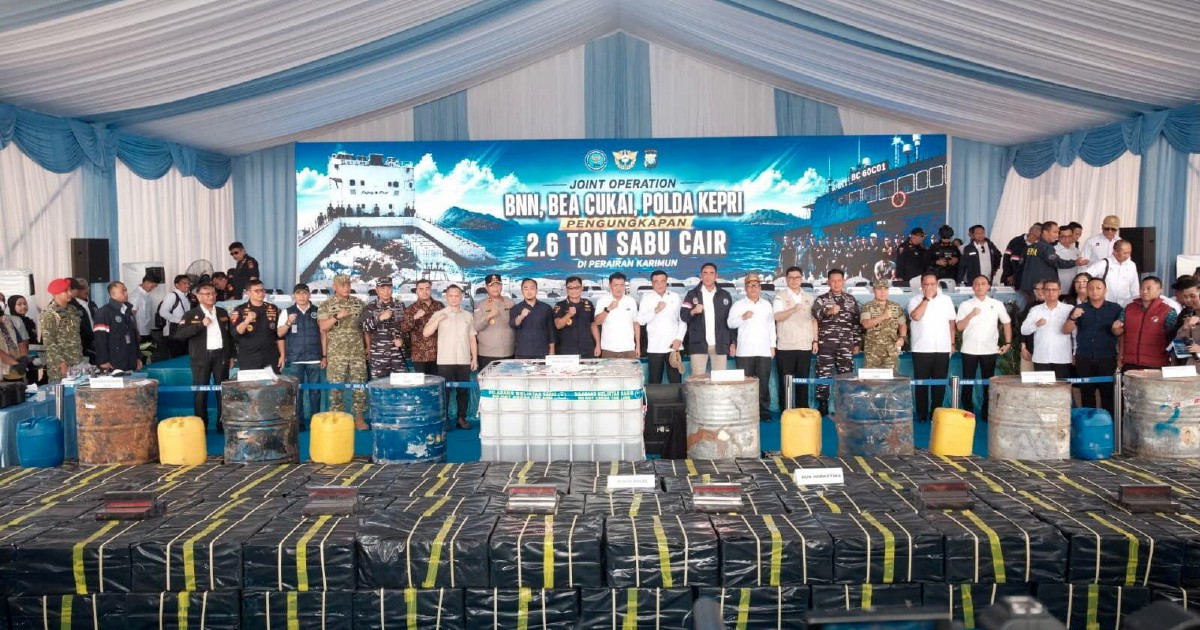
Indonesia's law enforcement agencies have moved against an international drug trafficking operation, apprehending 10 Myanmar nationals and seizing a record haul of 2.6 metric tonnes of liquid methamphetamine from a cargo vessel, officials announced at a Jakarta press briefing on Friday. The discovery represents one of the largest narcotics seizures in Southeast Asia in recent months and underscores the scale of clandestine chemical drug manufacturing operations that continue to plague the region despite coordinated enforcement efforts.
The vessel in question was operating under a Tanzanian flag when it was intercepted by Indonesian maritime and customs authorities during what officials characterized as a routine patrol operation. The strategic location of Indonesia's ports and maritime zones has long made the archipelago a critical chokepoint in the transnational flow of illicit drugs moving through Southeast Asia toward final markets in Australia, East Asia, and beyond. Intelligence assessments suggest that liquid methamphetamine—a form favored by traffickers because it is easier to conceal and transport than crystalline variants—originates primarily from clandestine laboratories operating in Myanmar's border regions, particularly areas controlled by armed groups with limited state oversight.
The arrest of the 10 Myanmar nationals provides investigators with potential leads into the supply chain architecture behind the operation. Interrogations of those detained will likely focus on identifying the manufacturing sources, the distribution networks, and the intended final destinations for the consignment. Indonesian authorities have indicated that the investigation is ongoing and that additional arrests may follow as they pursue upstream and downstream connections. The involvement of a vessel registered to Tanzania, a nation geographically distant from Southeast Asia, suggests the use of deliberate flag-state manipulation—a common technique employed by trafficking syndicates to obscure the true nationality and ownership of vessels engaged in illicit transport.
The liquid methamphetamine seizure arrives amid intensifying concerns within the region about the evolution of drug production and trafficking methodologies. Myanmar has emerged as a dominant source region for synthetic drugs, particularly methamphetamine and fentanyl precursor chemicals, driven by the convergence of permissive governance in remote border zones, access to chemical precursors, and the high profitability of the illicit pharmaceutical trade. The volume recovered in this single interdiction—enough to serve hundreds of thousands of consumers—illustrates the industrial scale at which these operations have expanded.
Indonesia's maritime enforcement capacity has improved substantially over the past decade through investment in coastal patrol capabilities and inter-agency coordination protocols. However, the sheer volume of cargo and maritime traffic transiting Indonesian waters daily presents formidable detection challenges. Traffickers routinely employ decoy shipments, route diversification, and corruption of port officials to increase the probability that contraband reaches its destination undetected. The successful interdiction of this consignment likely resulted from a combination of intelligence-led targeting, suspicious vessel behavior indicators, and enhanced screening procedures at key maritime chokepoints.
The ramifications of this seizure extend beyond Indonesia's borders and carry direct implications for Malaysia and other Southeast Asian nations. Methamphetamine trafficking networks operate transnationally, moving products through multiple jurisdictions to reach consumption markets. Malaysian port authorities and law enforcement agencies maintain similar interdiction operations and have recorded comparable seizures in recent years. The sophistication and scale of these trafficking organizations suggest that no single nation can effectively address the problem in isolation—regional cooperation mechanisms, including intelligence sharing and coordinated maritime patrols, have become essential components of counter-narcotics strategy.
The broader geopolitical context surrounding drug trafficking in Southeast Asia reflects the instability and state capacity gaps that characterize Myanmar's political environment. Since the military coup in 2021, central government authority has fragmented, creating operational space for armed ethnic organizations and criminal syndicates to expand drug production and export operations with minimal effective state interference. This structural challenge remains unresolved and will likely perpetuate Southeast Asia's role as a major production and transit region for synthetic drugs in the foreseeable future.
Indonesian officials have not disclosed the intended destination market for the intercepted shipment, though methamphetamine originating from Myanmar typically follows established trafficking corridors toward Australia, where street values are substantially higher than in Southeast Asia, or toward markets in Japan and South Korea. The involvement of Myanmar nationals in the transport phase suggests organizational links to production facilities, though whether this operation was controlled by transnational criminal organizations headquartered in Myanmar or coordinated by trafficking networks operating across multiple Southeast Asian jurisdictions remains unclear pending further investigation.
The seizure underscores the persistent challenge that regional governments face in combating an illicit drug trade that has become deeply embedded in transnational criminal ecosystems. Despite repeated large-scale interdictions and enforcement successes, the overall availability of methamphetamine and other synthetic drugs in Southeast Asian markets has not declined substantially, suggesting that trafficking networks possess considerable redundancy and flexibility in their operational capabilities. Addressing the problem comprehensively will require sustained attention not only to enforcement and interdiction but also to the underlying factors—poverty, limited economic opportunity, weak state presence, and permissive governance environments—that enable production and trafficking activities to flourish in source regions like Myanmar.

