Indonesian law enforcement agencies have successfully broken up an international drug smuggling operation with suspected Malaysian connections, marking a significant enforcement victory in the Riau Islands. The National Narcotics Agency (BNN) and the Customs and Excise Directorate General jointly announced the takedown on Friday, revealing a highly coordinated trafficking network that exploited maritime routes and concealment techniques to move narcotics across borders. Six Indonesian nationals have been detained, whilst investigators continue searching for two Malaysian individuals identified as SL and WKC, believed to have orchestrated supplies of etomidate and other controlled substances into Batam operations.
The investigation originated with a routine inspection at Soekarno-Hatta International Airport, where customs officers intercepted a parcel originating from Malaysia. The package bore a deceptive label identifying it as Orange Fiber Xtra food supplement, a common concealment tactic employed by sophisticated trafficking groups. Laboratory analysis conducted at the Customs and Excise Laboratory in Jakarta subsequently revealed the shipment contained MDMA, ketamine, and additional hazardous substances. This discovery triggered a collaborative tracing initiative between customs authorities and the BNN, leading to the identification and apprehension of individuals throughout Batam's criminal underworld.
Insp. Gen. Aswin Sipayung, the BNN's deputy for enforcement, described the syndicate's operations as remarkably professional, extending from initial smuggling through clandestine maritime entry points through to sophisticated repackaging and distribution within the Riau Islands region. The organisation demonstrated considerable operational security awareness, employing deceptive packaging methods and utilising multiple distribution nodes throughout Batam to minimise detection risks. Officers conducted simultaneous raids across four premises associated with the network, recovering evidence and apprehending key operatives. The primary location, a commercial shophouse in the Sakura Garden area of Batu Ampar, served as a focal point for the enforcement action and subsequent media briefing.
The investigation progressed rapidly following the initial airport seizure. Officers arrested a suspect identified as BAP on Wednesday as he attempted to collect the intercepted package in Batam. Subsequent interrogation provided investigators with actionable intelligence regarding additional network members. Within hours, law enforcement teams apprehended three additional suspects at a Baloi hotel: ED, the suspected package coordinator; NC; and TFS. The coordinated approach yielded immediate results, with officers discovering four vape cartridges containing etomidate, three ecstasy pills, and quantities of methamphetamine and ketamine powder at the initial arrest location.
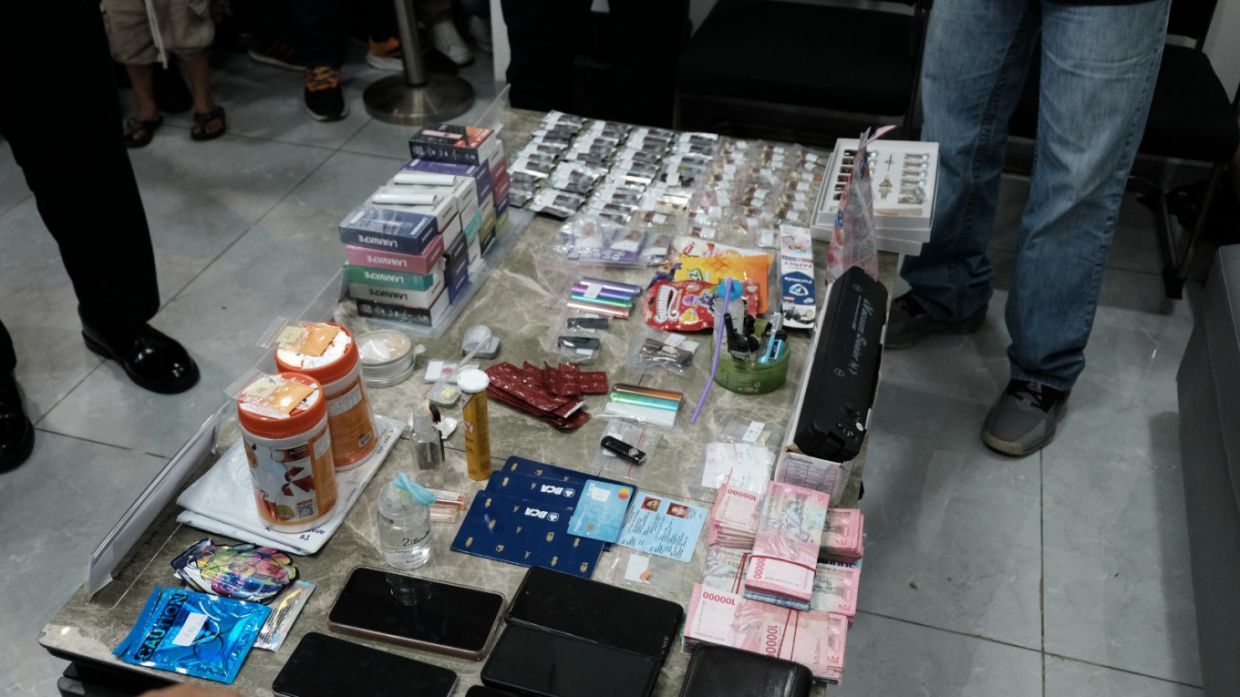
The investigation expanded to encompass additional properties connected to network participants. Authorities searched an apartment owned by TFS in Teluk Tering and a boarding house within the Sakura Garden shophouse complex occupied by AJ and DA. These locations yielded substantial quantities of contraband, including dozens of electronic cigarette pods filled with etomidate, methamphetamine, Happy Five tablets, and sachets containing Happy Water drinks. The thoroughness of the investigation, enhanced by deployment of narcotics detection canine units from the Batam Customs and Excise Office, reflected the scale of the suspected operation and the determination to dismantle all connected elements.
Simultaneously, customs personnel stationed at Batam Centre International Ferry Terminal intercepted a separate smuggling attempt. A Malaysian passenger identified as PS arriving from Stulang Laut International Ferry Terminal in Johor Bahru attempted to transport 48 etomidate-filled cartridges into Indonesian territory. This concurrent discovery suggested broader smuggling patterns and reinforced suspicions regarding Malaysian involvement in supplying substances to Batam-based distribution networks. Investigators are currently examining potential connections between the airport case, the main Batam operation, and this ferry terminal seizure, as well as assessing links to a previously raided drug manufacturing facility in the area.
The confiscated materials reveal the scale and sophistication of the operation. Authorities recovered 1,076.18 grams of MDMA, 50 grams of methamphetamine, 25.6 grams of ketamine powder, 86 Happy Five tablets, ten ecstasy pills, and 170 vape cartridges containing etomidate alongside 12 vials of liquid etomidate totalling 226 grams. The seizure extended to 88 vape devices, nine bongs used for methamphetamine consumption, three plastic sealing apparatus, and six digital scales utilised for drug measurement and packaging. Law enforcement also impounded four vehicles—a Toyota Alphard van, Toyota Agya hatchback, Chery SUV, and two motorcycles—suspected of facilitating distribution activities.
The syndicate's operational methodology involved deliberate deception targeting both borders and enforcement officials. Narcotics were concealed within authentic-appearing food and supplement packaging, with professional-grade plastic sealing devices employed to restore products to marketable condition. This technique capitalised on lower inspection rates for food category items at border checkpoints and postal facilities, allowing smugglers to move significant quantities with diminished detection risk. Aswin Sipayung highlighted this sophisticated concealment approach during official statements, underscoring the advancement of trafficking methodologies that enforcement agencies must now counter.
Batam Customs and Excise Office head Agung Widodo contextualised the enforcement outcome within broader public health and economic frameworks. The operation, conducted as part of routine border monitoring protocols, potentially protected approximately 6,770 individuals from drug-related harm. Authorities estimated the enforcement action prevented approximately Rp10.8 billion in prospective state healthcare and rehabilitation expenditures, translating to approximately US$599,000. This quantification reflects Indonesia's sophisticated understanding of narcotics enforcement as economic policy, recognising that prevention through border security constitutes substantially more cost-effective intervention than subsequent public health treatment requirements.
The two Malaysian suspects SL and WKC remain at large, with Indonesian authorities formally incorporating them into wanted persons registries and initiating international cooperation protocols to secure their apprehension. These individuals face serious criminal exposure under Indonesian narcotics legislation. The detained Indonesian suspects confront charges under Article 114(2) in conjunction with Article 132(1) and alternatively Article 112(2) in conjunction with Article 132(1) of Indonesia's Law No. 35/2009 on Narcotics, carrying potential sentences ranging from five years imprisonment to capital punishment, supplemented by maximum financial penalties of Rp10 billion.
This enforcement action carries significant implications for the Malaysia-Indonesia border region, where sophisticated trafficking networks have historically exploited geographical proximity and maritime accessibility. The investigation's Malaysian dimensions highlight persistent vulnerabilities in cross-border narcotics control despite bilateral cooperation frameworks. Intelligence agencies throughout Southeast Asia monitor such cases as indicators of evolving smuggling patterns, supply chain reorganisation, and syndicate adaptation strategies. The involvement of etomidate, a pharmaceutical-origin substance with emerging abuse potential, signals trafficking network sophistication and diversification beyond traditional methamphetamine and ecstasy markets. Malaysian authorities will likely receive detailed briefings regarding the two fugitive suppliers, potentially triggering parallel investigations into domestic manufacturing, acquisition, or export infrastructure supporting the international operation.

