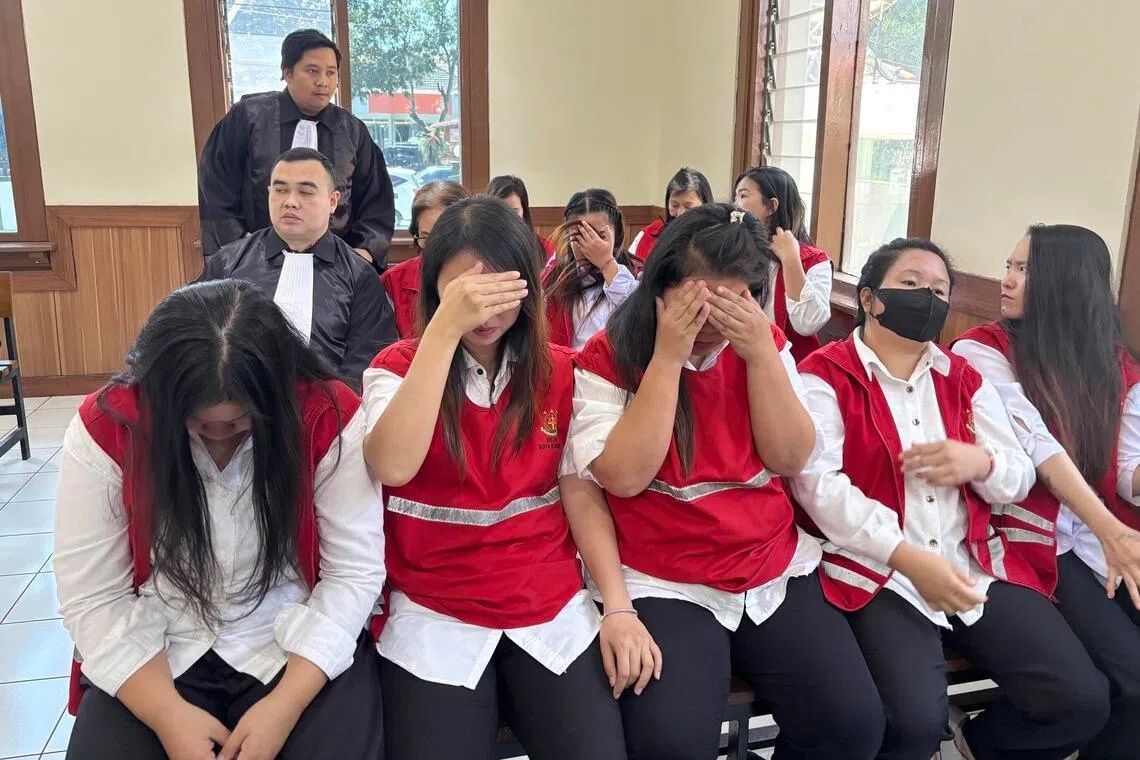
Indonesian prosecutors presented closing arguments on Tuesday in one of the country's most significant cross-border human trafficking cases, demanding prison sentences of up to a decade for members of a baby trafficking network accused of selling at least 34 infants. The case, which has drawn international attention due to alleged connections to Singapore, involves 19 defendants—18 women and one man—who have faced trial since April over accusations they trafficked babies between 2023 and 2025.
At the Bandung District Court hearing, Prosecutor Cucu Gantina laid out detailed charges against the defendants, seeking the maximum 10-year sentence for several alleged ring leaders. The prosecution's evidence reportedly showed that the syndicate operated with disturbing efficiency, moving vulnerable infants across borders while charging families substantial sums for each child. Prosecutors stated that at least 12 of the trafficked babies were transferred to Singapore, where each infant commanded a price between 200 and 250 million rupiah, equivalent to approximately 18,110 Singapore dollars. The financial dimension of the operation reveals the sophisticated nature of the criminal enterprise, which exploited the desperation of childless couples seeking to adopt while simultaneously targeting vulnerable pregnant women and their newborns.
Central to the prosecution's case is 70-year-old Lie Siu Luan, known also as Lily or Popo, who investigators have identified as the alleged mastermind orchestrating the entire operation. According to prosecutors, Lie's role extended far beyond passive participation—she actively coordinated the recruitment of babies, managed the creation of fraudulent adoption documents, and arranged the logistical details of sending infants overseas. The prosecution's strategy focused on establishing her leadership and demonstrating how her coordination enabled the trafficking network to function across multiple countries with apparent impunity until authorities uncovered the scheme.
The prosecution demanded matching 10-year sentences for three other defendants deemed crucial to operations: Astri Fitrinika, identified as a principal recruiter within the ring; Djaka Hamdani, another alleged recruiter; and Elin, who similarly played a recruitment role. Additionally, Lai Su Hua faces the same 10-year demand for her alleged involvement in falsifying state documents necessary to complete bogus adoption procedures. These charges reflect the prosecution's assessment that recruitment and document fraud formed the backbone of the trafficking network's success. The remaining 14 defendants, who allegedly served as caretakers for the babies prior to transfer, faced prosecution requests for five-year sentences, a distinction the prosecution made based on their perceived subordinate roles.
The emotional intensity of the proceeding became apparent when Lie and Astri wept as prosecutors detailed the charges and sentences they were seeking. The visible emotional responses underscored the gravity of the moment, though they also raised questions about accountability and whether emotional reactions indicated genuine remorse or merely the weight of potential imprisonment. Defense teams responded with contrasting strategies. Lie's lawyer, Sendi Sanjaya, indicated they would challenge the prosecution's characterization while respecting the court process. He notably disputed the prosecution's framing by arguing that the evidence presented during trial demonstrated the children were healthy and their locations documented, thereby contesting the prosecution's claim that exploitation had occurred—a crucial legal element in trafficking cases.
Astri's defense counsel, Hendri Samuel Tampubolon, adopted a different approach by attempting to minimize his client's culpability relative to Lie's. Tampubolon expressed dissatisfaction that prosecutors sought identical sentences for both Astri and Lie, arguing this failed to account for the power dynamic between a subordinate and the alleged mastermind. He emphasized Astri's cooperation with law enforcement authorities during investigation and prosecution phases, positioning this as a mitigating factor that should influence sentencing. This defense strategy highlights how trafficking cases often involve hierarchical structures where mid-level operatives may claim limited agency while following orders from above.
The investigation's origins trace to July 2025, when Indonesian authorities apprehended approximately a dozen suspects in West Java following information provided by Dani Hidayat, a West Java resident. Hidayat's involvement began innocuously when he joined a Facebook adoption support group while his wife was pregnant. Astri subsequently contacted him directly, allegedly offering 8 million rupiah for his unborn child—an interaction that triggered the eventual investigation. This discovery mechanism illustrates how trafficking networks exploited mainstream social media platforms and family-planning communities to identify potential victims and participants, operating largely hidden within ordinary online spaces.
The case has evolved into a significant diplomatic matter involving Southeast Asian nations. Both Singapore and Indonesian governments announced on January 9 that they were actively collaborating on investigations and prosecutions related to the syndicate. During trial testimony, Lie identified four Singaporeans she claimed functioned as adoption agents facilitating placements within Singapore: individuals she identified only as "Petter," "John," "Mr Tan," and "Mr Chew." These identifications have presumably formed the basis for Singapore's involvement in the broader investigation, though the extent of their investigations and any planned prosecutions remain unclear to the public.
For Malaysia and the broader Southeast Asian region, this case carries particular significance as it demonstrates how human trafficking networks exploit vulnerable populations across borders using increasingly sophisticated methods. The targeting of pregnant women and newborns represents a particularly heinous variant of trafficking that has received less public attention than labour or sexual trafficking, yet causes profound harm to victims and perpetuates cycles of exploitation. Malaysian authorities, who face their own documented challenges with human trafficking, can potentially benefit from the operational intelligence and prosecution precedents emerging from this case as they strengthen their own mechanisms for identifying and combating similar networks.
The trial's next phase will see defendants present their formal defenses, and the outcome will likely establish important legal precedents for how Indonesian courts prosecute complex cross-border trafficking cases. The sentences ultimately imposed may influence prosecution strategies and sentencing frameworks across the region, while also signaling to potential traffickers the serious consequences they face. The case underscores how international cooperation, tip-offs from vigilant citizens, and sustained investigation can dismantle sophisticated criminal networks, though it also raises questions about how many similar operations may currently operate undetected across Southeast Asia's porous borders and interconnected communities.

