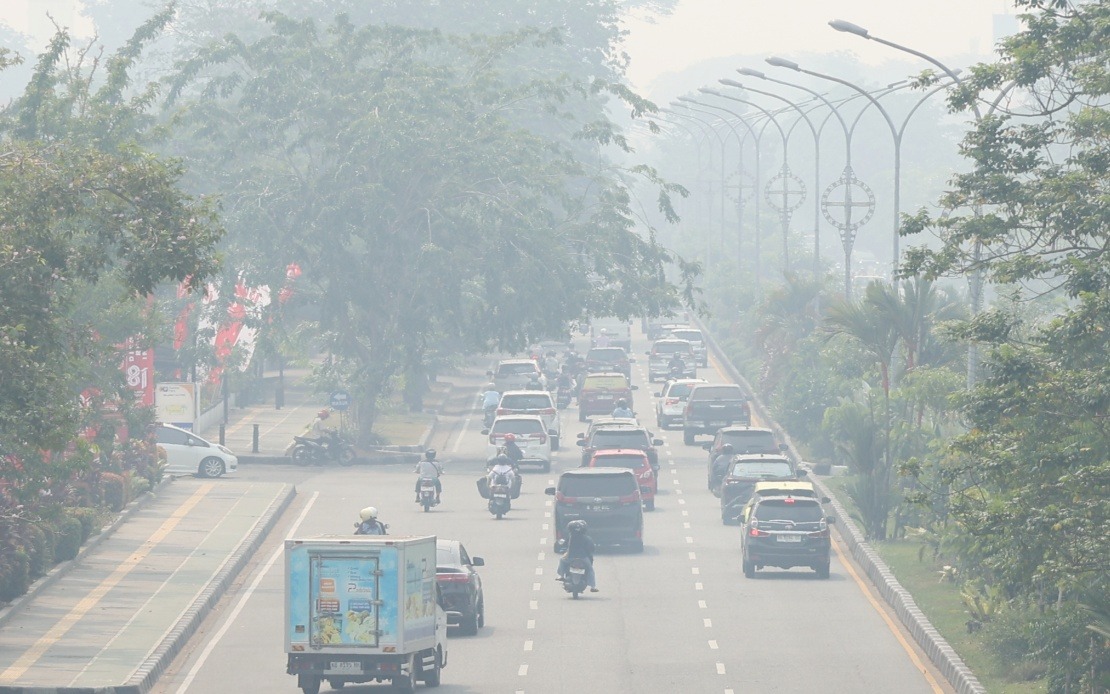
Indonesia is grappling with an escalating air quality emergency as forest and land fires continue to ravage multiple provinces, sending pollution levels to hazardous thresholds not seen in recent years. The Air Pollutant Index in Jekan Raya, a subdistrict within Palangka Raya in Central Kalimantan, has surged to 573 — a reading that places the area firmly in the hazardous category and poses significant health risks to residents. This measurement, recorded early on Wednesday morning across 17 air-quality monitoring stations, underscores the severity of Indonesia's seasonal fire challenge and its mounting implications for the broader Southeast Asian region.
The pollution crisis extends far beyond Central Kalimantan. Muaro Jambi Regency in the neighbouring Jambi province recorded an equally alarming API of 302, while several other locations across Sumatra and Kalimantan are experiencing very unhealthy air quality readings between 201 and 300. These include Pelalawan in Riau, Penukal Abab Lematang Ilir and Ogan Ilir in South Sumatra, Southeast Pontianak in West Kalimantan, and Gunung Mas and Katingan in Central Kalimantan. The geographical spread of dangerous air quality demonstrates that this is not an isolated incident but a region-wide environmental catastrophe affecting millions of people across Indonesia's most densely populated islands.
According to Indonesia's Health Ministry, the scale of human impact is staggering. Approximately 3.4 million people across seven provinces—Riau, Jambi, and South Sumatra on Sumatra island, plus West, Central, East, and South Kalimantan—have been directly affected by the fires and resulting haze. All seven of these provinces have declared an emergency alert status, a measure that reflects the severity of the situation while stopping short of a full emergency response declaration. This administrative distinction is significant; it indicates that while authorities recognise the gravity of conditions, they are attempting to manage the crisis through coordinated responses rather than invoking full emergency protocols.
Health authorities have implemented immediate protective measures for vulnerable populations. The Health Ministry's Environmental Health Director has issued clear guidance that people in areas with hazardous pollution levels must avoid outdoor activities altogether, recognising that exposure at such concentrations poses acute risks. For residents in very unhealthy zones, officials are advising against prolonged outdoor exposure, with particular concern for sensitive groups including children, the elderly, and those with pre-existing respiratory conditions. The ministry is preparing a comprehensive circular, expected to be issued within two days, that includes provisions allowing schools to transition to distance learning when air quality deteriorates to dangerous levels—a measure that acknowledges both the immediate health threat and the disruption to normal life.
Casualty reports remain relatively limited so far, though this may reflect the situation at an early stage. The Health Crisis Centre has documented 42 people suffering minor injuries related to the fires, while two individuals in South Kalimantan have sustained serious burn injuries requiring hospitalisation. Notably, no deaths or mass evacuations have been reported to date. Nonetheless, the ministry has mobilised 321 health personnel across the affected provinces to provide emergency medical support and monitor public health developments. This rapid deployment suggests authorities are preparing for potential escalation in health emergencies as fires continue and pollution levels persist.
Satellite monitoring data reveals the ongoing scale of fire activity driving the crisis. Indonesia's Forestry Ministry detected 805 high-confidence hotspots and 11,313 medium-confidence fire hotspots nationwide, indicating that new ignitions continue despite ongoing firefighting efforts. The distribution of these hotspots demonstrates that the threat remains diffuse and widespread rather than concentrated in a single location. South Sumatra recorded the highest concentration of confirmed fire locations with 239 high-confidence hotspots, followed by Central Kalimantan with 113. South Kalimantan and West Kalimantan recorded 89 and 86 respectively, while Jambi and Riau had significantly fewer confirmed hotspots at seven and one respectively. This suggests that while some provinces have managed to contain initial outbreaks, others continue to battle multiple simultaneous fire fronts.
The pattern of medium-confidence hotspots, while less immediately certain than their high-confidence counterparts, indicates where fires are likely to emerge or persist. West Kalimantan leads with 2,447 such hotspots, followed by Central Kalimantan's 2,168. These numbers underscore the potential for the current crisis to intensify further if weather conditions remain unfavourable and firefighting resources prove insufficient. The prevalence of medium-confidence hotspots suggests that the immediate firefighting challenge extends well beyond the currently burning areas, requiring sustained effort to prevent new fires from spreading across vast tracts of forest and agricultural land.
The implications for Malaysia and Singapore cannot be understated. Transboundary haze from Indonesian fires has historically affected air quality across the region, with Malaysian cities experiencing degraded air quality during peak fire seasons. The current API levels in Indonesian border regions suggest that haze transport into Malaysian airspace is likely unless meteorological conditions shift. This cross-border dimension adds urgency to the crisis, as multiple governments have interests in seeing the fires extinguished and air quality restored. Regional cooperation mechanisms, including information sharing and potentially coordinated air-quality monitoring, become increasingly important when pollution episodes of this magnitude occur.
The root causes of Indonesia's recurring fire crisis remain complex, involving a combination of factors including land-use practices, agricultural practices like slash-and-burn clearing, and seasonal drought conditions that render forests particularly susceptible to ignition. While authorities emphasise their commitment to firefighting efforts, longer-term solutions require addressing underlying drivers of fire incidence through improved land management, enforcement of environmental regulations, and potentially climate adaptation strategies. The declaration of emergency alert status across seven provinces represents a significant administrative response, but observers note that moving from alert to prevention requires investment in early detection systems, community engagement, and sustainable land-use practices that reduce the incentive for clearing fires.
The health ministry's willingness to permit school closures and remote learning during severe pollution episodes reflects a pragmatic acknowledgement that hazardous air quality poses genuine risks that cannot simply be managed through individual precautions. This represents a shift in how Indonesian authorities conceptualise public health during air-quality crises, moving beyond advisory guidance toward structural interventions that reduce population exposure. Such measures, while disruptive, may prove necessary as climate change potentially extends fire seasons and increases the frequency of severe pollution episodes. For regional policymakers in Malaysia, monitoring Indonesia's crisis management response offers insights into how governments can balance economic activity with public health protection during environmental emergencies.
The firefighting efforts described as proceeding gradually suggest that authorities have deployed significant resources but face challenges in fully containing the situation. Multiple provinces burning simultaneously, combined with the vast expanse of affected forest areas, means that even well-coordinated efforts may require extended periods to achieve full control. International assistance, whether through equipment, personnel, or financial support, occasionally plays a role in Indonesian firefighting efforts, though the political dimensions of such cooperation can complicate rapid mobilisation. The coming weeks will be critical in determining whether current efforts successfully reduce fire activity before conditions deteriorate further or whether the crisis expands to affect additional provinces and intensifies existing pollution in already-affected areas.

