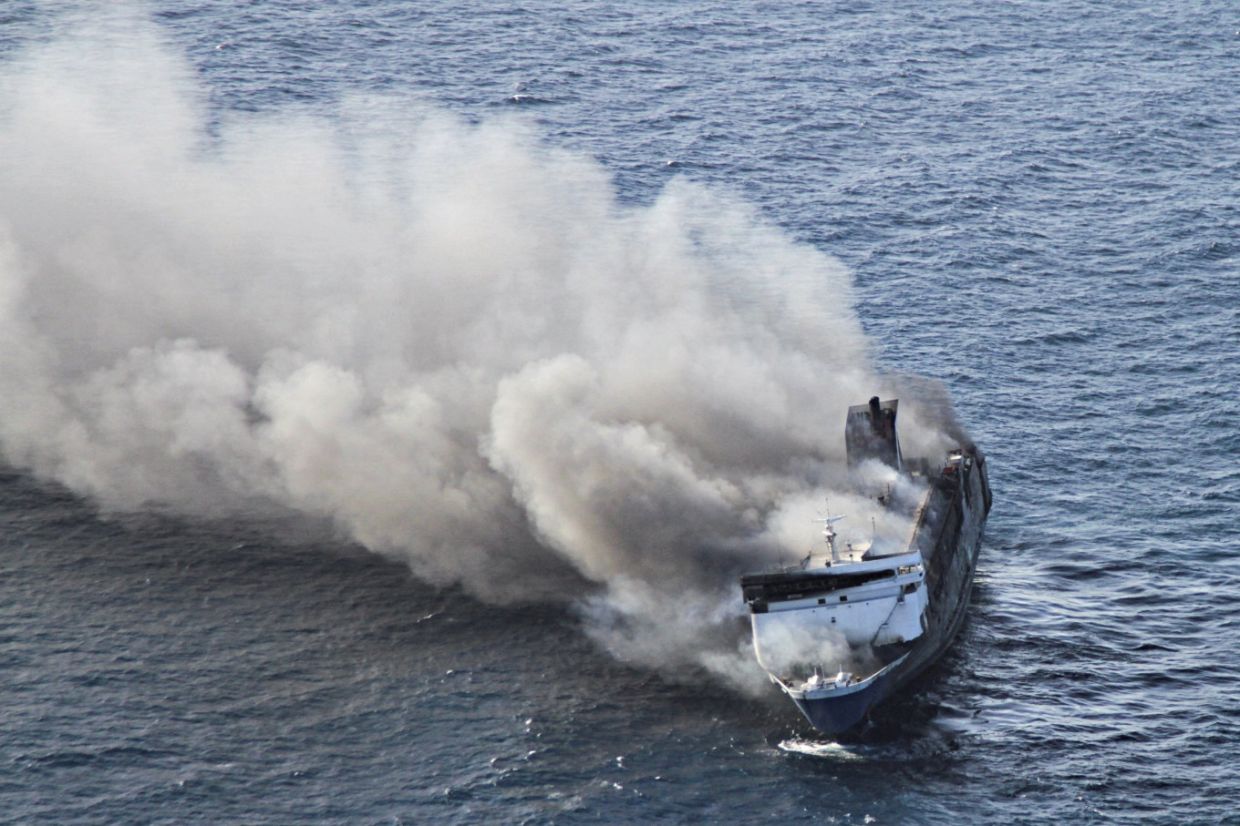
Indonesia's maritime safety framework faces renewed scrutiny following a catastrophic fire aboard the KMP Mutiara Sentosa II, a roll-on/roll-off passenger vessel that caught fire off Madura in East Java on August 2, killing at least five people and leaving two missing. The incident aboard the 160-meter-long ferry, which operates the Surabaya-to-Makassar route, has become a focal point for examining systemic weaknesses in how the nation's shipping industry is regulated and supervised. With 236 passengers—predominantly logistics truck drivers—and 39 crew members aboard, the scale of potential tragedy highlights the stakes involved when safety protocols fail in one of Southeast Asia's busiest maritime corridors.
Accounts from those who survived reveal a troubling absence of coordinated emergency response during the blaze. Udin Karo Karo, chairman of the Makassar-Surabaya Truck Drivers Association, documented that approximately 40 percent of drivers evacuated themselves rather than being guided by crew members, contradicting fundamental maritime safety requirements that mandate structured evacuation under crew supervision. Many passengers reportedly had no choice but to leap from the vessel using only life jackets, with no visible lifeboats or inflatable rescue rafts deployed during the emergency. These observations point not merely to equipment shortages but to a more profound breakdown in operational readiness—the gap between what regulations prescribe and what actually happens when crisis unfolds.
The involvement of PT Atosim Lampung Pelayaran (ALP) as the vessel's operator adds a particularly troubling dimension to the investigation. The company previously operated the KMP Mutiara Sentosa I, which experienced a similar fire near Madura on May 19, 2017, also resulting in five fatalities. That a single operator should preside over two major maritime disasters within five years raises uncomfortable questions about whether organizational learning and safety culture improvements have genuinely taken root. Edi Priyanto, deputy chairman of the East Java Occupational Safety and Health Council, articulated this concern directly: when similar incidents recur within the same operator, it demonstrates that lessons from previous catastrophes have not been properly embedded in practice. This pattern suggests systemic failures that transcend individual mechanical or technical causes.
The analytical lens through which experts are now examining the ferry fire extends well beyond identifying what sparked the initial blaze. Priyanto emphasized that investigators must scrutinize why the fire spread with such lethality—whether fire suppression systems functioned as designed, whether crew training and emergency procedures proved adequate, and whether the vessel's safety management systems reflected genuine operational reality rather than theoretical compliance. Such comprehensive investigation acknowledges that maritime accidents rarely result from single points of failure; instead, they typically emerge from the convergence of maintenance deficiencies, inadequate crew preparation, and organizational cultures insufficiently attuned to safety as a core value. The broader implication is that Indonesian regulators have historically treated safety oversight as a technical checklist exercise rather than a genuine commitment to preventing loss of life.
Transportation Minister Dudy Purwagandhi has committed the government to a comprehensive evaluation of PT ALP, contingent upon findings from the National Transportation Safety Committee's investigation into the accident's root cause. The minister acknowledged that the operator has compiled at least two major maritime accidents in its operational history, facts that should have triggered heightened scrutiny well before this latest disaster. His statement that the government would use findings to assess the company's compliance and prevent future incidents implies that oversight had perhaps been insufficiently stringent previously. For Malaysian readers familiar with their own maritime regulatory frameworks, the contrast is instructive: Indonesia's regulatory ecosystem appears to lack the proactive, consequence-driven approach that characterizes more mature safety systems.
The timing of this ferry disaster amplifies concerns about systemic breakdown. Merely one month before the KMP Mutiara Sentosa II fire, another passenger ferry sank near Selayar island off South Sulawesi, claiming at least four lives with fourteen others missing when the search concluded. The clustering of major maritime incidents within such a compressed timeframe—rather than appearing as isolated anomalies—signals to policymakers and industry observers that Indonesia's maritime safety architecture harbors deeper vulnerabilities. Abdul Hadi, a House of Representatives Commission V member overseeing transportation and infrastructure, articulated this interpretation with particular force: successive accidents within weeks demonstrate that isolated technical interventions will prove insufficient to address what has become a systemic challenge.
Abdul Hadi's warnings about the ritualization of safety inspection processes deserve particular attention in the Southeast Asian context. When maritime certification, seaworthiness inspections, and safety procedures devolve into administrative formalities disconnected from operational reality, vessels can theoretically meet all regulatory requirements while remaining genuinely unsafe. This pathology—whereby compliance on paper diverges dramatically from actual safety performance—represents a institutional failure that cannot be remedied through stricter rule-writing alone. It requires fundamental shifts in how maritime authorities conduct oversight, how they hold operators accountable, and how they cultivate professional norms that prioritize passenger protection above operational convenience. For regional maritime hubs like Malaysia and Singapore, the Indonesian experience offers cautionary lessons about the necessity of rigorous, non-negotiable enforcement.
The examination of PT ALP's safety culture and management systems will prove as important as determining the technical cause of the fire itself. Edi Priyanto's emphasis on organizational learning suggests that even technically competent vessel designs and equipment can fail catastrophically if the human systems surrounding them—training, accountability, decision-making, and prioritization of safety—are deficient. The company's apparent inability to translate the trauma of losing five people aboard the KMP Mutiara Sentosa I in 2017 into demonstrable operational improvements raises fundamental questions about corporate governance and regulatory enforcement. Did authorities conduct sufficiently rigorous post-accident oversight? Were there adequate consequences for safety failures? Did the company implement robust remediation programs, or did it pursue minimal compliance?
For Malaysia and Southeast Asian maritime stakeholders, the Indonesian ferry crisis underscores the critical importance of regional coordination on safety standards and information-sharing about operator performance. Vessels and operators often operate across national boundaries, and a company repeatedly involved in major accidents in one jurisdiction may pose equivalent risks in others. The absence of robust regional mechanisms for tracking operator safety records and escalating concerns represents a vulnerability that affects all maritime nations in the region. Malaysia's regulatory authorities might usefully examine whether their monitoring of foreign operators—particularly those regularly serving Malaysian ports or transiting Malaysian waters—incorporates intelligence about accident patterns and systemic safety deficiencies documented elsewhere.
The KMP Mutiara Sentosa II fire also illuminates the particular vulnerabilities of Indonesia's Ro-Ro vessel fleet, which plays an outsized role in the nation's domestic cargo and passenger transport networks. These vessels, designed for efficient loading and unloading of wheeled cargo and passengers, present distinct safety challenges if fire suppression or evacuation systems prove inadequate. The rapid fire spread that witnesses described may reflect structural or design features that, while acceptable under current regulations, create disproportionate hazards when human systems fail. As Indonesia continues expanding its maritime transport infrastructure to support economic growth and inter-island connectivity, ensuring that vessel designs, regulatory standards, and operational practices evolve in tandem becomes increasingly imperative.
Moving forward, the investigation and subsequent regulatory response will reveal whether Indonesian authorities can convert this tragedy into genuine systemic reform or whether the incident will eventually recede into the historical record as another cautionary tale followed by insufficient action. The credibility of Indonesia's maritime sector—and by extension, the safety of millions of passengers and crew members who depend on ferries for livelihood and connectivity—rests on whether regulators demonstrate the will to move beyond administrative compliance toward cultures of operational excellence and genuine safety primacy. Abdul Hadi's assertion that passenger lives must not be jeopardized by negligence or weak supervision articulates a principle that transcends Indonesia; it reflects universal humanitarian obligations that all maritime nations and operators must honor.

