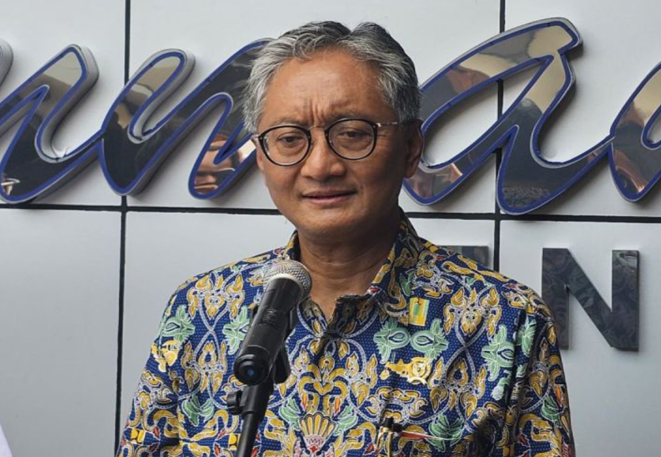
Indonesia's Public Works Ministry is grappling with severe institutional instability following the circulation of a confidential travel document that listed Minister Dody Hanggodo's wife and daughter as attendees on an official overseas delegation, igniting public backlash and allegations of state resource misappropriation. The incident has exposed deeper tensions within the ministry and raised questions about governance standards under Hanggodo's leadership since his appointment in October 2024.
The controversy originated from a ministry document dated June 29 and signed by secretary-general Apri Artoto, which outlined plans for eight delegates to travel to New York from July 13 to 19 for a United Nations meeting scheduled for mid-July. The roster prominently featured Irma Hermawati and Aurellia Tsabitha Meidirama, identified as the minister's wife and daughter respectively. Publication of the passenger list on social media platforms triggered immediate public outcry, with citizens questioning whether taxpayer funds were financing private family attendance at an official government function.
The fallout from the leaked document proved swift and consequential. Within days of the material becoming public, ministry leadership announced the cancellation of the entire New York trip, apparently concluding that proceeding would invite further reputational damage. However, the damage to internal morale had already taken root. Social media channels soon filled with reports suggesting that Hanggodo was orchestrating personnel reassignments as payback against officials suspected of orchestrating the leak, predominantly transferring staff members to regional postings located outside Jakarta and Java island.
When confronted by journalists on Wednesday, Hanggodo acknowledged the transfers but categorically rejected suggestions that they represented retaliation. The minister's response—noting that his ministry employs 38,600 individuals and asserting his prerogative to reassign them according to operational needs—sidestepped the broader credibility question raised by the timing and scope of the movements. His defensive posture underscored the political sensitivity surrounding personnel decisions within the ministry during a period of heightened scrutiny.
Secretary-general Apri offered an alternative explanation during a July 7 press conference, contending that inclusion of family members on the official delegation was administratively necessary to expedite visa processing through the Foreign Ministry. He additionally assured the public that government funds would not cover their participation costs. Apri simultaneously pledged to investigate the document's leak, characterizing it as confidential internal communication never intended for public distribution. He warned that legal penalties would be pursued against any identified official responsible for the disclosure, signaling the ministry's determination to prevent further embarrassing leaks.
Hanggodo's tenure at the Public Works Ministry has been marked by extraordinary personnel instability that extends well beyond the current controversy. Since assuming office as a member of the Democratic Party, the 60-year-old former engineer and businessman with ties to South Kalimantan entrepreneur Andi "Haji Isam" Syamsuddin Arsyad has executed multiple comprehensive staff reshuffles. Social media compilations have documented reassignments affecting more than 100 employees, spanning organizational levels from senior director-general positions down to junior civil service grades. This pattern of repeated upheaval has created organizational uncertainty and operational fragmentation throughout the ministry's bureaucratic structure.
The most recent significant reshuffle occurred in May when Hanggodo elevated seven high-ranking officials to new posts, including Apri's appointment as secretary-general—a position that replaced Wida Nurfaida after her tenure of fewer than twelve months. Notably, Wida herself had come to the position following yet another restructuring in July 2025, suggesting that instability rather than stability characterizes ministry management. The frequency and scope of these reorganizations have alarmed parliamentary oversight bodies responsible for infrastructure policy and budget allocation.
Parliamentary representatives have publicly expressed anxiety regarding the ministry's organizational volatility and its operational consequences. During a June 11 meeting of the House Commission V responsible for infrastructure oversight, PDI-P lawmaker Yasto Soepredjo Mokoagow directly challenged the approach, noting that disciplinary actions including director demotions to non-structural positions had generated fear among civil servants and threatened program implementation capacity. His warnings reflected genuine concerns that excessive personnel instability and perceived arbitrary management decisions were impairing the ministry's ability to execute infrastructure development initiatives essential to national economic progress.
Hanggodo has defended his restructuring agenda by identifying what he characterizes as a "deep state" operating within the ministry, using metaphors of termite infestation to describe officials he believes are obstructing reform initiatives and modernization efforts. This framing suggests that from the minister's perspective, substantial organizational upheaval represents necessary corrective action against embedded resistance to change. However, the narrative has not assuaged parliamentary critics or resolved underlying concerns about whether the instability itself constitutes a more immediate threat to operational effectiveness than the problems Hanggodo claims to be addressing.
Complications arise from concurrent corruption investigations that have ensnared senior ministry personnel in water resources project cases. The Jakarta High Prosecutor's Office identified multiple suspects in June, including former water resources director-general Dwi Purwantoro and former acting irrigation and swamp director Yosiandi Radi Wicaksono. These prosecutorial actions have provided potential substantiation for Hanggodo's claims regarding institutional misconduct, though they simultaneously underscore the ministry's governance challenges. Hanggodo has publicly committed to cooperating fully with law enforcement authorities investigating his subordinates, pledging non-interference in judicial proceedings despite the potential embarrassment to ministry reputation.
Yet Hanggodo's credibility on governance matters faces further strain from video evidence circulating on social media depicting tense interactions between the minister and subordinates. Particularly damaging footage from an April site visit to a school construction project in East Java captured Hanggodo reprimanding an employee with pointed fingers and dismissive language, characterizing the official's explanation as "dumb excuses." Such imagery reinforces perceptions that the minister's leadership style emphasizes confrontation and blame rather than collaborative problem-solving, potentially contributing to the workplace anxiety that parliamentary observers have documented and potentially explaining the alacrity with which officials may have leaked the family travel document as a form of quiet resistance.
For Malaysian observers and regional policymakers, Indonesia's Public Works Ministry dysfunction presents cautionary lessons regarding ministerial accountability and institutional governance. The incident demonstrates how even routine administrative decisions—such as personnel assignments—can become politically explosive when trust in leadership has eroded. The layering of alleged nepotism, aggressive personnel practices, corruption investigations, and confrontational management style suggests that single scandals rarely exist in isolation but rather reflect deeper organizational pathologies. As both nations pursue infrastructure development as central national priorities, the contrast between institutional stability and the volatility visible in Indonesia's Public Works Ministry carries implications for project execution, cost management, and delivery timelines that ultimately affect regional development patterns and competitive positioning.

