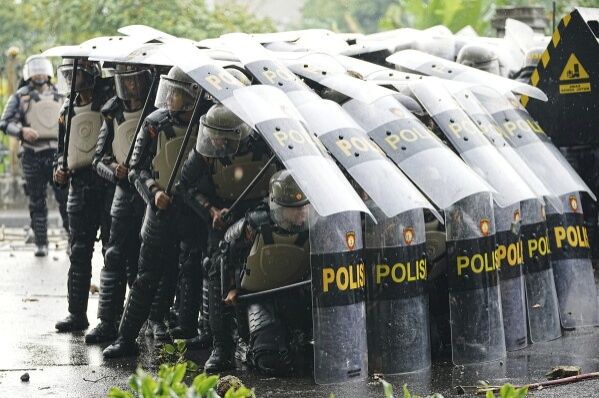
Tensions between Indonesia's law enforcement and military apparatus have surfaced publicly this week following aggressive police operations in and around Jakarta that recovered tens of millions of dollars in cash, gold and foreign currencies linked to multiple corruption inquiries. The dramatic seizures—which touched on a high-ranking prosecutor—prompted military intervention at a residential property, triggering broader concerns about potential institutional conflict and the country's commitment to civilian-led governance.
Police conducted a series of coordinated raids across the capital targeting alleged irregularities spanning coal procurement for state power stations, misconduct related to state insurers Asabri and Jiwasraya, and financial dealings concerning Krakatau Steel. In a raid on a South Jakarta establishment, officers uncovered rupiah and foreign currency totalling more than $3 million concealed within a two-metre-tall safe at a restaurant and an adjacent money-changing facility. The scale of the seizures underscores the authorities' assessment that large-scale financial crimes remain active within Indonesia's upper echelons.
The operation gained additional prominence when investigators entered a residence south of Jakarta owned by Febrie Adriansyah, Deputy Attorney General for Special Crimes. Police reported discovering 74 kilograms of gold bars alongside cash reserves and foreign denominations—all told valued at approximately $26.3 million—locked inside seven suitcases within a safe. Febrie holds one of Indonesia's most consequential positions in corruption prosecution, directing the Attorney General's Office unit responsible for major graft investigations spanning prominent state enterprises including Timah, Pertamina and Garuda Indonesia, as well as probes touching President Prabowo Subianto's free-meals initiative.
Febrie's acknowledgement that he owns the property came with a categorical denial of any connection to the seized valuables. The Deputy Attorney General stated that his office respects the ongoing investigation and awaits police findings, while cautioning against premature public judgement based on unverified social media accounts or preliminary media reporting. His emphasis on the presumption of innocence reflects standard legal convention but also signals potential discomfort within the Attorney General's institution regarding the scope and timing of the searches.
What transformed routine corruption probes into an institutional crisis was the subsequent military deployment to Febrie's residence. Armed personnel arrived at the property following the police operation, reportedly at the behest of the Attorney General's Office and justified under existing protocols for protecting prosecutorial staff. The military's intervention—framed by a spokesman as a security measure without institutional conflict—nonetheless created visual and symbolic evidence of inter-agency friction at a moment when Indonesia's democratic credentials face scrutiny.
Military and government officials moved swiftly to contain perceptions of institutional breakdown. A military spokesman asserted that security arrangements would not obstruct legal processes and rejected any suggestion of conflict between agencies. President Prabowo Subianto, speaking while inaugurating a dam on Lombok island, delivered oblique remarks urging officials, soldiers and prosecutors to remember their accountability to the population. His comments—suggesting that all institutions "belong to the people"—functioned as a gentle admonition to multiple power centres, signalling his desire to depoliticise what appeared to be an escalating confrontation.
Yet these reassurances failed to quell alarm among civil society observers and institutional analysts tracking Indonesia's democratic health. Amnesty International Indonesia warned that military deployment into civilian law enforcement operations risks undermining civilian supremacy and eroding public confidence in institutional credibility. The organisation called for explicit guarantees that investigators would encounter no intimidation or obstruction, implicitly questioning whether such assurances could be credibly provided in the current environment.
Nicky Fahrizal, a researcher at Jakarta's Center for Strategic and International Studies, characterised the episode as symptomatic of deteriorating institutional coordination and a wider pattern of military encroachment into civilian domains. He cautioned that continued escalation threatens the foundations of Indonesia's rule-of-law framework, potentially triggering a loss of confidence among both domestic constituencies and international investors whose decisions rest partly upon perceptions of institutional stability and predictable governance.
For Malaysian observers and regional analysts, Indonesia's current tensions carry significance beyond Jakarta's immediate politics. As Southeast Asia's largest economy and a crucial regional security partner, Indonesia's internal institutional health influences broader regional dynamics. The friction between police and military, and between law enforcement and prosecutorial organs, suggests that Indonesian institutions struggle to manage corruption probes through established mechanisms. When such investigations begin to involve senior officials and prosecutors themselves, institutional responses become politically fraught, potentially compromising the credibility of anti-corruption efforts that investors and trading partners expect from a G20 member state.
The underlying corruption cases themselves deserve scrutiny. Coal procurement irregularities linked to power blackouts directly implicate state energy policy and infrastructure adequacy—matters affecting Indonesia's economic productivity and attracting regional concern given energy cooperation frameworks spanning Southeast Asia. The involvement of state insurers and steel producers in parallel investigations suggests systemic rather than isolated problems within Indonesia's state-owned enterprise sector. These are not merely bureaucratic misdeeds but potential impediments to the institutional effectiveness that underpins long-term investment decisions.
The prosecution of high-profile figures depends upon institutional independence and public confidence in law enforcement impartiality. When military forces deploy protectively around a senior prosecutor during active investigations, the symbolic message—whatever official denials suggest—conveys uncertainty about institutional boundaries and potential politicisation of law enforcement. For Indonesia's anti-corruption agenda to retain legitimacy, future operations must proceed through clearly civilian-controlled channels with transparent accountability mechanisms, avoiding optics that suggest military-police rivalry or prosecutorial vulnerability to institutional pressure.
Indonesia's political leadership faces a consequential test in managing this intersection of corruption accountability and institutional stability. President Prabowo's measured public comments suggest awareness of the stakes, yet his administration must move beyond rhetorical appeals to implement structural protections ensuring that future investigations proceed free from inter-agency competition or military involvement in civilian law enforcement. Without such reforms, Indonesia risks precisely the institutional erosion that Fahrizal warns threatens investor confidence and democratic legitimacy—consequences that ripple throughout a region increasingly dependent upon Indonesia's economic and security contributions.

