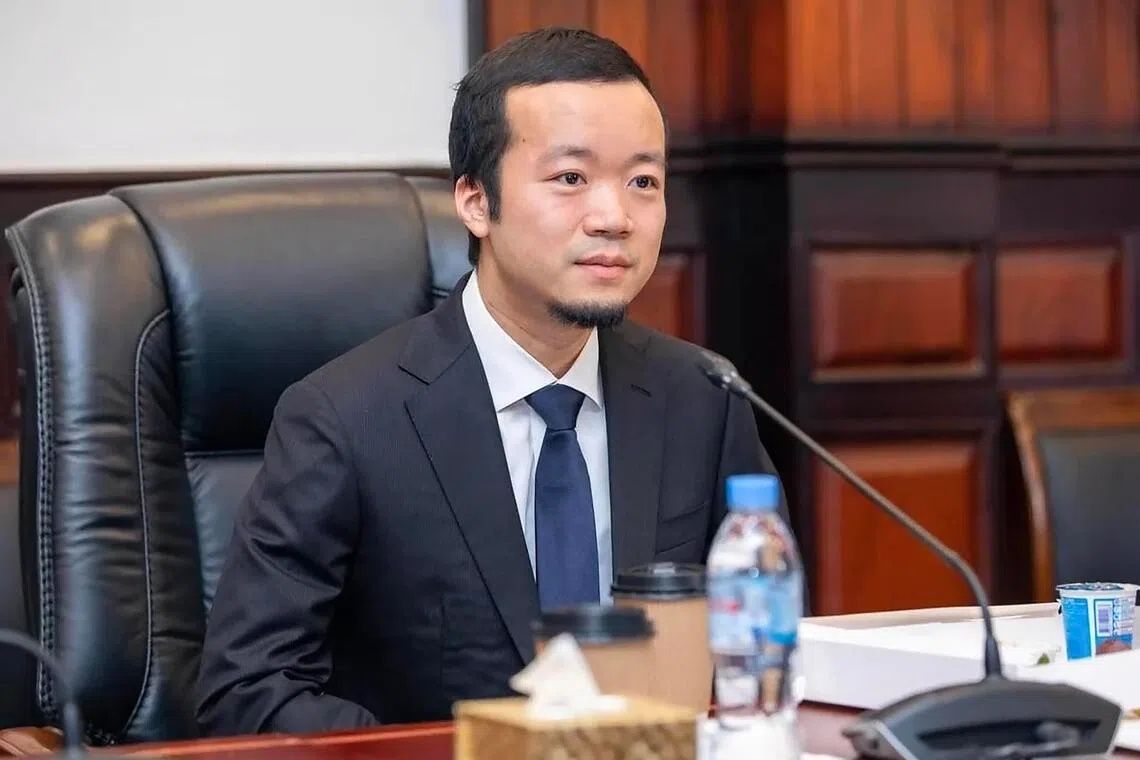
A six-month investigation by The Straits Times and the Organised Crime and Corruption Reporting Project has identified Chen Sokly as the principal lieutenant in one of the world's largest financial crime syndicates, exposing his central role in laundering billions of dollars extracted from enslaved workers held in Cambodian scam compounds. Indicted alongside scam mastermind Chen Zhi in October 2025, Sokly operated under multiple identities across jurisdictions, orchestrating a sophisticated network of shell companies and corrupt officials that stretched from Asia to North America. The revelations come as US authorities completed one of history's largest financial fraud takedowns, seizing 127,271 bitcoins valued at approximately US$15 billion.
Born in Shanghai in 1986 as Chen Xing, Sokly reinvented himself by acquiring Cambodian citizenship around the end of 2017, formally changing his name according to Cambodian government records. In Singapore's financial circles, he cultivated a separate persona as Martin Chen, a wealthy businessman whose true operations remained hidden behind layers of corporate structures. This deliberate fragmentation of identity mirrored the Prince Holding Group's broader strategy of obfuscation—creating multiple legal entities and national personas to evade detection by international authorities. The investigation confirmed his identity by cross-referencing corporate histories, citizenship documents, residential records spanning Singapore and the United States, and financial transactions logged across three continents.
Within the Prince Group hierarchy, Chen Zhi assigned Sokly a critical function as head of risk control, tasking him with a dual mandate: monitoring law enforcement investigations targeting the syndicate while simultaneously cultivating relationships with corrupt officials willing to protect the organisation's interests. Documents seized by US prosecutors reveal Sokly's brazen approach to bribery and coercion. In May 2023, he allegedly negotiated with a Chinese government official who promised to shield Prince Group associates from legal consequences, with Sokly pledging reciprocal favours including financial support for the official's son. Sokly even directed the same official to instruct local Chinese police officers to extort businesses on the syndicate's behalf, demonstrating the organisation's capacity to weaponise state institutions for private criminal gain.
Sokly's confidence in his network was not misplaced. A ledger of bribes maintained by Chen Zhi and recovered by US investigators documented Sokly's high-value gifts to foreign officials, including the 2019 purchase of a yacht exceeding US$3 million for an unnamed government functionary. Within Prince Group circles, Sokly and Chen Zhi frequently discussed the depth of their political penetration, with Sokly boasting about the number of officials effectively in the organisation's pocket. When circumstances threatened the syndicate's stability—such as Cambodia's enforcement actions against scam compounds—Sokly dismissed concerns, expressing confidence that his connections rendered the group untouchable. This casual disregard for law enforcement reflected the profound corruption underpinning the enterprise.
Beyond bribery, Sokly served as the organisation's enforcer, employing violence to maintain discipline within the syndicate's sprawling network. In July 2024, as the Prince Group's dominance began fragmenting, Chen Zhi instructed associates to contact Sokly regarding a member who had stolen funds, implicitly tasking him with violent recourse. This capacity to move seamlessly between boardroom negotiations with corrupt officials and street-level enforcement underscored Sokly's versatility as a lieutenant. Sokly occasionally boasted about the syndicate's scale, claiming at one point that the global operation was generating US$30 million daily through unlawful activities—a figure that, if accurate, would place the Prince Group among the world's most profitable criminal enterprises.
Sokly's American property portfolio reveals both his extraordinary wealth accumulation and his strategic asset positioning before the sanctions cascade. In 2019, he purchased a California residence from Fang Zhizhen, a member of the Knight Attack Group, a Chinese cybercriminal organisation predating the Prince Group itself. This transaction suggests overlapping networks and shared personnel between distinct transnational crime structures. Sokly subsequently sold that property in 2024 for approximately US$4.5 million, demonstrating rapid equity appreciation. More tellingly, weeks after international sanctions were imposed on Prince Group in October 2025, Sokly transferred ownership of a separate US$4 million American property to his wife on November 4, 2025—a transparent attempt to shield assets from government seizure through spousal transfers. The property was further protected by placement into a trust controlled by his wife in December 2025, exemplifying the legal mechanisms criminals employ to frustrate asset recovery proceedings.
Sokly's Singapore operations reveal an equally calculated approach to wealth concealment and money laundering. In 2017, announcing his arrival with characteristic ostentation, he purchased a 5,694 square-foot luxury apartment at 10 Leedon Heights for S$11 million (US$8.61 million). This high-profile acquisition served as a base camp for his subsequent corporate activities. Within months, he established M Capital Global Holdings, investing just over S$5 million alongside his wife in equal partnership. Though Sokly has since distanced himself from most of his Singapore directorships—which he accumulated to at least 16 firms between 2017 and 2020—he and his wife remain shareholders in M Capital Global Holdings, maintaining a residual legitimate presence in Singapore's corporate ecosystem.
The Singapore companies associated with Sokly shared a Shenton Way address, traditionally one of the island state's premier financial districts. However, contemporary investigation revealed only two legitimate businesses occupying the listed office space on the 12th floor, with no discernible connection to Sokly's operations. This disconnect—between registered business addresses and actual occupants—exemplifies how international crime syndicates exploit corporate registration systems that prioritise convenience over due diligence. Former employees who worked in proximity to Sokly's Singapore operations, speaking on condition of anonymity, described him as a seasonal resident, typically spending between two and three months annually in the city-state. During his stays, he socialised extensively with Prince Group associates in evening gatherings, displaying the conspicuous consumption typical of newly wealthy criminals: his vehicle fleet at Leedon Heights included a Bentley and luxury seven-seater vehicles, broadcasting his financial success throughout Singapore's exclusive residential enclave.
For Southeast Asian readers, Sokly's case illuminates systemic vulnerabilities in regional financial regulation and corporate governance frameworks. Singapore's corporate registry, despite its reputation for rigour, facilitated the integration of illicit proceeds into legitimate business structures through standard incorporation procedures. Sokly's ability to acquire Cambodian citizenship, establish multiple identities, and operate complex corporate networks across jurisdictions demonstrates how weak coordination between national authorities enables transnational crime. The Prince Group's reliance on corrupting officials in multiple countries—particularly China—suggests that even jurisdictions with advanced enforcement capabilities remain penetrable when organised criminals possess sufficient capital and sophistication. Malaysia, as a regional financial hub with exposure to similar money laundering risks, must examine whether comparable vulnerabilities exist within its own corporate and banking systems.
The case also underscores the predatory nature of the enterprise driving Sokly's wealth accumulation. The billions laundered through the Prince Group originated from investment fraud schemes that ensnared millions of victims globally, generating revenue through scam compounds where workers—many trafficked against their will—were coerced into committing fraud. Sokly's yacht purchases, California real estate acquisitions, and Singapore penthouse represented direct conversions of victim suffering into personal enrichment. His role monitoring law enforcement and corrupting officials meant he directly facilitated the continued operation of labour trafficking and forced fraud that sustained the organisation. Understanding Sokly not merely as a sophisticated financial operator but as an architect of modern slavery contextualises why international authorities pursued the takedown with unusual aggressiveness, resulting in the seizure of billions in cryptocurrency assets.
The investigation's methodology—combining official records from multiple jurisdictions, property databases, corporate registries, and witness interviews—demonstrates the investigative techniques necessary to penetrate transnational organised crime networks. The collaboration between journalistic institutions and law enforcement reveals intelligence gaps that persist even among sophisticated agencies. The fact that Sokly's identity and asset positions required a six-month private investigation to fully establish suggests that intelligence sharing between Singapore, United States, and Cambodian authorities remained fragmented throughout the criminal enterprise's operational period. This coordination deficit enabled Sokly to maintain multiple legitimate-appearing business presences while orchestrating criminal activities, evading scrutiny through sheer complexity and jurisdictional fragmentation.
As the Prince Group ecosystem continues fragmenting following sanctions, Sokly's whereabouts remain uncertain, though prosecutors believe he currently resides in the United States. His fate will partly depend on whether American authorities successfully prosecute the indictment against him and whether international extradition arrangements function effectively. For Southeast Asia specifically, the case raises urgent questions about strengthening anti-money laundering frameworks, improving cross-border information sharing, and enhancing corporate beneficial ownership transparency. The estimated US$15 billion in seized cryptocurrency assets represents only a fraction of the Prince Group's lifetime proceeds, with much having been successfully laundered into real estate, legitimate businesses, and corrupted officials' pockets across multiple countries. Sokly's exposure demonstrates that even sophisticated operators eventually generate paper trails, but only if authorities possess sufficient coordination, resources, and political will to pursue them. Without substantive reforms to regional financial governance and enforcement cooperation, the next Chen Sokly will likely operate with equal impunity.

