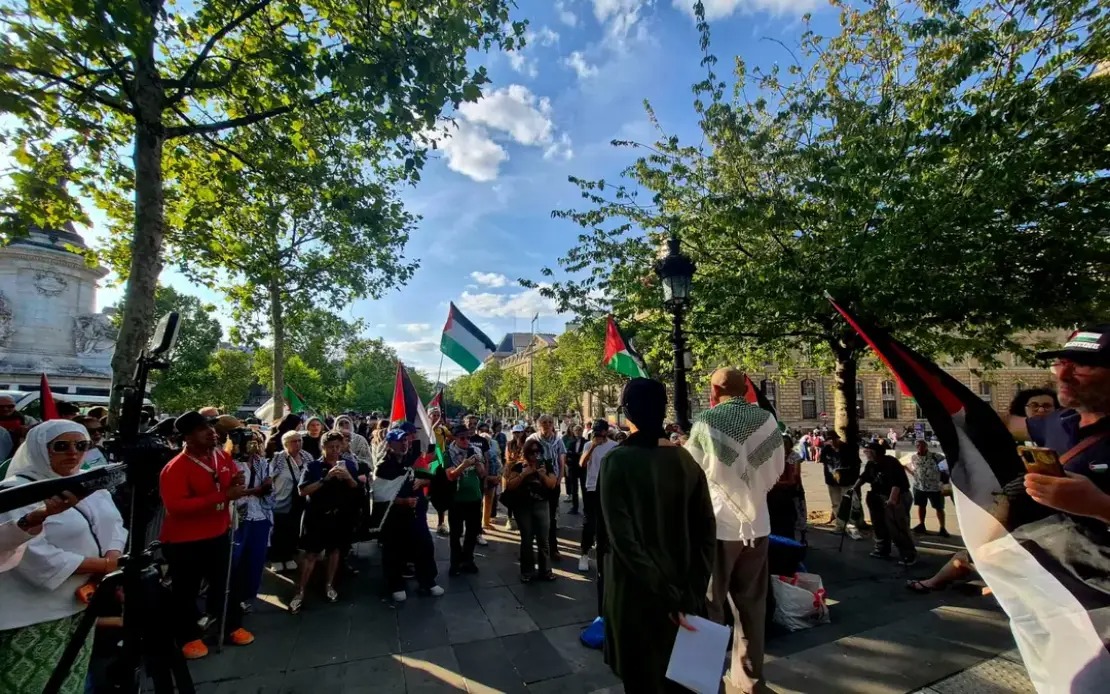
A grassroots international convoy comprising activists, academics, healthcare workers, and civil society representatives has set out from France on an ambitious overland journey designed to spotlight the ongoing Palestinian humanitarian crisis and alleged human rights violations. The initiative represents an attempt by independent organisers to mobilise global solidarity through direct action, with participants expecting to traverse thousands of kilometres across multiple continents before reaching their destination near the West Bank border.
The convoy will first converge in Srebrenica, Bosnia and Herzegovina, a symbolic choice reflecting the movement's commitment to remembering past atrocities and preventing future humanitarian catastrophes. From there, delegations from various European nations will join the main body before the expanded group proceeds to Istanbul, where a wider multinational assembly is anticipated. The route subsequently passes through Türkiye, Iraq, and Jordan, with the journey structured to allow for strategic meeting points and collaborative planning among participating organisations.
Palestine Convoy, the organising body behind the initiative, characterises the movement as an independent, people-driven international solidarity initiative rather than a traditional humanitarian aid operation. In official statements, organisers emphasise that the primary objective is advocacy and awareness-raising, with meetings and public events planned throughout the route to encourage broader engagement with Palestinian issues. The movement explicitly commits itself to peaceful and non-violent methodologies, reflecting broader international protest traditions centred on civil disobedience and public discourse.
The participant base reflects significant geographical and demographic diversity, drawing nearly 500 individuals from Malaysia, Indonesia, and across Europe, North Africa, and beyond. Representatives include healthcare professionals, students, trade unionists, academics, artists, and faith leaders, alongside independent activists from nations including France, Germany, Canada, Switzerland, Australia, Chile, Italy, Spain, South Africa, Finland, the Netherlands, Türkiye, Tunisia, Algeria, Libya, Morocco, the United States, the United Kingdom, and Belgium. This multinational character underscores the movement's positioning as a transnational civil society initiative rather than a campaign sponsored by any single government or major institutional actor.
The logistical arrangements reflect the grassroots nature of the undertaking, with participants travelling via diverse means including personal vehicles, vans, buses, motorcycles, and bicycles. This decentralised transportation model both symbolises the organic, volunteer-driven character of the movement and allows for flexible participation from individuals with varying resource constraints. The choice to utilise multiple transport modes also enables the convoy to maintain visibility throughout its journey while accommodating participants across different economic circumstances.
Beyond raising awareness about humanitarian conditions, the convoy explicitly opposes Israel's occupation of Palestinian territories and campaigns against recent Israeli legislation introducing capital punishment, which organisers characterise as discriminatory toward Palestinian detainees. This dual focus—on humanitarian advocacy and political opposition—reflects broader Palestinian solidarity movements that intertwine documentation of civilian suffering with explicit statements opposing particular government policies. The legislative focus on death penalty provisions indicates how international advocacy networks increasingly target specific legal mechanisms alongside territorial disputes.
For Malaysian and Southeast Asian observers, the participation of substantial numbers from the region carries particular significance. Malaysia's established role within international solidarity movements and its historical emphasis on Palestinian causes within multilateral forums suggests this convoy represents a continuation of long-standing regional diplomatic and civil society positions. The presence of Indonesian participants alongside Malaysian activists reflects broader Southeast Asian engagement with Middle Eastern affairs, while the journey itself provides a platform for these regional perspectives to gain expression within a globally distributed movement.
The convoy's routing through Istanbul and subsequently into the Middle East creates opportunities for engagement with local civil society organisations and communities directly affected by regional conflicts. By physically traversing territories connected to the convoy's ultimate destination, participants experience firsthand the geographical and political complexities of their advocacy focus. This methodology contrasts with remote activism, instead prioritising embodied solidarity and direct encounter with communities and landscapes central to the movement's concerns.
Organisers have deliberately structured the initiative to avoid replicating traditional humanitarian logistics, instead emphasising the political and symbolic dimensions of collective travel. Rather than focusing primarily on delivering material aid—though participants may carry supplies—the convoy positions itself as a statement of international witness and solidarity. This approach reflects evolving protest methodologies that combine public demonstration, route-based activism, and international coalition-building into integrated campaigns.
The initiative emerges within a context of intensified international debate regarding Palestinian representation and accountability mechanisms. By bringing together diverse professional communities including healthcare workers and academics, the convoy attempts to foreground technical expertise and professional testimonies regarding humanitarian conditions. This strategy leverages the credibility of specialist participants to underscore claims about civilian suffering and policy impacts beyond purely political assertion.
As the convoy progresses through multiple jurisdictions, it will inevitably encounter varying governmental and public responses reflecting different national positions on Israeli-Palestinian affairs. This geographical dimension tests the movement's capacity to maintain coherence and message consistency across diverse political contexts. The journey essentially maps contemporary international divisions regarding Middle Eastern conflicts onto a physical route, with each border crossing and national transit reflecting broader geopolitical alignments.
The convoy's emphasis on non-violent, civilian-led action positions it within established traditions of international solidarity movements, whilst its specific focus on Palestine reflects the particular centrality of this conflict within global civil society discourse. By assembling participants across 20 countries and diverse professional backgrounds, organisers seek to counter narratives portraying Palestinian advocacy as sectarian or monolithic, instead demonstrating its embedding within mainstream international civil society networks and professional communities across the Global North and South.

