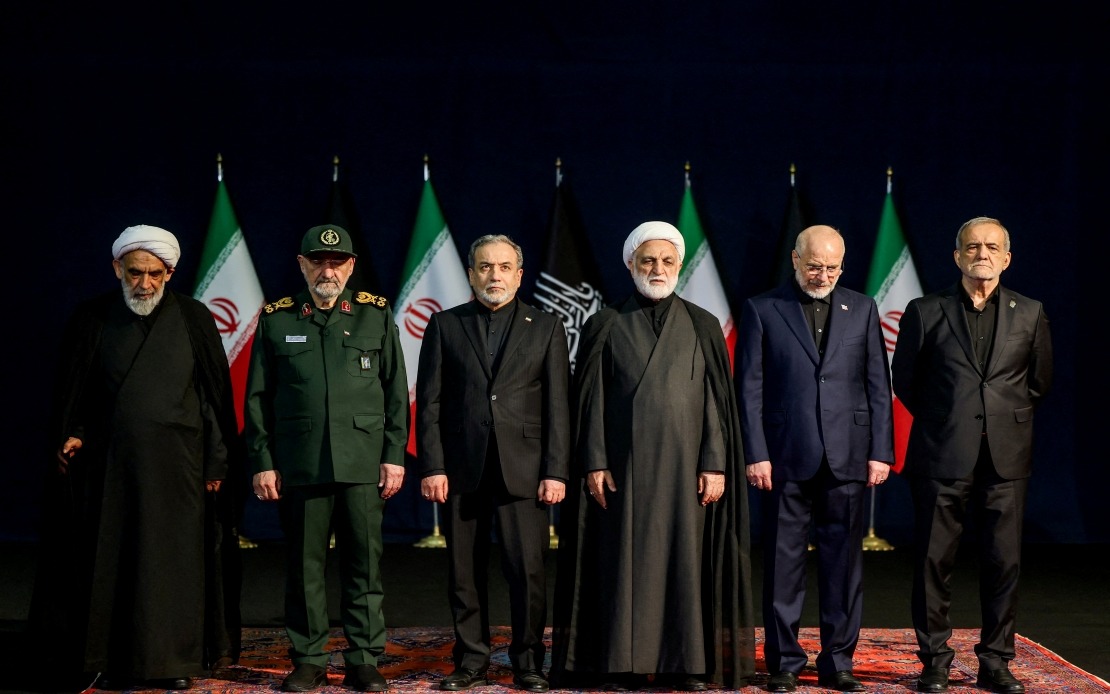
A significant gathering of Iranian state leadership and international dignitaries convened in Tehran on Friday to pay final respects to Ayatollah Ali Khamenei, Iran's late Supreme Leader, at ceremonies that began at the iconic Imam Khomeini's Mosalla prayer hall in the capital's central district. The occasion underscored Iran's continued engagement with regional and global powers despite recent geopolitical tensions, with attendees representing a cross-section of political, military, and religious institutions.
The domestic delegation showcased Iran's entire power structure, with President Masoud Pezeshkian leading the procession alongside senior figures whose influence shapes governance and policy across the Islamic Republic. Parliament Speaker Mohammad Baqer Qalibaf's presence highlighted legislative representation, while Judiciary Chief Gholamhossein Mohseni-Ejei and Sadeq Amoli Larijani, who chairs the influential Expediency Discernment Council, demonstrated the involvement of Iran's complex system of checks and balances. These officials collectively represent the institutional pillars that sustain Iran's political framework, and their unified appearance conveyed stability during a period of succession.
The international representation extended across Asia and the Middle East, reflecting Iran's strategic partnerships and its role within regional geopolitics. Pakistan's Prime Minister Shehbaz Sharif and Field Marshal Syed Asim Munir travelled to Tehran, signalling the enduring ties between Islamabad and Tehran despite broader South Asian tensions. This visit carries particular significance for Malaysia and other Southeast Asian nations mindful of Pakistan's balancing act between its Gulf partnerships and its relationship with Iran. Armenian Prime Minister Nikol Pashinyan and Georgian President Mikheil Kavelashvili attended from the Caucasus, a region where Iran maintains historical and cultural connections, while Iraqi President Nizar Amedi and the Kurdistan Region's President Nechirvan Barzani underscored Iraq's complex relationship with its neighbour.
The presence of delegations from China and Russia alongside representatives from these Middle Eastern and South Asian nations illustrated the multipolar dimension of Iran's foreign relations. For Malaysian observers, this gathering provided a window into how Iran navigates relationships across competing geopolitical blocs, particularly as Beijing and Moscow seek to deepen ties with Tehran amid Western sanctions. The attendance of Tajik President Emomali Rahmon further demonstrated Iran's reach into Central Asia, a region increasingly contested between regional powers and external actors seeking influence.
Beyond governmental representatives, the ceremony drew religious scholars, tribal leaders, and community figures whose participation underscored the deeply cultural and spiritual dimensions of Khamenei's legacy within Iran. These attendees represented constituencies across Iranian society whose worldviews have been shaped by Khamenei's four decades of supreme leadership, making the transition to his successor a moment of both continuity and potential change in how Iran's government relates to its people.
The funeral proceedings extend far beyond the initial Friday tribute ceremony, with officials announcing a full week of commemorative activities stretching through July 9. These observances will unfold across Iran's three most significant religious and political centres: Tehran, where government authority is concentrated; Qom, the theological heart of Shia scholarship; and Mashhad, home to one of Islam's holiest shrines. The ceremonial geography itself carries meaning, allowing Iranians across different regions to participate in collective mourning while reinforcing the spiritual and administrative legitimacy of Iran's leadership structures.
Iraq's inclusion in the funeral schedule, with specified rites to be conducted there, reflects the deep historical and religious bonds connecting these two predominantly Shia nations. This transnational dimension of mourning practices carries implications for how Iran's new leadership might engage with Iraq and other neighbouring states, particularly given Iraq's precarious position balancing relationships between Iran, the United States, and regional actors. For Malaysian policymakers and analysts tracking Middle Eastern affairs, these ceremonial details offer clues about Iran's intended diplomatic priorities under new supreme leadership.
The Iranian government's announcement of public closures and airspace restrictions in Tehran and Mashhad demonstrates the scale of anticipated public participation and the security measures deemed necessary during this sensitive transition period. The declaration of Thursday as a national day of mourning transformed a period of individual grief into a coordinated state ceremony, reinforcing the Supreme Leader's role as a unifying national symbol rather than merely a political figure. This distinction matters significantly for understanding Iran's governance model and how leadership succession occurs within the Islamic Republic's institutional framework.
Ayatollah Ali Khamenei's death on February 28 marked the end of an era spanning four decades of supreme leadership, a period encompassing Iran's post-revolution consolidation, its devastating war with Iraq, nuclear programme development, and repeated cycles of international sanctions and diplomatic initiatives. His successor, his son Mojtaba Khamenei, was selected by Iran's Assembly of Experts in March, elevating a figure who had previously maintained a lower public profile compared to his father's prominent role. This succession represents a pivotal moment for Iran's trajectory, and international observers—particularly those in Southeast Asia concerned with regional stability and the management of great power competition—view the transition with careful attention to potential shifts in Iranian policy.
The gathering of such a diverse array of foreign officials at Iran's state funeral suggested that despite profound disagreements with Western governments and ongoing international tensions, Iran maintains sufficient diplomatic relationships to command respect from significant regional and global actors. For Malaysia's foreign policy establishment, which maintains non-aligned principles and seeks balanced relationships across different geopolitical blocs, Iran's continued ability to attract high-level international recognition carries lessons about the persistence of diplomatic channels even amid conflict and sanctions. The week-long funeral proceedings provide Iran's new supreme leader with a crucial opportunity to signal continuity or change in its foreign relations and domestic priorities during what remains an inherently unstable period of governmental transition.

