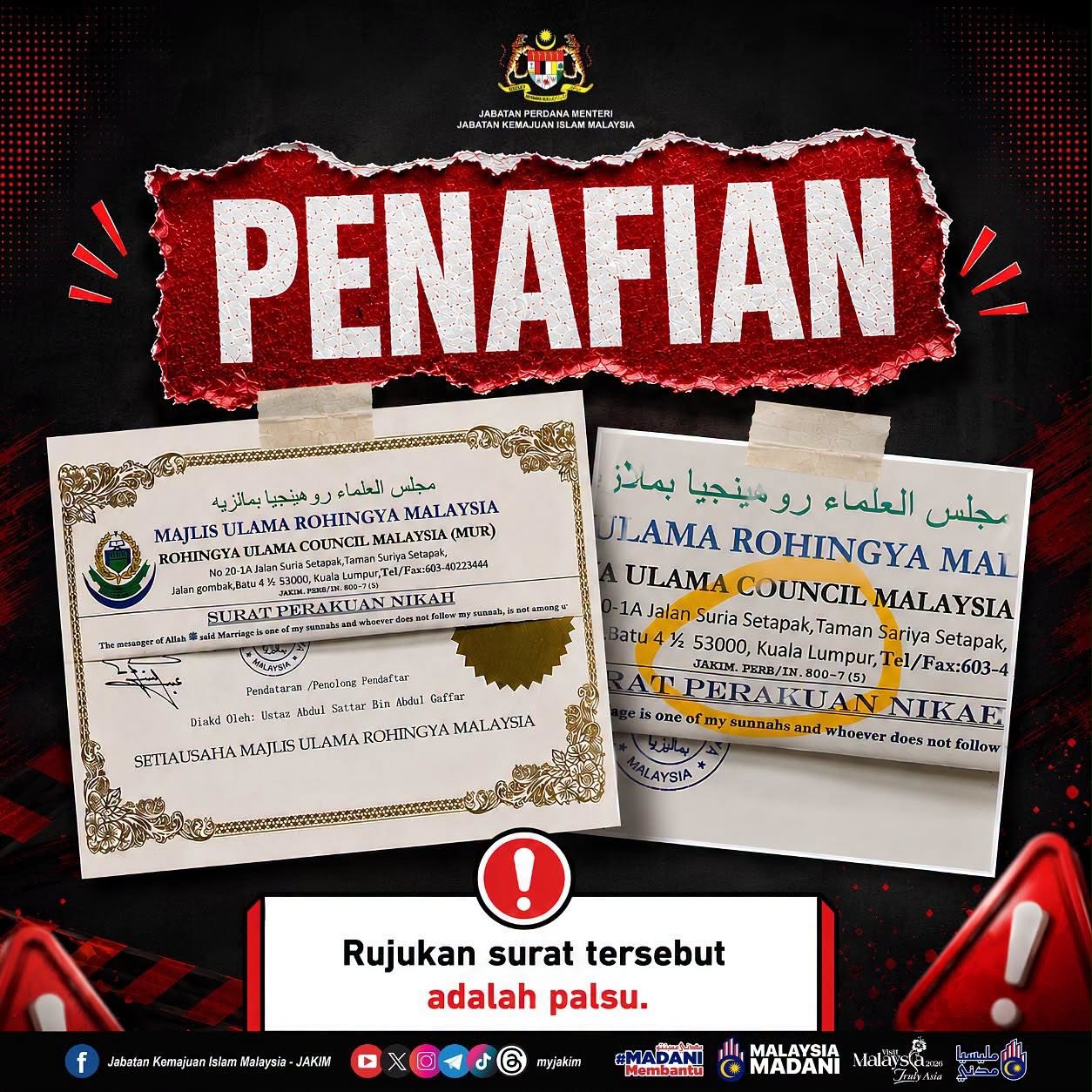
The Department of Islamic Development Malaysia (JAKIM) has moved swiftly to address a growing concern about document fraud, publicly confirming that a reference number appearing on a marriage-related letter circulating across social media platforms is entirely fabricated. In an official statement released through its Facebook page on July 15, JAKIM clarified that the document in question was neither created nor authorised by the department or any legitimate Islamic religious body operating within Malaysia's regulatory framework.
The questionable letter, allegedly issued under the banner of the Malaysia Rohingya Ulama Council, carried the reference number "JAKIM.PERH/LN.800-7(5)" and purported to certify matters related to marriage. The suspicious documentation gained considerable traction online, prompting concerned citizens and social media users to question its legitimacy and connection to official government bodies. The viral spread of such documents represents a significant risk to public trust in authentic religious certification processes and highlights vulnerabilities in how easily fraudulent paperwork can circulate in the digital age.
JAKIM's investigation revealed that neither the department nor any state-level Islamic religious councils or departments have ever engaged the mentioned organisation to oversee, validate, or administer marriage-related certifications. This categorical denial effectively dismantles any claims of official endorsement that the document might have suggested to unsuspecting members of the public. The explicit confirmation that the reference number is counterfeit represents an important guardrail against document fraud in religious and administrative matters, which carry significant consequences for individuals seeking to formalise marriages or other religiously significant transactions.
The existence of such fraudulent documents points to a broader challenge facing Malaysia's regulatory bodies: the increasing sophistication of forged official paperwork and the ease with which fabricated materials can achieve widespread distribution through social media networks. In an era where digital literacy varies considerably across different demographic groups, official-looking documents bearing seemingly authentic reference numbers can deceive ordinary citizens who may lack the means to independently verify authenticity. This incident underscores why public institutions must remain vigilant and responsive in debunking false documents before they gain further credibility through circulation.
In response to the unfolding situation, the Minister in the Prime Minister's Department overseeing religious affairs, Dr Zulkifli Hasan, indicated that the matter would be subject to formal investigation once comprehensive information had been compiled. This commitment to investigation signals that authorities are treating the incident seriously and view it not merely as a social media curiosity but as a potential criminal matter that warrants proper investigative procedures. The involvement of the ministerial level demonstrates the gravity with which the government treats document fraud involving religious institutions and processes.
JAKIM has seized this opportunity to educate the public about protective measures against document fraud. The department has explicitly urged Malaysian citizens to adopt a verification practice before accepting any purportedly official religious documents at face value. This guidance emphasises that individuals should contact JAKIM directly or consult relevant state Islamic religious authorities when encountering documents whose authenticity appears questionable. By empowering citizens with clear information about how to verify documents, the department aims to reduce the pool of potential victims who might otherwise be deceived by sophisticated forgeries.
The incident highlights the particular vulnerability of Rohingya-related documentation, given the complex legal and administrative status of Rohingya populations within Malaysia. The invocation of a Rohingya Ulama Council in the fraudulent letter may have been a deliberate choice, exploiting the relative unfamiliarity many Malaysians have with Rohingya institutional structures and the sensitivity surrounding Rohingya integration issues. This dimension suggests that bad actors may be weaponising knowledge gaps and community-specific circumstances to craft convincing fakes that would fool casual observers.
For Malaysian readers and Southeast Asian observers, this case serves as a cautionary tale about the importance of institutional authentication in an increasingly digital world. Religious matters, marriage certifications, and official documentation carry profound personal and legal implications, making document verification not merely a bureaucratic inconvenience but a critical safeguard. The proliferation of counterfeit official documents undermines public faith in legitimate institutions and creates confusion that can lead vulnerable individuals into problematic situations.
The practical implications for ordinary Malaysians are substantial. Anyone who encounters religious or official documentation should recognise that appearance alone does not guarantee legitimacy. Reference numbers can be invented, letter formats can be replicated, and institutional names can be invoked fraudulently. The safest approach is to treat all such documents with healthy scepticism and to verify through direct contact with the claiming institution rather than accepting face-value claims of authenticity. This advice applies equally to marriage certifications, Islamic educational credentials, or any other official document bearing religious or governmental authority.
Looking forward, this incident may prompt Malaysian authorities to strengthen their own internal document tracking and reference number systems to make forgeries easier to detect. It may also encourage greater public awareness campaigns about document verification, particularly targeting communities that might be vulnerable to such fraud. For the broader Southeast Asian region, where fraudulent documentation represents an ongoing challenge to governance and public administration, Malaysia's swift response to this particular case offers a useful model of institutional transparency and public communication.

