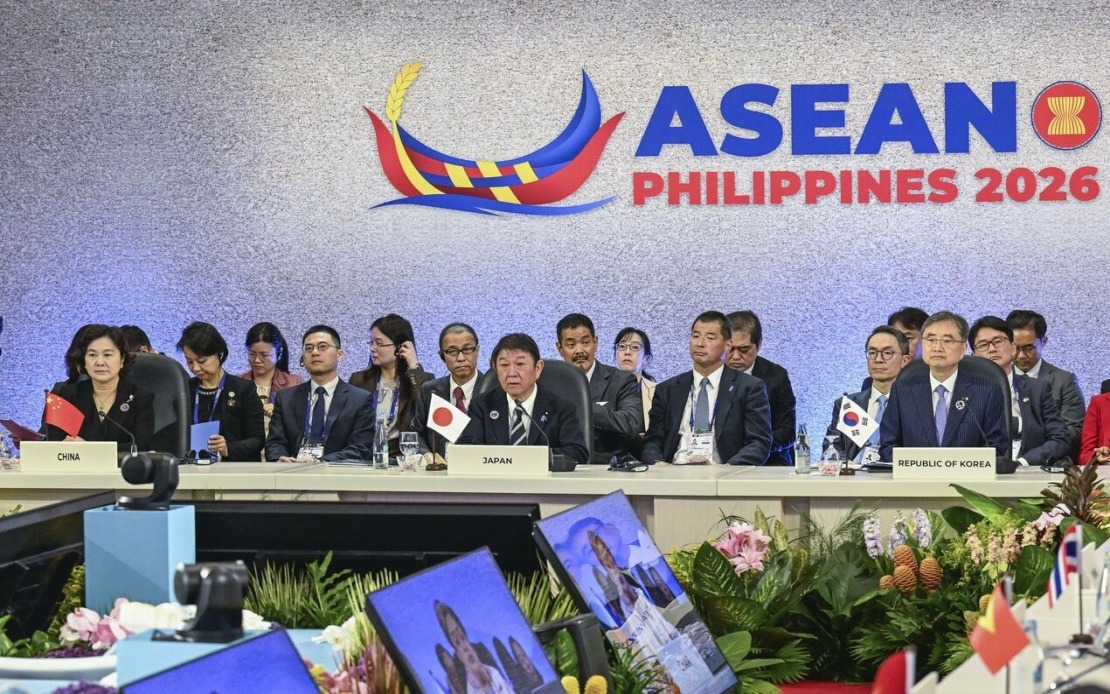
Japan has signalled its intention to deepen regional cooperation on energy resilience and digital security threats during high-level talks with ASEAN members, China, and South Korea in Manila. Japanese Foreign Minister Toshimitsu Motegi used the ASEAN-plus-three foreign ministers gathering to outline Tokyo's strategic priorities, emphasizing both practical collaboration and alignment with established regional frameworks that have guided East Asian diplomacy for over two decades.
Motegi's presentation highlighted Japan's recognition that the collective economic weight of ASEAN-plus-three nations—representing more than 25 percent of global GDP—grants the grouping substantial leverage in shaping international affairs. This framing reflects Tokyo's broader strategy to position itself as a bridge between Southeast Asia and Northeast Asia while reinforcing multilateral institutions at a time when regional tensions and global fragmentation pose challenges to stability. By invoking the economic heft of the assembled nations, Japan sought to underscore why the grouping's decisions on energy policy and security matter well beyond Asia's borders.
Energy security emerged as a central concern at the talks, with participants expressing alarm at volatile conditions affecting West Asian energy supplies. Japan, heavily dependent on imported energy resources, has long advocated for diversified supply chains and regional cooperation to insulate the Indo-Pacific from external shocks. The discussion reflected broader regional anxieties about supply chain vulnerabilities exposed during geopolitical crises, a concern that directly affects Malaysian and other Southeast Asian economies reliant on stable energy markets. Strengthening intra-regional networks for energy distribution and strategic reserves could shield member states from price volatility and supply disruptions.
Cybercrime, particularly online scams targeting both individuals and businesses, has emerged as a pressing transnational challenge across Southeast Asia. The commitment to combat these offences signals recognition that digital fraud syndicates often operate across borders, requiring coordinated law enforcement and information-sharing mechanisms. For Malaysia and its neighbours, where online scam networks have increasingly sophisticated operational structures, such cooperation offers potential pathways to enhance cybersecurity infrastructure and prosecution capacity.
Motegi reiterated Japan's backing for ASEAN centrality and unity, principles that have underpinned regional diplomacy since the founding of ASEAN in 1967. This support carries particular significance given geopolitical pressures that have occasionally tested ASEAN cohesion. Japan's endorsement of the ASEAN Outlook on the Indo-Pacific—a framework adopted to safeguard maritime freedom, rules-based order, and prosperity—underscores Tokyo's alignment with Southeast Asian vision statements on regional governance. The explicit affirmation that Japan's own free and open Indo-Pacific strategy shares fundamental principles with AOIP indicates Tokyo's effort to present itself as a natural partner rather than an external power imposing its agenda.
China's participation through Vice Foreign Minister Hua Chunying, rather than Foreign Minister Wang Yi, carried subtle diplomatic weight, potentially signalling either scheduling constraints or a deliberate calibration of Beijing's engagement level. Regardless of intent, China's presence affirmed its stake in ASEAN-plus-three mechanisms even as broader Sino-Japanese and Sino-American tensions persist in the region. The framework itself, established following the 1997 Asian financial crisis, represents one of Asia's longest-running multilateral institutions, proving resilient through successive geopolitical cycles.
The commitment to promote AOIP through ASEAN-plus-three coordination reveals Japan's sophisticated approach to advancing its strategic interests through consensus-building rather than unilateral action. By channelling Tokyo's Indo-Pacific initiatives through regional multilateral bodies, Japan seeks legitimacy and burden-sharing while maintaining influence over regional rule-setting. This approach holds implications for Malaysia's own diplomatic positioning, as Southeast Asian nations navigate between multiple regional powers advancing competing visions of order.
Motegi's subsequent bilateral meeting with newly appointed British Foreign Secretary Ed Miliband illustrated Japan's parallel effort to strengthen ties with Western democratic partners. The mention of Prime Minister Andy Burnham's administration signals Tokyo's expectation of continuity in UK-Japan strategic partnership despite British political transitions. For Southeast Asian observers, Japan's simultaneous deepening of ties with both Asian and Western democracies reflects the region's status as a strategic arena where multiple powers compete for influence and alignment.
The ASEAN-plus-three summit, last held in Malaysia in October, represents the grouping's highest decision-making level. Regular ministerial meetings like the one in Manila maintain momentum between summits, allowing for detailed policy development and issue-specific coordination. The energy and cybercrime agenda reflects both immediate security concerns and longer-term structural challenges facing the Indo-Pacific region. Malaysia, as an ASEAN member with significant energy interests and growing digital economy vulnerabilities, stands to benefit from enhanced multilateral mechanisms addressing these domains.
Japan's diplomatic positioning at this juncture underscores Tokyo's recognition that regional stability serves its interests while supporting the broader Indo-Pacific security architecture. By emphasizing cooperation rather than competition, and by operating through established multilateral channels rather than ad-hoc coalitions, Japan seeks to maintain optionality and avoid the perception of leading exclusive groupings that might provoke Beijing's countermeasures. For Southeast Asian nations balancing relationships with major powers, Japan's approach offers a model of engagement that emphasizes inclusive frameworks over divisive alignments.
The gathering in Manila demonstrated that despite global fragmentation, East Asia's diplomatic institutions retain capacity for productive engagement on shared challenges. Energy security and cybercrime transcend ideological divides and affect all member states regardless of bilateral tensions. How effectively ASEAN-plus-three translates these pledges into operational mechanisms—whether through joint task forces, intelligence-sharing protocols, or coordinated infrastructure investments—will determine whether the Manila meeting represents a meaningful advance or merely ceremonial diplomacy. For Malaysia and its Southeast Asian partners, the success of such initiatives directly influences regional prosperity and security resilience in coming years.

