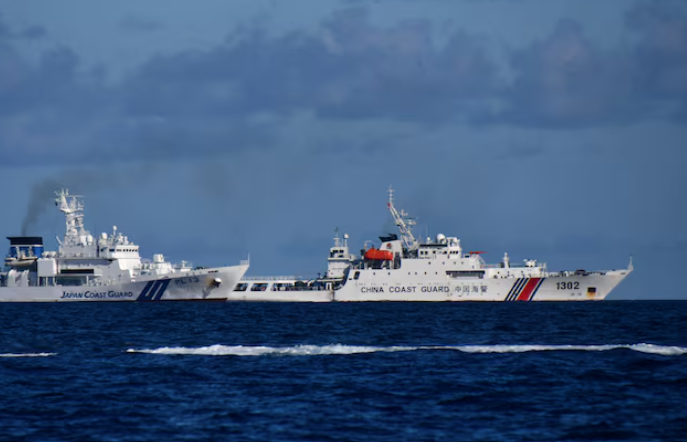
Japan's coast guard successfully expelled two Chinese coast guard vessels from waters surrounding the Senkaku Islands on Tuesday, in what represents an increasingly common flashpoint in maritime tensions between Asia's two largest economies. The expulsion occurred after the Chinese ships attempted to approach a Japanese fishing vessel that was lawfully operating in the disputed area, prompting immediate intervention from Japanese maritime authorities who declared the incident a breach of international law.
The Senkaku Islands, which China identifies as the Diaoyu and claims as its own territory, sit strategically positioned between Taiwan and Japan's Okinawa prefecture. These uninhabited rocky outcrops have served as a enduring source of bilateral friction for decades, with both nations asserting sovereign rights over the archipelago. The geographic location amplifies the islands' strategic importance, as the surrounding waters are believed to contain substantial deposits of oil and natural gas reserves that could be crucial to energy security across the region.
While incursions into these contested waters by Chinese maritime forces have become increasingly routine, the approach toward a Japanese fishing vessel represents a notable escalation in confrontational behaviour. The coast guard documented that four Chinese ships were initially operating in the general vicinity before two of them breached into what Japan recognises as its territorial waters. Upon issuing directives for the vessels to depart, Japanese authorities reported successfully forcing them to exit Japanese-claimed territory by approximately 9:20 am local time. Simultaneously, the coast guard established a protective cordon around the Japanese fishing boat to safeguard it from further interference.
Tensions between Tokyo and Beijing have intensified markedly since November, when Prime Minister Sanae Takaichi made controversial remarks regarding Japan's potential military response to any assault on Taiwan. Her statements, which suggested Japan might intervene militarily to defend the self-governed island, provoked sharp condemnation from Beijing, which views Taiwan as a breakaway province and has explicitly retained the option of forceful reunification. These comments represented a significant diplomatic departure from Japan's traditionally cautious positioning on cross-strait security matters.
The Chinese government responded to Takaichi's November comments through multiple retaliatory channels. Beijing has discouraged its citizens from travelling to Japan, implemented selective trade restrictions targeting certain Japanese companies, and ramped up maritime activities around the disputed islands as a demonstration of resolve. The coast guard statement on Tuesday emphasised that such Chinese operations constitute systematic violations of international law and directly threaten Japan's territorial integrity and the safety of its maritime workers.
This particular incident differs from many previous intrusions because it involved direct interaction with a civilian fishing vessel engaged in lawful economic activity. Previous Chinese incursions, while frequent, often involved patrol operations around the islands themselves. The targeting of a working fishing boat signals an attempted assertion of Chinese authority over the fishing grounds, which represent a valuable economic resource for Japanese maritime communities. Such actions place ordinary fishermen in vulnerable positions during an already tense geopolitical situation.
Japan's coast guard has adopted what officials describe as a posture of "calm and resolute" response, committing to continued monitoring and enforcement of maritime law within its claimed territorial waters. This measured approach reflects Japan's broader strategy of avoiding direct military confrontation while firmly maintaining its legal position. However, the frequency of these incidents suggests that diplomatic channels have become insufficient to manage the escalating pattern of Chinese incursions.
The broader context involves Chinese activities across multiple disputed zones throughout the East China Sea. Beijing has systematically deployed coast guard and maritime militia vessels to assert control over contested waters throughout the region, a strategy that extends beyond the Senkaku Islands to other areas where territorial claims overlap with those of neighbouring nations. Japan has repeatedly protested these operations through official channels, yet the incursions have continued unabated, suggesting that economic and energy interests drive Chinese policy more than diplomatic objections can counter.
For Southeast Asian readers, this conflict carries significant implications. The Senkaku Islands dispute demonstrates how regional maritime tensions can escalate independently of formal military confrontation, creating zones of persistent instability. The energy reserves in the East China Sea represent resources that could affect energy prices and availability across the region. Additionally, the dispute illustrates how tensions between major powers can affect smaller nations' fishing industries and economic access to traditional maritime zones.
The incident also highlights Japan's role as a potential counterbalance to Chinese maritime assertiveness in Asian waters. Tokyo's willingness to confront Chinese vessels, combined with its alliance relationships and military capabilities, positions it as a stabilising force in regional security calculations. However, without diplomatic breakthroughs addressing the underlying sovereignty question, such maritime incidents appear likely to become more frequent rather than less, potentially creating risks of miscalculation or accident.
The relationship between Japan and China remains fundamentally strained across multiple domains, from historical grievances to contemporary strategic competition. The Senkaku Islands represent just one manifestation of deeper structural tensions that encompass trade policies, military modernisation, and competing visions for regional order. Until both capitals develop mechanisms to manage these disputes peacefully, incidents such as Tuesday's expulsion will likely persist as recurring reminders of unresolved tensions in one of the world's most economically significant regions.

