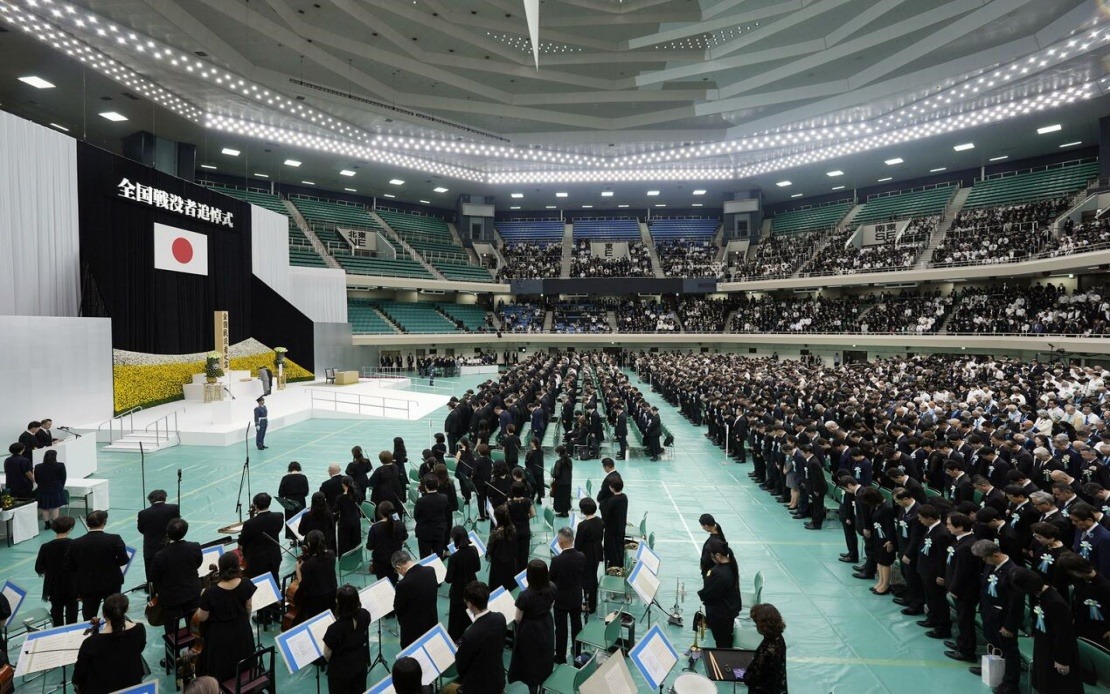
Japan observed the 81st anniversary of its surrender in World War II on Saturday with a solemn state ceremony in Tokyo, yet the occasion underscored a widening political divide over how the nation should publicly acknowledge its wartime legacy. Prime Minister Sanae Takaichi, attending the memorial for the first time since assuming office last October, delivered a speech emphasising Japan's dedication to peace while conspicuously refraining from invoking the concept of national "remorse" that has increasingly featured in recent years' observances. The ceremony drew Emperor Naruhito and Empress Masako to mourn approximately 2.3 million military personnel and roughly 800,000 civilians who perished during the conflict that concluded in 1945.
Takaichi's linguistic choice represents a significant retreat from the language employed by her immediate predecessor, Shigeru Ishiba, who at last year's commemoration explicitly referenced Japan's "remorse" over the war and pledged the nation's commitment to renouncing armed conflict. Ishiba's willingness to use that terminology had itself been noteworthy, as it marked the first time in thirteen years that a sitting Japanese prime minister had articulated remorse at an August 15 ceremony. The contrast highlights growing tension within Japan's ruling Liberal Democratic Party between those who view explicit acknowledgment of wartime aggression as essential to national reconciliation and those who prefer framing Japan's historical narrative around peace commitment without dwelling on past culpability.
The omission carries particular significance given Takaichi's known hawkish orientation toward national security matters. Her rhetorical pivot—asserting that Japan "has consistently walked the path of a nation that values peace and made all possible efforts for world peace and prosperity"—sidesteps the more emotionally resonant language of acknowledgment that characterised the Ishiba address. This formulation allows her to reaffirm Japan's contemporary peace orientation without conceding moral accountability for historical transgressions, a distinction that Southeast Asian nations with their own complex histories of Japanese wartime occupation will likely view with concern.
The ceremonial treatment of wartime aggression has undergone notable transformation since the administration of Shinzo Abe, Takaichi's political mentor, who returned to power in December 2012. Prior to Abe's second tenure, consecutive Japanese prime ministers had consistently acknowledged the nation's military expansion across Asia and expressed official remorse at August 15 observances. The post-2012 era witnessed a gradual softening of such acknowledgment, reflecting ideological preferences within conservative circles to reframe Japan's historical identity away from narratives of aggression toward emphasis on resilience, sacrifice, and contemporary pacifism. Takaichi's approach continues this trajectory, suggesting that the brief period of explicit remorse may prove ephemeral rather than marking a sustained policy shift.
Emperor Naruhito maintained the imperial tradition by expressing "deep remorse" during his own remarks at Saturday's ceremony, language he has consistently employed annually. The Emperor's separate articulation of remorse—distinct from the prime minister's omission—creates an interesting constitutional dynamic, with Japan's ceremonial head of state offering the acknowledgment of historical responsibility that the elected government declines to voice. This bifurcation allows Japan to maintain a formal position of remorse through imperial pronouncement whilst permitting the administration to chart a different rhetorical course, effectively providing domestic and international audiences with multiple registers of national self-understanding.
Notably absent from Takaichi's remarks was any direct reference to Japan's wartime aggression in Asia, encompassing military operations across China and the Korean Peninsula. This avoidance echoes a pattern established by recent prime ministers, contrasting sharply with the pre-Abe convention of explicit acknowledgment. The strategic vagueness permits politicians to avoid contentious specifics about colonial occupation, wartime atrocities, and regional displacement whilst maintaining plausible deniability about whether such omission constitutes denial or merely rhetorical restraint. For regional observers, particularly in China and Korea, the absence registers as meaningful, regardless of intent.
The timing of this anniversary proves particularly loaded given Japan's current strategic environment and its accelerating military reorientation. The ceremony occurred against a backdrop of elevated tensions in West Asia and Japan's own dramatic shift in defense posture, including substantial increases in national security expenditure and relaxation of regulations governing defense equipment exports. These policy developments suggest that Japan's security establishment views the contemporary international landscape as one demanding military preparedness and technological dynamism, potentially informing the government's preference for forward-looking peace narratives over backward-looking acknowledgment of historical responsibility.
For Southeast Asia specifically, the recalibration of how Japan publicly processes its wartime past carries diplomatic implications. Nations within the region that experienced Japanese military occupation and occupation-era violence maintain complex relationships with contemporary Japan, balancing recognition of current regional cooperation and Japanese technological and economic contributions against historical memory and ongoing disputes over acknowledgment. The Prime Minister's rhetorical choices at this ceremonial moment signal whether Japan intends to maintain or further attenuate its formal engagement with historical accountability, information that informs bilateral and regional diplomatic calculations.
The ceremony concluded with a moment of silence observed at noon, precisely the hour at which Emperor Hirohito announced Japan's surrender via radio broadcast in 1945. This synchronized observance provides continuity with seven decades of tradition, even as the contemporary narrative framing surrounding the ceremony undergoes subtle but significant revision. The technical precision of the memorial—the preserved broadcast time, the consistent gathering of Japan's highest officials—contrasts with the increasingly contested meaning attributed to the historical moment itself, reflecting how nations struggle to maintain ceremonial unity whilst internally disagreeing about historical interpretation and contemporary implications.

