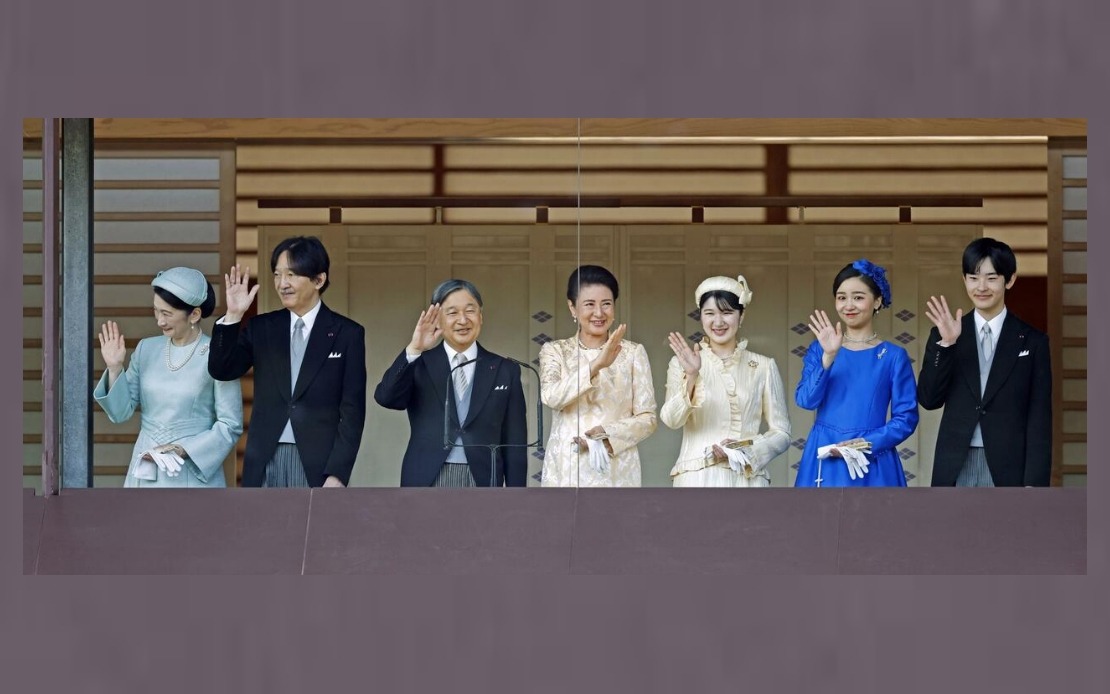
Japan's parliament has approved a significant revision to its Imperial House Law on Friday, marking the first substantive overhaul since 1947 as the nation grapples with a dwindling royal lineage. The legislative changes represent an attempt to modernize succession rules without fundamentally altering the principle that only males in the direct paternal line may ascend the Chrysanthemum Throne, a position that sits uneasily with broader public sentiment favouring greater flexibility.
The reformulated law introduces two noteworthy modifications to the legal framework governing Japan's imperial institution. It now permits the adoption of unmarried males aged 15 and above who descend from former branch families through exclusively male lines, potentially expanding the pool of eligible successors. Additionally, the revision grants imperial women the right to maintain their royal status following marriage to non-aristocratic men, a change that acknowledges contemporary social realities while stopping short of addressing succession possibilities through female heirs.
These amendments emerge against a backdrop of genuine demographic crisis within the imperial family. Japan currently has only three male heirs to Emperor Naruhito, a concerning shortage for an institution that has maintained an unbroken lineage for over a millennium. The eleven former branch families, whose members were stripped of imperial status in 1947 following Japan's post-war reconstruction, suddenly present a potential solution to this succession bottleneck. Previously considered legally impossible, adoptions from these families now offer a mechanism to bolster the pool of eligible male successors without disrupting the patrilineal succession principle.
The government led by Prime Minister Sanae Takaichi, Japan's first female premier, has positioned the revision as pragmatic rather than revolutionary. Officials maintain that male descendants of adopted members would retain full rights to the throne under the revised framework, theoretically resolving succession anxieties for generations to come. However, this assertion rests on an untested legal structure, as such adoptions have never been implemented in practice. The government chose not to elaborate on detailed procedures or timelines for reintegrating descendants of former branch families into imperial service.
Yet the legislative process underlying this reform reveals significant tensions within Japan's political establishment. The ruling coalition—comprising Takaichi's Liberal Democratic Party and the junior Japan Innovation Party—faced sustained criticism from opposition lawmakers for what they characterised as inadequate parliamentary scrutiny. The months-long cross-party negotiations yielded a legislative "consensus" incorporating viewpoints from 13 parliamentary parties and groups, but conspicuously avoided addressing the succession issue directly. Opposition members contended that such a fundamental matter affecting Japan's constitutional monarchy deserved more thorough debate and deliberation before being enshrined in law.
Moreover, critics argued that the coalition's apparent determination to preserve male and patrilineal succession traditions represented a missed opportunity for broader reform. The revision's silence on female or maternal-line emperors reflects conservative institutional preferences that increasingly diverge from public opinion. This disconnect highlights how Japan's establishment institutions sometimes resist evolutionary pressures that broader society has largely accepted.
Public sentiment presents a striking counterpoint to legislative caution. A Kyodo News poll conducted in May revealed that 83.0 percent of respondents supported permitting female emperors, while only 13.1 percent opposed the concept. This substantial majority opinion suggests that ordinary Japanese citizens view the imperial succession question through a more egalitarian lens than their political representatives. The overwhelming public backing for female succession indicates that further reform is virtually inevitable, though likely to require additional legislative action beyond this initial revision.
Historically, the 1947 Imperial House Law that governed for over seven decades was itself a product of post-war transformation under United States occupation. That framework explicitly mandated that "the throne shall be succeeded to by a male offspring in the male line belonging to the Imperial Lineage," language that persists unchanged in the current revision. The maintenance of this principle across all subsequent reforms underscores how deeply entrenched patrilineal succession remains within Japan's institutional DNA, despite demographic pressures and evolving social values.
For Southeast Asian observers, Japan's approach to this constitutional challenge offers instructive parallels and contrasts. Many regional monarchies similarly grapple with succession dynamics and the tension between tradition and modernization. Thailand, Malaysia, Brunei, and Cambodia all maintain monarchical systems with varying rules governing succession and female participation. Japan's incremental reform strategy—addressing practical problems through limited modifications while preserving core principles—may appeal to conservative monarchical establishments across Asia. Yet the stark gap between public opinion and governmental caution also illustrates the risks of institutional rigidity when confronting social change.
The revision's practical implications remain somewhat opaque given the unprecedented nature of potential branch family adoptions. Questions persist about selection criteria, timing, and whether such adoptions would genuinely resolve Japan's succession anxieties or merely defer more fundamental restructuring. The law assumes that male descendants from these families would be willing and able to abandon civilian lives to assume imperial duties, an uncertain proposition in contemporary Japan.
Looking forward, the Imperial House Law revision may represent merely an interim solution rather than a final settlement of Japan's succession question. Political and demographic pressures favouring female succession appear likely to intensify over coming decades. When Japan's current male heirs eventually age beyond reproduction years without producing sufficient successors, the nation may find itself revisiting this question with even greater urgency. The Takaichi government's decision to defer more comprehensive reform, while solving immediate concerns through the adoption mechanism, leaves unresolved the larger question of whether Japan's world's oldest continuous monarchy can indefinitely maintain its male-succession tradition in an increasingly egalitarian age.
For now, Japanese lawmakers have opted for a pragmatic middle path that expands the succession pool without overtly challenging male-line privilege. Whether this compromise satisfies the complex pressures bearing upon Japan's imperial institution will become apparent only as the new law operates in practice and as demographic realities continue evolving.

