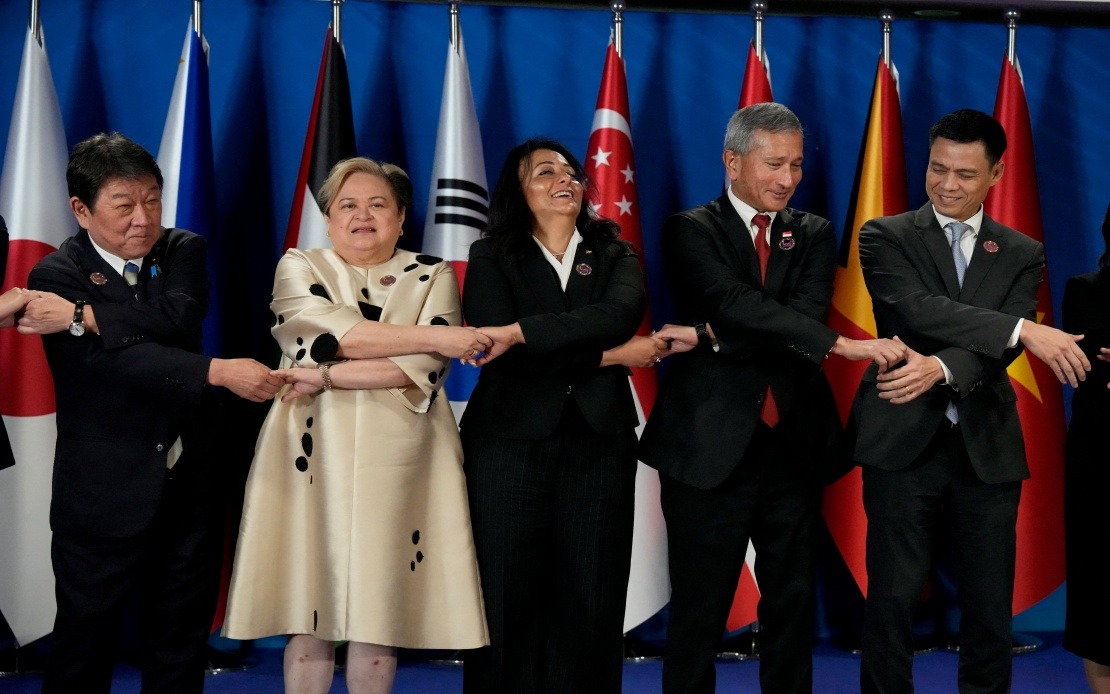
The Post-Ministerial Conferences between ASEAN and four major Asia-Pacific partners in Manila revealed a consolidated commitment to regional stability and cooperation, even as unprecedented global pressures reshape the geopolitical landscape. Japanese Foreign Minister Toshimitsu Motegi, South Korean counterpart Cho Hyun, New Zealand's Winston Peters and Australia's Penny Wong each stressed the centrality of ASEAN in maintaining regional balance and prosperity, underscoring how deeply entangled the fortunes of major powers have become with Southeast Asia's trajectory.
Japan's position reflects Tokyo's strategic pivot toward deepening engagement across multiple domains of future economic competition. Beyond traditional diplomatic niceties, Motegi identified digital transformation, artificial intelligence and green energy transition as priority areas for expanded partnership. These three sectors represent the frontiers of global economic power in coming decades—nations that lead in AI capabilities and renewable energy will disproportionately shape regional and global influence. By framing these as areas of mutual interest rather than competitive battlegrounds, Japan signals a preference for collaborative technological development alongside ASEAN members, a message likely designed to counterbalance perceptions of confrontational great-power rivalry in the region.
South Korea's diagnosis of regional challenges captures the interconnected nature of contemporary instability. Cho Hyun identified three destabilizing forces: fracturing global supply chains, West Asian tensions and accelerating technological change. Each phenomenon directly affects Southeast Asia. Supply chain disruptions have exposed the region's dependency on stable logistics networks and created vulnerabilities that authoritarian actors can exploit. Unrest in the Middle East reverberates through energy markets and maritime security corridors critical to ASEAN members' prosperity. Meanwhile, the speed of technological advancement outpaces many nations' capacity to develop regulatory frameworks, creating asymmetries of power and competence. Seoul's emphasis on solidarity as a stabilizing force represents a diplomatic strategy: if ASEAN nations coordinate responses rather than pursue individual adaptations, they retain collective bargaining power against external pressures.
South Korea's concrete initiatives—including an AI companionship programme and support for cultural and creative industries—demonstrate how regional powers are translating broad strategic rhetoric into tangible projects. These initiatives carry deeper significance than surface appearance suggests. AI companionship technologies address demographic challenges facing several Asian economies while generating intellectual property and technical expertise. Creative industries represent a softer form of cultural influence that builds affinity between populations without the overtones of traditional power politics. By directing investment toward these domains, Seoul positions itself as a partner invested in ASEAN's long-term development rather than merely extracting resources or strategic advantage.
New Zealand's characterization of the current moment as presenting a "new and unique set of challenges" reflects genuine uncertainty about the trajectory of international order. Peters identified renewed geostrategic competition—a euphemism for great-power rivalry between the United States and China—alongside challenges to the rules-based system that has underpinned regional stability since the Cold War's end. Artificial intelligence and climate change represent existential challenges that transcend traditional state interests; both require international coordination yet generate competitive advantages for first-movers. Wellington's emphasis on partnership as "our greatest strength" appeals to ASEAN's preference for consensus-based decision-making and its traditional skepticism toward power-based solutions to disputes.
Australia's Foreign Minister Penny Wong offered perhaps the most candid assessment of strategic turbulence. Her description of "a challenging year" acknowledges that 2024 has witnessed multiple shocks—escalating tensions in the Middle East, regional military buildups, and economic dislocations—whose full consequences remain unclear. She specifically noted how West Asian instability affects food and energy security, a concern with direct relevance to Southeast Asia, where several nations depend on Middle Eastern energy imports and where food security remains persistently fragile. Her reference to disrupted supply chains for fuel, fertilisers and other essentials connects abstract geopolitical rhetoric to tangible economic pain that Malaysian households understand viscerally.
Australia's advocacy for ASEAN-led initiatives like the ASEAN Power Grid and Digital Economy Framework Agreement reveals how major powers are attempting to embed themselves within ASEAN institutions rather than competing outside them. By supporting ASEAN's own economic integration projects, Australia positions itself as a force multiplier for regional prosperity rather than a protagonist in zero-sum competition. For Malaysian policymakers, such initiatives matter enormously; they determine whether Southeast Asia's integration accelerates under ASEAN leadership or whether great-power competition fragments regional cohesion and forces smaller nations into choosing sides.
Wong's assertion that ASEAN "holds the centre of this region" and that ASEAN's role is "crucial" to Australia's own security and prosperity represents a significant diplomatic statement. It acknowledges that Australia's regional position depends on ASEAN remaining unified and neutral rather than aligning with particular great powers. This framing challenges the notion that Australia simply pursues American interests in the region; instead, it presents Australian interests as genuinely aligned with ASEAN's prosperity and autonomy. Whether such alignment can persist as geopolitical pressures intensify remains an open question.
The Manila ministerial gathering demonstrated that four major partners—despite their own competing interests and different strategic cultures—recognize ASEAN's indispensability. Japan seeks markets and partners for technological development; South Korea pursues influence through soft power and innovation; New Zealand seeks to maintain a rules-based order that allows smaller nations voice in international affairs; Australia seeks to prevent regional fragmentation that would create opportunities for Chinese dominance. Yet their public messaging converged on support for ASEAN centrality, suggesting either genuine consensus or at least a shared understanding that overt competition over ASEAN's allegiance would prove counterproductive.
For Malaysia and other ASEAN members, these ministerial pronouncements carry both promise and peril. The promise lies in genuine offers of technological cooperation, investment and support for regional institutions. The peril emerges from the implicit competition underlying the cooperative rhetoric; major powers ultimately pursue their own interests, and ASEAN's ability to maintain equidistance among rivals will face increasing strain. Malaysia's challenge lies in extracting maximum benefit from great-power competition while avoiding entrapment within any single power's orbit.
The emphasis on digital transformation, AI, green energy and supply chain resilience reflects recognition that future regional competition will unfold primarily in these domains rather than through military confrontation. This technological focus creates opportunities for Southeast Asian nations to develop expertise and industrial capacity in emerging sectors. However, it also raises the stakes for educational systems, regulatory capacity and infrastructure investment. Nations that fail to build technological competence risk becoming mere consumers of foreign technology rather than partners in development.
Ultimately, the Manila ministerial illustrated both the density of ASEAN's international partnerships and the complexity of maintaining those partnerships amid heightening great-power rivalry. That major powers continue emphasizing ASEAN centrality suggests the concept retains diplomatic utility, even if underlying strategic logic shifts. For Malaysian observers, the key question concerns whether ASEAN can translate its strategic importance into concrete leverage over major powers' behaviour, or whether ASEAN remains important precisely because it lacks sufficient unity to challenge any major power's fundamental interests.

