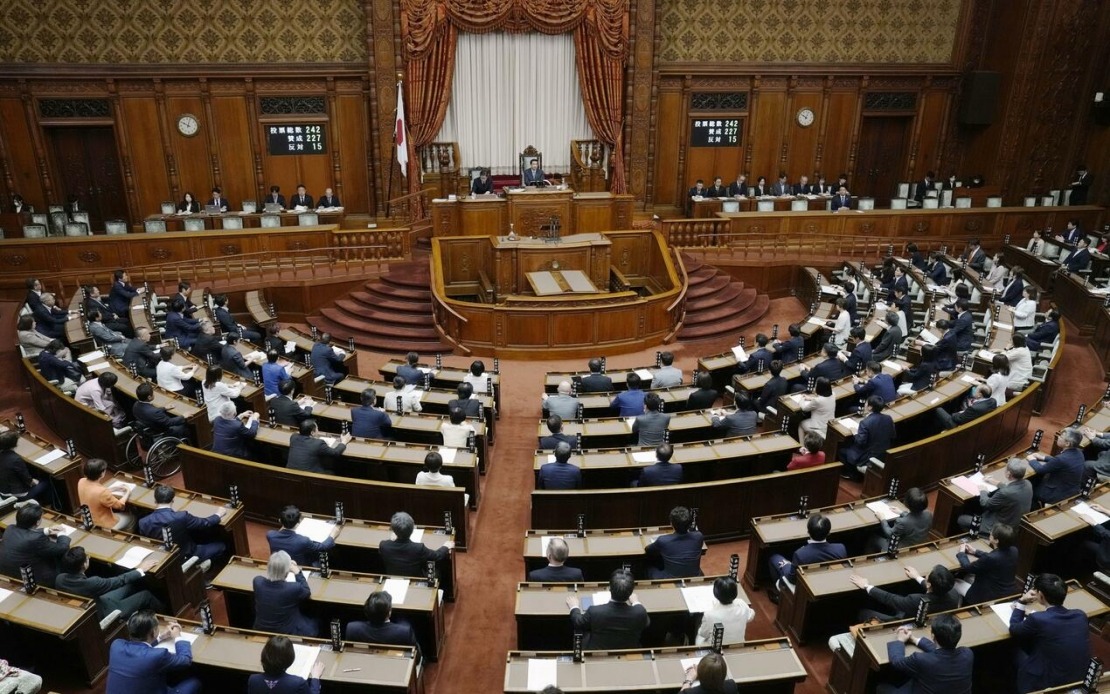
Japan took a significant step towards modernising its defence posture on Friday when parliament enacted legislation to restructure and rebrand the country's Air Self-Defence Force as part of a comprehensive strategy to safeguard its space-dependent infrastructure and respond to evolving security challenges in the Indo-Pacific region. The passage of this landmark measure in the House of Councillors reflects Tokyo's determination to adapt its military capabilities to emerging threats and maintain technological superiority in an increasingly contested strategic environment.
The restructured military service, set to become operational during the fiscal year concluding in March 2027, will establish a dedicated space operations group overseen by a lieutenant general rank officer. This organisational change represents a fundamental shift in how Japan conceptualises and manages its defence responsibilities, elevating space from a supporting function to a central pillar of national security strategy. The new unit will focus specifically on enhancing space domain awareness and bolstering satellite surveillance capabilities, recognising that modern military operations depend critically on uninterrupted access to space-based systems.
Defence Minister Shinjiro Koizumi underscored the civilian dimensions of Japan's space capabilities, emphasising that the nation's reliance on satellite technology extends far beyond military applications. Navigation systems that guide vehicles, smartphone mapping applications that inform daily commutes, and meteorological services that track typhoons and other weather phenomena all depend on functioning space infrastructure. This civilian-military nexus means that threats to Japanese space assets represent risks to the broader population's wellbeing and economic functionality, not merely military concerns.
The legislative package also authorises the appointment of a second senior vice defence minister, a bureaucratic innovation designed to distribute leadership responsibilities more effectively during emergencies and major natural disasters. This structural enhancement will facilitate improved coordination during crises while simultaneously enabling expanded defence exchanges with the United States and other allied nations. The government anticipates naming this additional minister as early as summer this year, signalling the priority it places on the overall defence reform agenda.
For Malaysian and Southeast Asian observers, Japan's strengthening of space capabilities carries broader regional implications. As China continues expanding its military presence across the Indo-Pacific and enhancing its own space-based surveillance capabilities, Japan's determination to develop countervailing space-based systems reflects the technological arms race underway in Asia. Countries throughout the region, including Malaysia, depend on secure maritime passages and unobstructed access to sea lanes for international commerce, making Japan's enhanced space awareness particularly relevant to regional stability and prosperity.
The defence restructuring also addresses persistent recruitment and retention challenges facing the Self-Defence Forces, issues that mirror challenges confronting military establishments worldwide. The legislation increases post-retirement benefits for SDF members, whose mandatory retirement ages vary according to rank and typically occur earlier than comparable civil service positions. This adjustment aims to attract and retain qualified personnel at a time when demographic trends in Japan are making military recruitment increasingly competitive with the civilian economy.
A particularly notable aspect of the reform involves upgrading the Ground Self-Defence Force's 15th Brigade, positioned in Naha, Okinawa Prefecture, to the status of a full division. This enhancement directly responds to security concerns centred on Japan's southwestern remote islands and reflects Tokyo's assessment that the region faces mounting pressures from Chinese maritime assertiveness and military modernisation. The Ryukyu Islands and surrounding waters represent strategically crucial territory lying between Japan and Taiwan, making the military capacity of these areas critical to regional security architecture.
Japan's emphasis on defending its southwestern periphery cannot be divorced from broader concerns about potential Chinese military actions involving Taiwan or disputes over contested maritime territories. By strengthening ground forces in Okinawa and elsewhere in the southwest, Japan signals its commitment to maintaining military credibility in zones of potential friction. This development carries particular significance for Southeast Asian nations like Malaysia, which have their own maritime disputes and depend on navigational freedom through waters where great power competition is intensifying.
The comprehensive nature of Japan's defence overhaul indicates Tokyo's view that contemporary security challenges demand integrated responses spanning space, air, and ground domains. The simultaneous elevation of space capabilities, enhancement of southwestern ground forces, and expansion of ministerial capacity suggests Japan is not merely reacting to specific threats but rather implementing a coherent strategic vision for the 2020s and beyond. This integrated approach mirrors recommendations from defence analysts who emphasise that modern military operations require seamless coordination across traditionally separate domains.
For regional powers and allies, Japan's defence restructuring demonstrates the seriousness with which Tokyo approaches security adaptation in an increasingly multipolar Asia. The country's willingness to invest resources in space operations, upgrade peripheral defences, and expand leadership capacity indicates that Japan will likely remain a stabilising force in Indo-Pacific security dynamics. Malaysia and other ASEAN nations will be watching closely to understand how these enhanced Japanese capabilities might contribute to or complicate regional balance-of-power arrangements in coming years.

