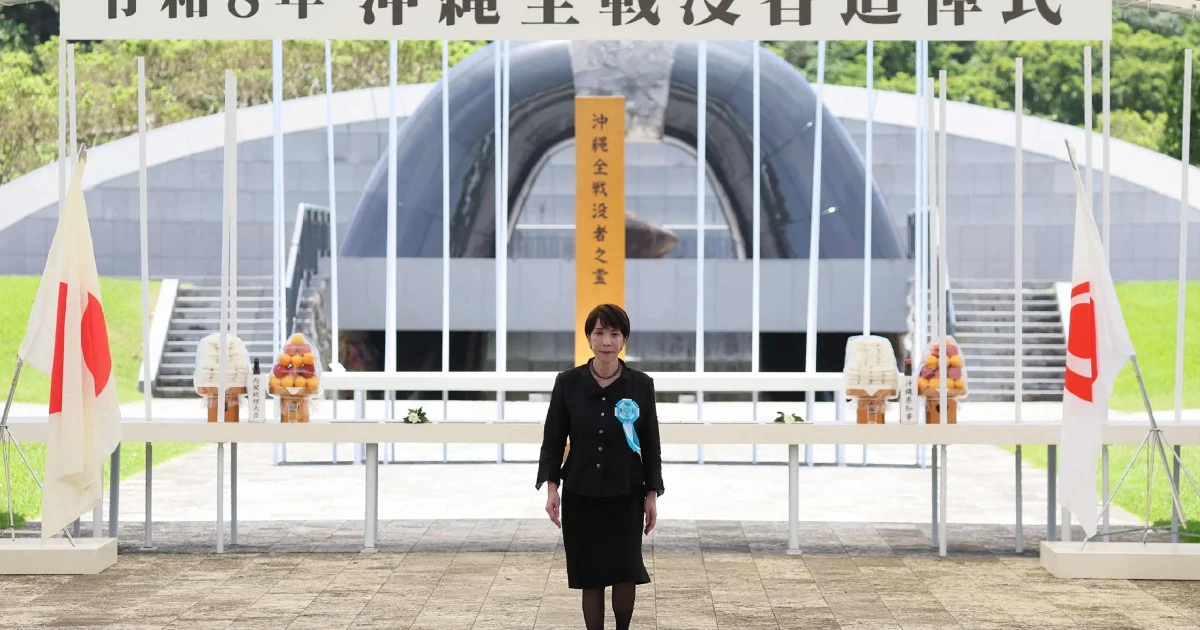
Japan's newly appointed Prime Minister Sanae Takaichi was met with hostile demonstrations at a World War II memorial ceremony, highlighting deepening domestic divisions over Tokyo's strategic pivot toward expanded military capabilities. Television reports documented the confrontation as protesters voiced their objections to the administration's security policy direction, underscoring the tension between Japan's historical peace constitution and contemporary geopolitical pressures reshaping defence strategy.
The incident at the commemorative event reveals the fault lines within Japanese society regarding military modernisation. For decades, Japan's postwar identity rested on constitutional constraints limiting armed forces to self-defence purposes and renouncing war as an instrument of state policy. This pacifist foundation, born from the ashes of 1945, became central to Japan's national narrative and regional diplomatic positioning throughout the Cold War and beyond.
Takaichi's government represents a significant acceleration in reconsidering these historical commitments. The administration has signalled intentions to substantially increase defence expenditure, develop offensive military capabilities, and reinterpret constitutional provisions long viewed as prohibiting such measures. These moves reflect calculations about strategic vulnerability in a rapidly militarising Asia-Pacific region, where China's defence spending has surged and North Korea continues weapons development.
For Malaysia and other Southeast Asian nations, Japan's military trajectory carries important implications. Tokyo's enhanced regional military presence could reshape power balances in shared waters and security arrangements. Some regional observers view Japanese rearmament cautiously, given historical wartime grievances that remain unresolved in parts of Asia. Others welcome stronger Japanese counter-balancing against Beijing's assertiveness.
The protesters at the memorial event articulated concerns held by substantial segments of the Japanese population who view the military expansion as abandoning core postwar principles. Opinion surveys suggest generational divides on defence policy, with older citizens who experienced wartime destruction expressing particular reservations about armament acceleration. Peace movements and leftist political parties have mobilised opposition, framing the shift as a dangerous deviation from constitutional pacifism.
Takaichi herself represents a hawkish faction within Japan's conservative establishment that has long questioned whether postwar constraints remain appropriate. Her elevation to the premiership signals this faction's growing influence within the ruling Liberal Democratic Party, which has governed Japan continuously except for brief intervals. The party's rightward drift on security matters reflects both genuine threat perceptions and ideological commitments to restoring what proponents call Japan's "normal nation" status.
China's military modernisation and assertive posture in the East China Sea and beyond constitute the primary strategic driver for Tokyo's policy reorientation. Japan faces the possibility of simultaneous conflicts with both China and North Korea under worst-case scenarios that military planners now seriously contemplate. These calculations override historical inhibitions about military buildups that shaped Japanese policy for generations following 1945.
Regional partners including the United States have encouraged Japanese rearmament as essential for maintaining balance against Chinese power projection. Washington views Japan as a critical counterweight in its Indo-Pacific strategy and has pressed Tokyo to assume greater military responsibilities. This external pressure, combined with genuine security anxieties, has strengthened the hand of defence-minded politicians and weakened traditional pacifist arguments.
Yet the public backlash illustrated at the WWII memorial demonstrates that Japan's population has not fully embraced the strategic rationale for military expansion. Many Japanese citizens question whether increased defence spending represents the wisest response to regional challenges and worry about escalation dynamics that military arms races can trigger. The generational gap in attitudes suggests that consensus supporting the military shift may not be durable, particularly if defence budgets grow substantially without corresponding economic improvements for ordinary households.
International observers have focused heavily on Japan's constitutional reinterpretation allowing collective self-defence arrangements. Previously, the constitution was understood to prohibit Japan from defending allied nations or participating in military coalitions. New interpretations now permit such arrangements under specific circumstances, fundamentally altering Tokyo's military doctrine and signalling willingness to shoulder greater regional security burdens alongside Washington.
For Southeast Asian governments, Japan's military evolution presents a complex diplomatic challenge. Most nations maintain cordial defence relationships with Tokyo and appreciate its non-aggressive posture historically. However, memories of Japanese occupation and wartime atrocities during the 1930s and 1940s remain relevant to public sentiment across the region. Some Malaysian analysts worry that substantial Japanese rearmament, if perceived as nationalist or revisionist rather than purely defensive, could revive historical anxieties and complicate regional security cooperation.
The incident at the memorial also reflects broader questions about how Japan will narrate its wartime history as military power expands. Takaichi herself has faced controversy regarding remarks about Japan's historical conduct, signalling potential tensions between military modernisation and honest historical reckoning. This connection troubles both international observers and domestic peace advocates who fear that military expansion might coincide with historical revisionism.
Moving forward, Takaichi's government faces the challenge of building domestic consensus for defence policies that substantial portions of the population view skeptically. International visits and security dialogues will proceed, but the backlash at home signals that Japan's strategic reorientation remains contested territory politically and socially, even as geopolitical pressures steadily push Tokyo toward greater militarisation.