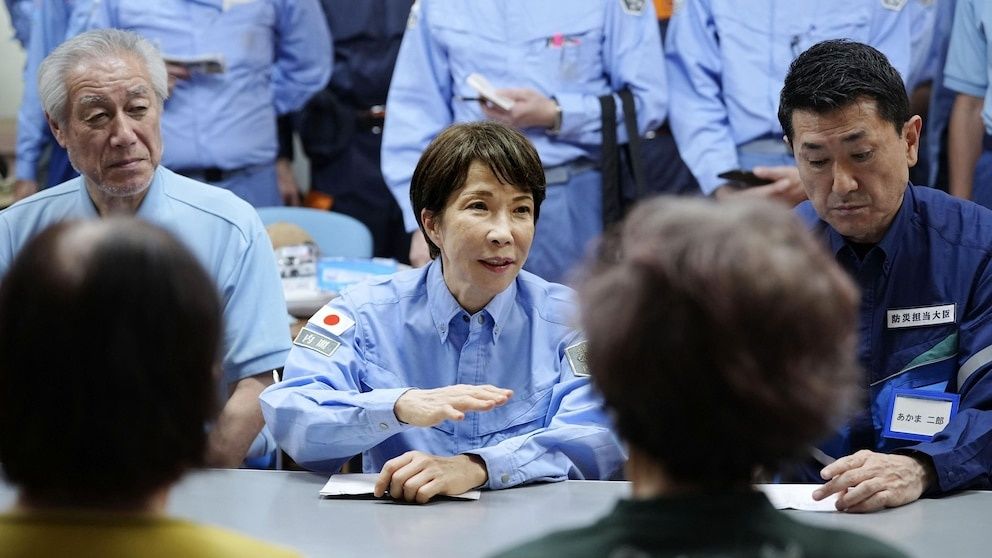
Prime Minister Sanae Takaichi made her first visit to Kumamoto Prefecture on Monday as Japan's southwestern region grapples with the aftermath of a devastating magnitude 7.1 earthquake that struck Kyushu's main island on Tuesday, August 4. The timing of the disaster has created a cascade of humanitarian challenges that extend far beyond the immediate structural damage, as residents face a deadly combination of extreme heat, infrastructure collapse, and inadequate shelter provisions that threaten to turn an already dire situation into a public health emergency.
The earthquake claimed 38 lives across the prefecture, with deaths continuing to mount even as recovery operations progress. Among the victims was a person who died of heat stroke while sheltering in a vehicle, underscoring the immediate threat posed by the sweltering conditions that have gripped the region. Another death remains under investigation, according to prefectural officials, as authorities work to understand the full human toll of the disaster.
The physical destruction has been enormous in scale. Approximately 700 homes were completely destroyed, while more than 11,300 buildings sustained varying degrees of damage. In towns such as Uki and Hikawa, authorities have already begun constructing temporary housing units to accommodate the displaced population. Some hotels and inns in the region have opened their facilities to evacuees, offering a glimmer of respite for those who have lost their homes, though these private accommodations can only absorb a fraction of those in need.
What distinguishes this disaster from many previous earthquakes is the severity of concurrent utility failures compounding the initial damage. More than 46,000 households remain without access to water supplies, a critical shortage in an environment where temperatures are predicted to approach 40 degrees Celsius. Simultaneously, fuel shortages have left many residents unable to power generators or vehicles, restricting their ability to seek cooler environments or cook meals. This convergence of infrastructure failures has created conditions where heat-related illness has become as immediate a threat as the earthquake itself.
Emergency shelter conditions have deteriorated rapidly as the number of displaced persons far exceeds available accommodation. More than 8,500 people remain crowded into emergency shelters, many of which are converted community centers, school gymnasiums, and classrooms that lack air-conditioning. These facilities struggle with basic sanitation, privacy, and hygiene standards, creating breeding grounds for disease and psychological distress. Beyond official shelters, thousands more have resorted to sleeping in vehicles parked at town hall lots and public parks, or camping outside their damaged homes with minimal protection from the heat.
Takaichi's visit included an aerial tour of the affected areas from an army helicopter, allowing her to survey the scale of destruction across multiple municipalities. She subsequently visited one of the region's better-equipped emergency shelters, which featured cardboard beds, privacy partitions, and air-conditioning systems. However, this choice of venue drew sharp criticism on social media, with observers noting that the shelter she toured represented a stark exception rather than the norm, and that her visit risked presenting an unrealistically positive picture of conditions facing most evacuees.
During his meeting with the Prime Minister, Kumamoto Governor Takashi Kimura pressed for enhanced national support, emphasizing that the "abnormal heat" afflicting the region was exacerbating the hardship already imposed by the earthquake. The governor specifically highlighted the deficiencies in many evacuation centers, particularly the absence of adequate clean water supplies and medical care services. These weren't abstract concerns but practical matters affecting thousands of vulnerable people, many of them elderly, in dangerous conditions.
Takaichi's response acknowledged the governor's concerns and committed to examining what the national government could do to support recovery efforts, though she offered no specific commitments or timelines. She pledged that the government would "move proactively," language that suggested receptiveness to Kumamoto's requests while leaving the precise form and scope of assistance undefined. For Malaysian observers, this measured response reflects the bureaucratic caution that often characterizes official disaster response in developed nations, where political considerations sometimes slow immediate relief efforts.
The disaster has also exposed corporate accountability issues when profit intersects with emergency protocols. Habita, a local general store operator with a shop inside the Aeon Mall in Kashima, instructed two employees to return to the damaged building to secure sales proceeds in a safe, despite the obvious risks posed by a structurally compromised facility. Both employees were killed in a subsequent explosion attributed to a gas leak. The mall's operator had evacuated approximately 3,000 shoppers to a parking lot following the initial quake, but failed to ensure all personnel had safely exited the building.
Two Habita executives attended the wake of one victim, 22-year-old Kurumi Otake, where they apologized to her grieving parents. Sales manager Goji Yuse acknowledged that the company had instructed the employees to deposit cash if possible, revealing a tragic prioritization of financial assets over human safety in the immediate aftermath of a major earthquake. Otake's mother's response—"I wish someone had stopped her. My daughter is not coming back"—captured the irreversible consequences of this institutional failure.
The Aeon Mall collapse itself proved particularly lethal because personnel remained inside the damaged structure after the initial evacuation. Rescuers ultimately recovered five survivors but also retrieved the bodies of seven fatalities from the building's rubble. The company's attribution of the subsequent explosion to a gas leak suggests that multiple system failures combined to create the disaster, though questions remain about why employees were sent back into a demonstrably unsafe environment.
The broader context of this disaster carries implications extending beyond Japan. Southeast Asian nations, which experience their own seismic activity and typhoons, can observe how even a wealthy, developed nation like Japan struggles to rapidly establish adequate shelter, water, and medical services during emergencies. The crowded, unsanitary emergency shelters serving thousands represent institutional capacity gaps that exist in more vulnerable developing countries, where disaster response systems often lack even Japan's resources. Malaysia, positioned in a region prone to earthquakes and floods, should consider whether its own disaster response frameworks could efficiently scale to accommodate tens of thousands of displaced persons requiring extended shelter, water, and sanitation services.
With recovery operations continuing and heat warnings remaining in effect, Kumamoto faces weeks of challenging restoration work. The combination of physical reconstruction, utility restoration, and the management of thousands of displaced residents in extreme conditions will test government coordination at prefectural and national levels. For Japan, this earthquake marks another reminder of the persistent vulnerabilities that remain even in the world's most earthquake-prepared nation.

